Bills trade for DJ Moore with Bears: Fantasy football outlook, Josh Allen's upside in 2026 and more
Moore is now set to play with the best QB he's ever had in his career

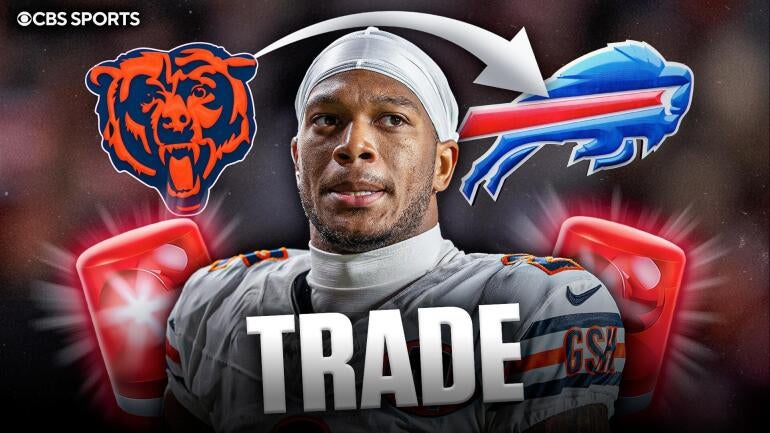
We love it when trades work out for everyone -- in Fantasy and reality -- and that happened Thursday when the Bears sent D.J. Moore and a fifth-round pick to the Bills in exchange for a second-round pick. Josh Allen now has a No. 1 wide receiver in Buffalo, and Chicago opened up targets for Colston Loveland, Luther Burden and Rome Odunze. This feels like a winner for almost everyone involved.
Let's start with the Bills, where Moore instantly gets a boost in Fantasy value. He's worth drafting as a No. 2 Fantasy receiver in all leagues as early as Round 5.
He's coming off a down season in 2025 with the Bears where he only had 50 catches for 682 yards and six touchdowns on 85 targets, and he averaged 12.2 PPR points per game. It's the fewest catches and yards of his career and the second-fewest targets.
But Moore is now the alpha in Buffalo's receiving corps, and he should thrive being reunited with Joe Brady. The Bills' new head coach was Moore's offensive coordinator in Carolina in 2020 and 2021, and Moore averaged at least 13.9 PPR points in each of those two seasons.
In 2020, Moore had 66 catches for 1,193 yards and four touchdowns and averaged a career-best 18.1 yards per catch on 118 targets in 15 games. In 2021, Moore had 93 catches for 1,157 yards and four touchdowns on 163 targets, and it would be great if he could get that type of volume from Josh Allen.
Allen has been without a No. 1 receiver since Stefon Diggs left after the 2023 season. In 2024, his top receiver was Khalil Shakir, who had 76 catches for 821 yards and four touchdowns on 100 targets. And in 2025, Shakir led Buffalo with 72 catches for 719 yards and four touchdowns on 95 targets.
Diggs, meanwhile, was posting elite numbers with Buffalo. He had at least 154 targets, 103 catches, 1,183 yards and eight touchdowns in all four years he spent with the Bills from 2020-23. He averaged at least 16.1 PPR points per game in each season, including two years with at least 19.8 PPR points per game.
It would be fantastic if Moore could get to that level of production. However, the best year of Moore's career was 2023, his first year in Chicago, when he averaged 16.9 PPR points per game. That's a realistic goal for him with the Bills.
Allen was already the No. 1 Fantasy quarterback heading into 2026, so he only gets better with the addition of Moore. And maybe Allen could perform like he did with Diggs.
In four seasons with Diggs, Allen averaged 28.5 Fantasy points per game, including two years of 29.1 points or more. He attempted at least 567 passes in each season with a better receiving corps. In the past two years, Allen only averaged 26.8 Fantasy points per game, and he attempted 483 passes at most in 2024.
The earliest I would draft Allen is Round 3, but his Average Draft Position will likely be Round 2 based on how most Fantasy managers draft quarterbacks in one-quarterback leagues.
The players who lose in this trade are in Buffalo with Shakir, Keon Coleman and Dalton Kincaid. Shakir will likely be No. 2 on the team in targets, and he's worth drafting with a late-round pick in all leagues. If the pass volume increases for the Bills then Shakir can still average around 12.4 PPR points per game, which is what he's been at for the past two seasons.
No one was excited to draft Coleman prior to the Moore trade, and Coleman was a bust in 2025 when he averaged just 8.9 PPR points per game. At best, you can add Coleman off the waiver wire if he starts off the season playing well.
Kincaid can still be considered a borderline No. 1 Fantasy tight end in all leagues, but he's only worth drafting with a late-round pick. He has to stay healthy after dealing with knee injuries in each of the past two seasons, and he ended the 2025 campaign with a torn PCL, which won't require surgery. When healthy, Kincaid scored at least 14.1 PPR points in six of 13 games, including the playoffs, and he would clearly benefit with more pass volume as well.
For the Bears, the three main pass catchers -- Loveland, Burden and Odunze -- will all get a boost with Moore gone, barring a significant addition to Chicago's receiving corps this offseason. Even though Moore only had 85 targets, he still kept Burden and Odunze off the field enough to limit their upside.
Loveland is my favorite Bears' player to draft this season, and I like him as the No. 3 Fantasy tight end behind Trey McBride and Brock Bowers. Loveland ended his rookie campaign on fire with at least 21.4 PPR points in three of his final four games, including the playoffs, and he had at least 10 targets in each outing. I would draft Loveland as early as Round 4 in all leagues.
Burden won't be far behind Loveland on Draft Day, and Burden did well when his targets were up in his rookie campaign. He had four games with at least seven targets in 2025, and he averaged 13.6 PPR points over that span.
He should consistently see around seven targets per game in 2026, and I would draft Burden in Round 5 in all leagues. For now, I would draft him slightly ahead of Moore.
Odunze is also worth a look in Round 5, and he got off to a hot start in 2025 when he scored at least 15.2 PPR points in each of his first four games. He scored 18.4 PPR points in Week 8 and 20.6 PPR points in Week 10, but then a foot injury caused him to miss five games from Weeks 14-18 before he returned for the playoffs.
He struggled in two postseason outings, but the good news is he won't require foot surgery in the offseason. And, now, he will benefit with Moore gone.
I'm not worried about Caleb Williams without Moore, and I like Williams as a borderline top-five quarterback in all leagues. He had a breakout season in 2025 at 24.6 Fantasy points per game, and he should continue to improve in Year 2 under Ben Johnson. Williams is worth drafting with a mid-round pick in all leagues.
The Bills made a huge splash by adding Moore. I love this trade for Moore and Allen, and Loveland, Burden and Odunze also benefit. Everyone of significance wins with this trade.