Every option, every draft plan, every strategy you can think of is available when you're picking from ninth overall.
But you should let your first two picks dictate exactly which option, plan and strategy you'll go with.
That's why it's of the utmost importance to go into your draft with a rank list of your top 20 players, knowing that you're guaranteed to get two of them with your first two picks. And it's especially important to have those top nine players settled before you hit the draft since that's where your first pick will come from.
Here's my top 20 list for PPR:
1. J. Gibbs
2. B. Robinson
3. J. Chase
4. P. Nacua
5. J. Smith-Njigba
6. A. St. Brown
7. J. Taylor
8. C. McCaffrey
9. C. Brown
10. J. Cook
11. D. Achane
12. C. Lamb
13. O. Hampton
14. K. Walker III
15. J. Jefferson
16. A. Brown
17. D. London
18. S. Barkley
19. D. Henry
20. C. Olave
Pretty standard, really. You can see I was prepared to take five running backs and four wide receivers with my first pick. Not having to make a tough decision on Christian McCaffrey was a relief, but the true joy was taking my No. 7 player and No. 9 overall. That felt like a small win and set me on a course to not have to reach for a running back in Round 2 if I didn't have to.
The alternative would have meant taking CeeDee Lamb, which I would have only done if there were at least five running backs I would have settled for in Round 2. That's simply an issue of supply and demand: If only one or two top-tier wide receivers are available, and a full tier of near-elite running backs are on the board, then the receiver is the easy pick first with a running back on the way back. You just can't love one running back over the rest if you do that -- any preference toward one or two RBs should force you to draft the RB in Round 1.
Anyway, in Round 2 the best player left was Justin Jefferson, giving me a top-five running back and top-six receiver to begin my team. I'll always advocate for one RB and one WR with your first two picks because it takes pressure off of filling either of those positions in Rounds 3 through 5. However, you should be able to look at my rankings above and deduce that had one of Chase Brown, De'Von Achane, CeeDee Lamb, Omarion Hampton or Kenneth Walker III made it back to me at 2.04, I would have taken them over Jefferson. That may have meant taking two running backs early -- and I'd have been okay with that, even if it meant having to focus on receivers with most of my next several picks.
I suppose that means I ultimately took the "best player available" according to my rankings. Definitely nothing wrong with that approach, so long as you know how to move forward in Round 3 and beyond. Just know that picking late in the odd rounds will mean some less-than-ideal starters at running back in Round 5 and receiver in Round 7. Plan accordingly.
Here's how my team turned out in our recent PPR mock.
My draft from the ninth pick:
1.09: Jonathan Taylor, RB, IND
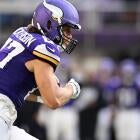
2.04: Justin Jefferson, WR, MIN
3.09: Javonte Williams, RB, DAL
4.04: Garrett Wilson, WR, NYJ
5.09: Tyler Warren, TE, IND
6.04: David Montgomery, RB, HOU
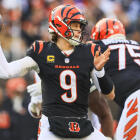
7.09: Joe Burrow, QB, CIN
8.04: Michael Wilson, WR, ARI
9.09: Matthew Golden, WR, GB
10.04: Jonah Coleman, RB, DEN
11.09: Kaelon Black, RB, SF
12.04: Keaton Mitchell, RB, LAC
13.09: Bo Nix, QB, DEN
14.04: James Conner, RB, ARI
I've talked enough about Rounds 1 and 2 -- let's get into the picks after that.
That whole supply-and-demand issue applied to my third-round pick of Williams, arguably my favorite RB of anyone left in that spot. Taking him ahead of receivers like Ladd McConkey, Garrett Wilson, Luther Burden III and Jaylen Waddle, all of whom are around the same tier of very good Fantasy receivers, was an easy choice knowing there was a good chance at least one of those wideouts (or Colston Loveland) would make it back to me.
Round 5 was similar, taking Warren before anyone in Picks 10 and 11 could nab a tight end of their own. As for Round 6, I felt like Montgomery was the last of the appealing running backs who would be awesome as a flex or No. 3 running back for me. I didn't mind collecting that kind of depth there over a third receiver like Chris Godwin or Marvin Harrison Jr. Besides, Michael Wilson in Round 8 isn't such a bad third wideout.
But the best pick of all? That came in Round 7, and I can use it to make an important point about how to draft quarterbacks this year.
Favorite pick: Joe Burrow
I don't expect you to find Burrow in Round 7 of your drafts. This draft was with a bunch of fancy Fantasy nerds who like to wait for a quarterback. I'm no different, but I do think it's to everyone's advantage to draft a quarterback when he's an obvious steal. Burrow's average draft position is 54th overall -- essentially the middle of Round 5. I got him at 81st overall. This feels like buying a Lamborghini for the price of a used Saturn. Please remember to only draft a quarterback when it feels like a steal -- I promise, the point will come in every draft you're in.
Pick I might regret: Justin Jefferson
What if? What if Jefferson doesn't have a strong connection with Kyler Murray? What if Murray simply doesn't live up to modest expectations? It would be a shame for Jefferson to go through another season without big numbers. And Murray hasn't produced a Fantasy receiver north of 15 PPR points per game since DeAndre Hopkins for five games in 2022. I took Jefferson because I was worried I wouldn't be crazy about any receivers that made it back to me in Round 3. Had I passed on Jefferson, I could have taken Saquon Barkley to be my No. 2 running back in Round 2 and then Ladd McConkey in Round 3. If you're not down with Jefferson, that would have been how you may have picked after Taylor in Round 1.
Player who could make or break my team: Jonathan Taylor
No secret here: If Taylor can't approach the 21.3 PPR points per game he had last year, he'll be a bust. In 2024, he averaged 17.5 PPR points in an 8-9 season, which was exactly Indy's record in 2025. He tends to play really well in wins, struggles in losses. I'm hoping the combination of a healthy Daniel Jones, an improved Colts defense and Shane Steichen's playcalling magic can keep the Colts in far more games, thus giving Taylor a platform for a strong season.