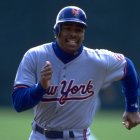


For a lot of MLB players and ex-players, July 1 is a big day. It's the day many signing bonuses and deferred salary payments (or portions thereof) are paid out. It must be fun checking that huge direct deposit each year, huh? Bobby Bonilla, a former All-Star who last played in 2001, has become the face of the July 1 payday.
As part of a deferred salary arrangement, the New York Mets have paid Bonilla a little bit more than $1 million ($1,193,248.20 to be exact) on each July 1 since 2011. The annual payments will continue until 2035. 2035! Bonilla, now 61, will be 72 when the payments end.
The Mets signed Bonilla to a five-year contract worth $29 million in 1991, at the time the richest contract in team sports. He spent the first three and a half seasons of that contract with New York before being traded away. Bonilla won a World Series with the then-Florida Marlins in 1997 and was later traded back to the Mets as part of Florida's post-championship fire sale.
The Mets released Bonilla in January 2000 but were still on the hook for his $5.9 million salary that season. Believing they were poised to make a significant profit through their investments with Bernie Madoff, Mets ownership instead agreed to defer Bonilla's salary with 8% interest, and spread the payments across 25 years from 2011-35.
Well, Madoff's Ponzi scheme fell apart, and Bonilla's $5.9 million swelled to $29.8 million from 2000-11. That $29.8 million divided by 25 years equals the annual $1.19 million payment. A few years ago, CBS Sports created a bobblehead to commemorate Bonilla's annual deferred payments:
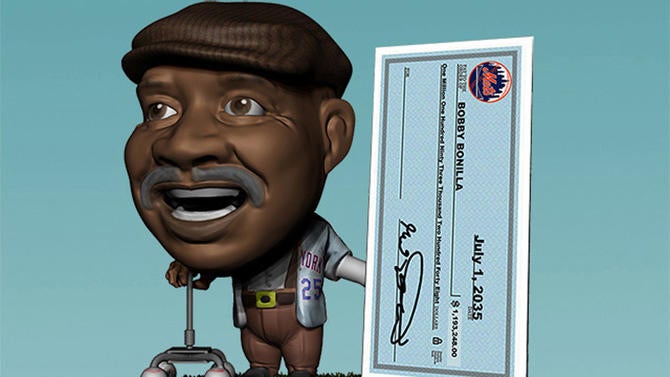
After Mets owner Steve Cohen purchased the franchise in 2020, he suggested the team could have an annual Bobby Bonilla celebration at Citi Field, complete with a novelty oversized check. That plan has not yet come to fruition, but it still could one day.
Bonilla's deferred salary with the Mets is the most famous July 1 payment in baseball, hands down, but it is not the only July 1 payment in the game. In fact, Bonilla has a second deferred salary agreement with the Baltimore Orioles, who owe him $500,000 a year from 2004-28. July 1 is a good day in the Bonilla household.
Here are a few other notable deferred salary payment plans:
- The Cincinnati Reds paid Ken Griffey Jr. roughly $3.6 million each year from 2009-24.
- The Boston Red Sox have paid Manny Ramirez approximately $2 million each year since 2011. He'll receive his final deferred salary payment in 2026.
- The St. Louis Cardinals began paying Matt Holliday his deferred salary in 2020. He gets $1.5 million a year until 2029.
- Beginning in 2023, the Orioles will pay Chris Davis $3.5 million annually through 2032. He then gets $1.7 million a year from 2033-37.
- The Mets have paid Bret Saberhagen $250,000 each year since 2004 and will continue to do so through 2028.
- Shohei Ohtani's record-setting $700 million deal with the Dodgers came with heavy deferments. Ohtani is set to make just $2 million per season during the 10-year contract. The other $680 million will be paid between 2034 and 2043.
The Washington Nationals used to load their largest contracts with salary deferrals. They owe Max Scherzer, who now pitches for the Toronto Blue Jays, 15 million a year from 2022-28. Not bad work if you can get it.