

LOS ANGELES — The quiet blared in the Dodgers clubhouse like a siren. A deafening absence of noise. The kind of desperation that screams through whispers.
The quiet lingered over Max Muncy as he sat at his locker, scrolling through his iPhone. Cut-sleeve dark gray shirt with his white Dodgers pants still on, he dodged the disappointment with his thumbs. Instead of getting dressed, he marinated in the 0-3 NLCS deficit against the Brewers a little longer.
The quiet muffled the voice of Blake Snell, who spoke so softly that even in the hushed home clubhouse one could barely make out his words. The bill of his black-and-camouflage Los Angeles cap hovered over his face, but it still couldn't hide his disappointment. The silence taunted Kiké Hernández at his locker, his face pointed toward the floor as he rummaged through his closely cropped, bleached-blond hair, searching for answers.
This home clubhouse has known the raucous rage of victory better than any other recently. The two-time defending World Series champs have filled this space and others with champagne and euphoria, three times in the previous six seasons. They made a noise that history could hear.
But Wednesday night, this place, with its wooden walls and royal blue chairs, sounded more like a mausoleum than a mosh pit. Muted by Milwaukee.
The Brewers have simply been better. Smarter. Tougher. Hungrier.
The Brewers have a 3-0 lead in the NLCS. One more victory and they'll capture the National League pennant for the first time in team history. They can finish a sweep of the Dodgers, who have been the World Series favorites all year long, on Thursday night.
"It's a pretty simple answer," Muncy said. "We're playing like shit. They're playing great."
They're close to being consumed by the quiet. A 3-0 hole in this NLCS, following a 6-2 beatdown in Game 3 at Dodger Stadium, feels insurmountable even for a club that's repeatedly proven its resolve. Because across from them, a young, exuberant bunch is not only fearless against the $433 million juggernaut. They can sense the mortality of the legends they're facing. The Dodgers are being forced to wrestle with the end of their dominance.
Uncharted territory.
In some ways, this is playing out predictably. Dynasties often end with epic thuds. Their demise, when it comes, is sudden -- or so it feels. Their excellence trains the expectations. Especially these Dodgers, who've rallied from the improbable, who've authored moments of magic, whose endless well of talent always produces a hero. So when the dominance dies, or meets a greater great, it feels like it came out of nowhere.
So it has been with the Dodgers. Their inevitability morphed into impotence. Their supremacy's screeching to a halt. Withering away is their chance to become the first three-peat champs since the Y2K Yankees.
The ends of eras don't come with announcements. Or reprieves. And the only antidote for their unraveling is the hope of more magic. Los Angeles heads into Game 4 under a cloud of quiet, searching internally for answers that once came so easily. Once unstoppable, the Dodgers appear to be coming undone.
"We've done it before," said Hernández, whose personal October magic is running on fumes, "but we've never been in this big of a hole."
Even as Snell dealt, yielding just one run on a first-pitch homer by Jackson Chourio to open the game, the angst never left Dodger Stadium. Even when Will Smith delivered a bases-loaded, two-run double off Abner Uribe, one of the Brewers' top arms in arguably baseball's deepest bullpen, the nervous tension never loosened its grip.
This is what the Brewers do. They take the air out of teams, out of their offense and out of their audience. They make it hard for opponents to breathe. Their three Game 3 home runs punctured the lungs of the Los Angeles faithful.
The Brewers waited out Snell. They didn't have a choice. Snell, a starter not known for his command, could suddenly pelt a bee in the butt with his four-seamer. His fastball played in the zone, drawing a 46% swing-and-miss rate. He punched out nine batters across six frames.
The goal is to coax Snell's stuff up in the zone. But with the slider and changeup working, and the curveball altering batters' eye level, the Brewers struggled to pick their poison.
"Snell was unbelievable," Brewers manager Pat Murphy said. "Like, he was absolutely on it. Like, this guy was sensational."
Yet the seismic shift rocked the Dodgers in the seventh when Andrew Vaughn drew a walk on a curveball that Snell got underneath, leaving it up and out of the zone.
Then Jake Bauers battled Snell through an 11-pitch at-bat, forcing the left-handed pitcher to shy away from his fastball. On that 11th pitch, with the count full, Snell had no choice but to go back to it.
And Bauers clobbered it.
His no-doubter traveled 412 feet before landing in the right-field bleachers for a two-run homer. Milwaukee led 3-2. The next batter, Garrett Mitchell, followed with another blast to right.
"I just left a fastball over the middle to Bauers," Snell said. "Hats off to him. What an at-bat. I threw him everything I had."
That's the reality of the end. At some point, everything the champion has is no longer enough. Whether fatigue or regression or leveled-up competition, the best they can do becomes insufficient.
The Dodgers sent out Tarik Skubal, the two-time Cy Young Award winner acquired at the deadline, in Game 1. They lost.
They sent out Yoshinobu Yamamoto in Game 2, easily one of the best postseason starters of this generation. They lost.
Then, in Game 3, they turned to Snell, another two-time Cy Young Award winner, at home. They lost.
For much of this year, the Dodgers were certain Shohei Ohtani would be OK. That the war of attrition, the force of his stubbornness, would somehow heal the injuries to his right bicep and his left knee. Los Angeles would eventually infuse his once-in-a-lifetime skill set into this series.
Yet Ohtani hasn't looked right. He hasn't homered in nearly two months. Last postseason, he hit eight.
The wear and tear of his folkloric physique, it seems, has begun to take its toll. His left leg drags, barely lifting off the grass as he walks to the plate.
He's 32 with a lot of baseball miles on his body. His knee can no longer withstand the torque and power that only he can generate. He has virtually become a singles hitter in these playoffs.
And after the game, Ohtani's locker remained vacant. Engulfed by the quiet.
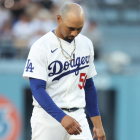
Ditto for Mookie Betts. His empty locker surrendered to the quiet. His game turned down a few volumes. Despite putting together quality at-bats in this series, the 34-year-old is no longer the star he used to be.
Betts is trying to become the only active player to have four World Series rings. And the Dodgers are trying to become the first NL team to threepeat. But the chance to make history is fading from their grasp. It might already be over.
"I don't know the mindset of being down 0-3," Muncy said. I've never been down 0-3. So I can't tell you."
Little time. Few words. No answers. In the world of the Dodgers, the quiet is getting louder.