

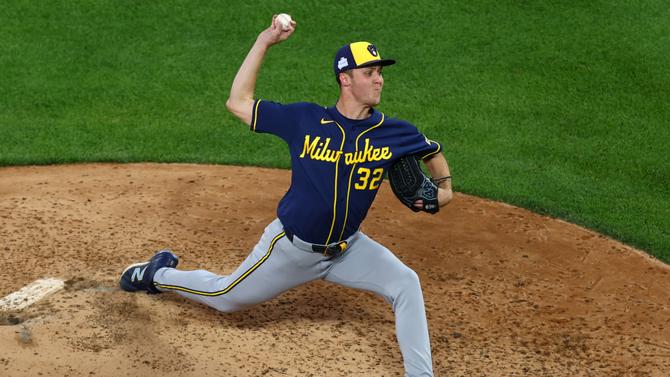
If young Milwaukee Brewers ace Jacob Misiorowski were part of the Greek or Roman pantheon, then he'd probably be pulling double duty right about now. Among the elemental gods, Misiorowski was already in charge of fire -- this, after all, is a pitcher whose first three pitches in the majors were in excess of 100 mph. Now, though, Misiorowski has expanded his jurisdiction to include earth -- mound dirt, to be more specific. Indeed, the 24-year-old primal force known informally as "The Miz" is throwing harder than ever (and harder than any starting pitcher ever), and he's also harnessed that fiery stuff to go from occasionally dominant but flawed to just plainly overwhelming. The best pitcher in the world is right now equal parts thrower and pitcher, equal parts fire and earth.
We were sharply reminded of this, Miziorowski's swift evolution, during his most recent work of art against the Phillies, in which he struck out 15 batters with no walks and spotted 74 of his 95 pitches for strikes en route to a one-hit shutout. It was, without exaggeration, one of the greatest starts ever glimpsed.
As Misiorowski enjoys some extra rest heading into this next start, his 15th of the season, we can appreciate that thus far he's been at the very top of his guild so far:


Last season, Misiorowski flashed the unthinkable fastball velocity and missed lots of bats. However, he also walked 31 batters, all unintentionally, in 87 innings. That lack of control plus a bit of misfortune on batted balls led Misiorowski to post a below-average ERA with a mark of 4.36. Adjust for ballpark effects and you get an ERA+ of 96, or 4% worse than the league mean. This season, Misiorowski's ERA+ is an MLB-best 308, or 208% (!) better than the league mean. In matters related, his 131 strikeouts lead the majors by a wide margin, as does his K%, or strikeouts as a percentage of batters faced, of 39.8%. He's truly on another plane right now -- a celestial one.
The extent to which Misiorowski has not just kept runs off the board but also done so in such overpowering fashion raises the matter of how he's taken this next step. Let's explore, as Misiorowski on Friday aims to continue a run that's seen him pitch to an ERA of 0.17 ERA over his last eight starts.
The velocity
Misiorowski is, as noted, famous for his big fastball, and in that most recent start, he topped out at 104.5 mph. That's the fastest pitch on record by a starter and, given how velocity has trended upward over the years, it's safe to say it's the fastest pitch ever thrown by a starter. Against the Phillies, 58 of his pitchers were triple digits -- the third time this season he's thrown more than 50 pitches at 100 mph or greater in a start -- and his 95th and final pitch of the outing clocked in at 103.1 mph. We could go on, of course, but the superlatives have already been exhausted.
What's impressive is the velocity trajectory for Misiorowski. Coming into the 2022 Draft, Baseball America's scouting report on Misiorowski, then of Crowder College in Missouri, noted that his fastball sat between 94-96 mph. That's solid enough velo, no doubt, but it's nothing close to what Miz is capable of in the here and now. He reached Triple-A for the first time in 2024, and his fastball averaged 98 mph at the Brewers' top rung. He saw action again in Triple-A last season prior to making his big-league debut, and his fastball sat at 97.7 mph. In the majors last season, he took the big leap to an average four-seamer velo of 99.3 mph. And this season? In 2026, Misiorowski is averaging 101.1 mph with his fastball. To put that in context, the average right-handed starting pitcher this season has a fastball that sits 95 mph. So Miz's heater is more than six full ticks above the mean (and that's with his fastball slightly dragging up that league-average mark).
But wait: That's not all! Check out, via Brooks Baseball, how Misiorowski's fastball velocity has tracked through those 14 starts of his this season:
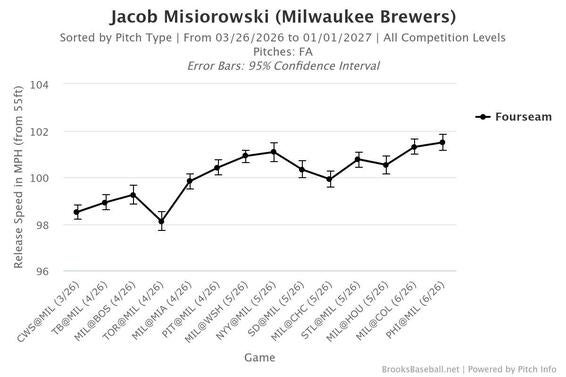
The trendline isn't perfect, but he's still creeping up, still redefining our notions of the possible. In that Phillies start we can't stop talking about, Miz averaged 101.7 mph with the fastball (he was averaging a "mere" 100.1 mph with the pitch coming into that game). The Brewers, quite famously, know a thing or two regarding a thing or two when it comes to pitcher development. That's why they can trade guys like Corbin Burnes and Freddy Peralta and somehow barely notice. Give them raw material like Misiorowski, and they can turn him into something all but fictional. The easy assumption is that Misiorowski is surely done adding sizzle to his fastball, but, well, recent years, weeks, and even days suggest otherwise. The extra jump he's enjoyed this year has made his fastball even more untouchable.
The extension
There's a thing called "effective velocity," which measures what a fastball "feels" like to a hitter. Actual measured velo does the heavy lifting, as you would expect, but a pitcher's plate-ward extension off the mound plays a secondary role. This stands to reason: the closer a pitcher releases the ball to the plate, the less time the hitter has to react. Conversely, a pitcher who releases the ball from a relatively shallow point sees his fastball play down relative to its actual velocity.
Well, here's Misiorowski getting down the mound:
This is from his June 6 start against the Rockies, and you can see how much farther forward he lands relative to the landing spots of his Colorado counterparts. Misiorowski is already a sky-scraping 6-foot-7, and as you can see above, he gets drive off the rubber and some "toe drag" which inches him more toward the plate. Not pictured above is how far in front of his landing foot he releases the ball, and that's after getting even more drive off the rubber. The result is 7.6 feet of extension toward the plate. That puts him in the 100th percentile among major-league hurlers, not surprisingly.
That brings us back to effective velocity. That best-in-class extension off the mound gives Miz an effective fastball velocity of 102.5 mph, or almost a full mph greater than his radar velo. Yes, that's an average of 102.5 mph, not a top-end figure. Given how hard he already throws the fastball, this is basically piling on thanks to body type and mechanics.
As well, that Misiorowski gets so stretched out and delivers the ball from a low-ish 30-degree arm angle allows him to have a flatter angle to the top of the zone, where he generally likes to place his fastball:

On those rare occasions when batters aren't late on Miz's fastball, they're very often swinging under it.
The velo, the extension, the spin (slightly increased over 2025 levels), the different movement profile (a bit more ride this season with more arm-side run), and the placement all add up to a suffocating pitch. Opposing hitters in 2026 are batting .165 against Miz's four-seamer, and they're slugging .224 against it.
Now for a few more numbers. Let's compare Miz's 2026 fastball to his 2025 fastball and the 2025-26 league averages in some key ways (data via TruMedia):
| Season | Fastball K% | Fastball swinging-strike rate | Fastball in-zone contact rate |
|---|---|---|---|
Misiorowski in 2026 | 47.4% | 21.2% | 63.7% |
Misiorowski in 2025 | 31.8% | 15.8% | 75.2% |
MLB averages, 2025-26 | 21.9% | 10.5% | 82.2% |
*Note that swinging strike rate is swings and misses as a percentage of total pitches, whereas the commonly used whiff rate is swings and misses as a percentage of total swings.
Miz's fastball in 2025 was a devastating offering compared to league norms. Miz's fastball in 2026 is a devastating offering compared to Miz's fastball in 2025. When it comes to the traits of a dominant fastball, he's taken our assumptions, stuffed them in a locker, and then buried that locker at sea. People, we're not getting those assumptions back.
The fastball emphasis
A very basic repertoire tweak pitchers can make is "throw your best pitch more often." In Misiorowski's case, there's no reason not to lean way into a fastball the likes of which no one has ever seen before. In 2025, for instance, Misiorowski threw his four-seamer 55.2% of the time. This season, that rate of fastball usage is up to 63.4%. The league as a whole has seen a general decline in fastball usage in recent years, and in 2026, the fastball percentage in MLB is down to 30.6% -- the lowest on record. When you have a fastball like Misiorowski's, though, you wisely want no part of that trend.
Let's also appreciate that Misiorowski hasn't widely deviated from this overall approach in 2026, regardless of context:
- Fastball usage versus left-handed batters: 64.0%
- Fastball usage versus right-handed batters: 62.7%
- Fastball usage in pitcher's counts: 60.5%
- Fastball usage in hitter's counts: 72.2%
- Fastball usage in even counts: 61.8%
None of this is to suggest that Misiorowski is a one-pitch moundsman -- he's thrown five different pitch types this season, and he's used four of them at least 10% of the time. But going to the fastball even more often than he did in 2025, and thus taking advantage of the pitch's improved traits, has been critical to his success this season.
Those other pitches
As for the rest of the repertoire, Misiorowski's stuff is so off the scale that pitch classification systems are often left as frustrated as opposing hitters. What's long been called Misiorowki's slider is really more of a cutter. Willi Castro, though, doesn't much care what you call it as long as you keep it away from him:
Miz also has a hard curve, which occasionally blurs the boundaries with a pitch he's added this season -- more of a true slider than the filth you see above. Once again, back to that Phillies game for a look at that slider:
As for the curve, it's probably his second-best pitch. He averages 87 mph with it, and while Misiorowski is capable of using it as a ball-to-strike pitch that freezes hitters, it's typically used to get swing and miss. Ridiculously, he has a higher whiff rate on his curve this season than he does on his fastball. In 2025, his curveball whiff rate was 30.7%. This season, it's all the way up to 46.4%. That's a pitch you'd lean on heavily if, you know, Misiorowski didn't already have that fastball.
The control
At an execution level, the biggest difference between Misiorowski the tantalizing but unrealized talent of 2025 and Misiorowski the Cy Young (and MVP?) frontrunner of 2026 is his ability to limit walks. Last season, Misiorowski walked 11% of opposing batters, which put him, tidily enough, in the 11th percentile among MLB pitchers. This season, however, he's walked just 6.7% of hitters despite the fact that the ABS challenge system has led to the highest league-wide walk rates since 2000. So far in 2026, Misiorowski is in the 76th percentile in walk rate.
Here's what's interesting about this: Misiorowski is actually throwing a lower percentage of strikes in 2026 -- 52.1% of pitches in the zone -- than he did in 2025 -- 54.6% of pitches in the zone. Instead, he's getting called strikes at a higher clip than he did last season, up from 31.2% to 36% in 2026. At the same time, batters in 2026 are making contact less often when they swing at Misiorowski's strikes, down from 78.6% to 72.2%. On top of all that, he's tempting hitters to swing at pitches outside the zone somewhat more often and getting them to whiff much more often when they do chase. In simpler terms, Misiorowski has cut down on his walks not by throwing more strikes but rather by fooling and overwhelming hitters with pitches in and out of the zone. It's sort of fitting that Misiorowski has found his way to fewer walks via dominance rather than conventional paths to improved control.
The road ahead
This one's pretty simple. We know the stuff is off the charts, and that's the biggest reason Misiorowski figures to continue dominating. At a performance level, the numbers agree. Expected ERA (xERA) measures what a pitcher's ERA should be based on the frequency and quality of contact allowed. Miz right now has an xERA of 2.03, which is tops in MLB by a huge margin (Paul Skenes is second with an xERA of 2.49). FIP, or fielding independent pitching, measures what a pitcher's ERA should be after you remove the effects of defense and luck, whether good or bad. Miz at this writing has a league-leading FIP of 1.69. In second place is Cristopher Sánchez with an FIP of 2.15. You can't really do what Misiorowski has done, which is pitch to a 1.34 ERA thus far, without some degree of luck in your favor. The fundamentals, as measured by xERA and FIP, though, say he's been about as good as he can be in 2026. Barring injury, the dominance will continue, it says here.
Misiorowski has been the phenomenon of the 2026 MLB season. If you've somehow missed the show so far, then the good news is that it's not over.