MacKenzie Gore trade grades: Rangers set up impressive rotation; Nationals pick up haul and more questions
What exactly is the plan in D.C.?

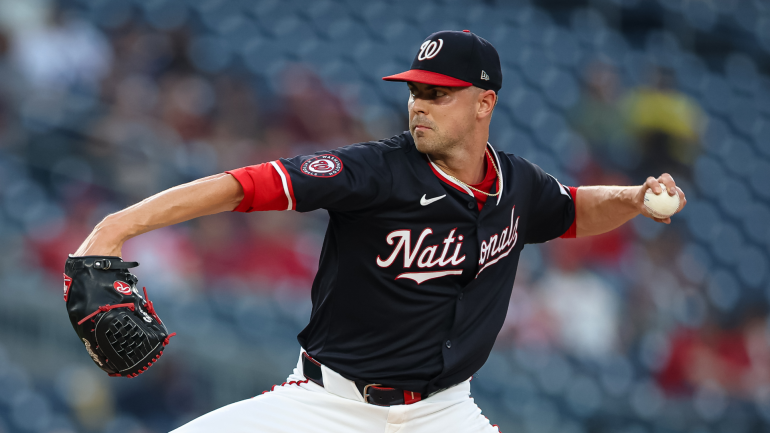
The Texas Rangers and Washington Nationals pulled off a six-player trade on Thursday that sends left-handed starter MacKenzie Gore from the District of Columbia to Arlington. In return, the Nationals netted five prospects, including shortstop Gavin Fien, the 12th pick in last summer's draft.
Whenever there's a notable trade during Major League Baseball's offseason, I pop up to break down every player involved in the swap. I also render judgement by handing out a letter grade to each team, a summation of how well (or poorly, in some cases) I perceive them to have done in the deal. The letter grade is, without question, the least important part of this exercise. Keep that in mind.
Before getting too far down the road, here again is the trade in its entirety.
- Rangers receive: LHP MacKenzie Gore
- Nationals receive: SS Gavin Fien, RHP Alejandro Rosario, 1B/OF Abimelec Ortiz, INF Devin Fitz-Gerald, OF Yeremy Cabrera
Let us proceed.

Rangers grade: B
Well, this is a surprise. The Rangers, coming off a .500 season, spent most of the winter doing not much. They non-tendered outfielder Adolis García and catcher Jonah Heim; they traded Marcus Semien (for Brandon Nimmo); and their only free-agent additions to date have been catcher Danny Jansen and relievers Alexis Díaz, Jakob Junis, and Tyler Alexander. On paper, they didn't seem likely to come in with the best bid to secure Gore's services. Yet here they are, standing tall in the end.
You needn't work too hard to figure out Chris Young's thinking. The Rangers should now be able to trot out one of the finer one-two-three punches in the American League, in Jacob deGrom, Nathan Eovaldi, and Gore. Texas' lineup ranked 22nd in runs scored and 25th in wRC+ last season, but they almost have to get more from DH Joc Pederson and first baseman Jake Burger than they did in 2025. It's not out of the question that infielder Sebastian Walcott, one of the best prospects in the sport, finds his way into the majors before the year is out, either, potentially giving them another lift.
There are other questions to ask about that Rangers club -- how about the rest of the rotation? Can the bullpen hold its own? -- but in the three wild-card era, any team with the potential for 80-plus wins has a real chance of making it to October. This trade, though damaging as it may be to an already sketchy farm system, certainly boosts the Rangers' odds for the next two years.
Gore, 27 in February, has had an eventful run in pro ball. He was the third pick in the 2017 Draft, at the time eliciting superficial comparisons to Clayton Kershaw because of their shared handedness and feel for breaking balls. Gore then nearly had his career derailed by a bout with the yips, but he's since recovered to compile a 4.19 ERA (98 ERA+) and a 2.64 strikeout-to-walk ratio in 105 big-league starts to date. He made his first All-Star Game appearance last summer, but his performance cratered down the stretch and he finished with a 6.75 second-half ERA and an average of more than five walks per nine innings.


You may look at those statistics and wonder why the Rangers -- or any other club for that matter -- valued Gore so much. Put simply: how a pitcher fared in the past doesn't always inform how they'll perform in the future. Not anymore, not with all the accessible data, technology, and training available these days. Once you look beyond Gore's statline, you'll find it easier to spot the meat left on the bone.
Indeed, Gore throws five different pitches: a mid-90s fastball, three breaking balls (curve, slider, hard cutter), and a changeup. His fastball doesn't just come in hot for a lefty, it also features more induced vertical break than is typical for someone with his release height (5-foot-7). The rest of his arsenal, meanwhile, each generated whiff rates exceeding 35%.
So, why isn't Gore better? Part of it has to do with his command, as he's walked nearly four batters per nine innings for his career, and he almost never throws his cutter or his changeup within the strike zone. Part of it may also have to do with his overall pitch selection (he threw 52% heaters to right-handed batters, or close to 18 percentage points above the lefty starter average). The Rangers can tinker around in pursuit of a more optimized Gore. If they find it, then the best is yet to come.
That's a pleasing thought for the Rangers to hold. Should it come to fruition, they ought to benefit not only from Gore's performance, but, if the club falters, from the possibility of again moving him -- be it this summer, next winter, or the summer thereafter -- to recoup some of their sacrificed prospects.

Nationals grade: B
Here it is, the first notable move from the new Nationals front office. It's a big one, in terms of structure and potential intent about what else is to come (or, perhaps, who else is to go). Don't mistake this for a case of the Nationals taking quantity at the expense of quality. They successfully snagged three of the most interesting prospects in the Rangers system (Fien, Rosario, and Fitz-Gerald) while also grabbing two hitters in Ortiz and Cabrera who have a little something working in their favor.
Fien, 18, was held as one of the top prep bats in last year's draft. He went 12th overall and subsequently appeared in 10 games in the Carolina League, hitting .220/.267/.341 with four extra-base hits. That sample size makes his line of no real concern, and it's more encouraging to note that scouts believe he can grow into above-average offensive production with time thanks to his projectable frame and feel for the strike zone. Those same scouts have pegged Fien for an eventual move from shortstop to third base, adding some pressure to the development of his offensive game if he's to validate his pre-draft hype.
Rosario, 24, is a former fifth-round pick who enjoyed a successful introduction to pro ball in 2024, posting a 2.24 ERA and a 9.92 strikeout-to-walk ratio in 88 innings split across the A-ball levels. He hasn't pitched since after injuring his elbow last spring and he won't pitch anytime soon either. Rosario delayed undergoing Tommy John surgery until earlier this calendar year, putting him on schedule to return sometime in spring 2027. There's above-average starter promise here if he's able to return to full form after a two-year layoff.
Fitz-Gerald, 20, is a switch-hitting infielder who was drafted in the fifth round in 2024. He hit .302/.428/.482 with six home runs, eight stolen bases, and more walks than strikeouts in 41 games last season, albeit with most of them taking place in a complex setting. Fitz-Gerald has the chance to develop into an above-average hitter thanks to his feel for contact and the zone alike, as well as the aptitude he's shown in pulling and lifting the ball (something that would allow him to slug more than his raw power indicates). He's also considered an instinctual player, an attribute owed in part to his father, long the coach at Florida's Marjory Stoneman Douglas High School. Fitz-Gerald isn't the most dynamic player otherwise, but those positives could provide him with a pathway to a starting role.
Ortiz, 24 in a matter of weeks, will be the first member of this group to reach the majors. He hit .257/.356/.479 with 25 home runs across Double- and Triple-A in 2025, setting himself up to debut at some point in 2026. Ortiz has shown legitimate thump (his 112.7 mph maximum exit velocity is on par with the likes of Teoscar Hernández and Corey Seager) and an above-average feel for contact. He does expand his zone with regularity, however, and he's been ineffective against left-handed pitchers. Add in his defensive limitations (he's a first baseman or he's a DH), and he'll need to hit to stick.
Cabrera, 20, spent last year batting .256/.364/.366 with eight home runs and 43 stolen bases in the Carolina League. He's a quality runner and outfield defender, but his future will be dictated by if and how he matures at the plate. On the plus side, he made strides with his contact rate, bumping it by more than seven percentage points without altering an already patient approach. On the minus side, his power output has been inconsistent and he hasn't performed well when facing left-handed pitchers (.205/.333/.339 over the past two seasons), suggesting that he may be ticked for a platoon role.
As suggested in the introductory paragraph, the main question in D.C. is now what comes next? If they're heading toward another large-scale teardown, they could attempt to trade shortstop CJ Abrams. Doing so, though, would raise questions about outfielder James Wood's future in the District. If that last part feels a little familiar, well, it's only been a few years since the Nationals were sorting through a similar mess with Juan Soto. This time, they can only hope to get it right.