On Thursday we looked at the five best moves of the 2015-16 offseason, and now it's time to look at the other side of the coin. We're going to examine the five worst moves of the winter, as determined by myself following consultation with the other EOB scribes.
For the most part, MLB teams are making smarter moves with each passing season, so the number of confounding is are decreasing each year. Clubs are very good at evaluating players, or at least they're very good at evaluating players the same way many fans do. Here are the five worst deals of the winter, starting with a blockbuster trade.
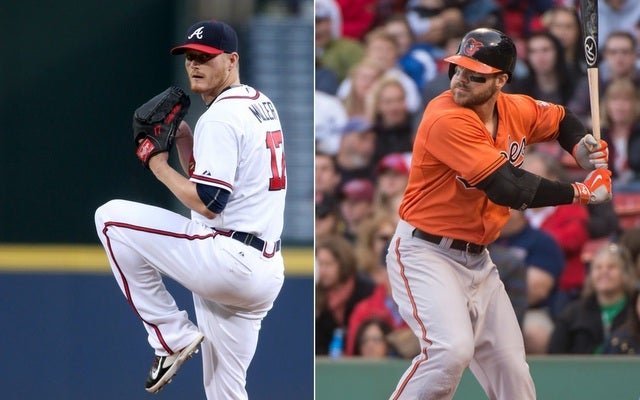
1. Diamondbacks trade Ender Inciarte, Dansby Swanson, and Aaron Blair to the Braves for Shelby Miller and Gabe Speier.
Shelby Miller is a very good pitcher. He had a 3.02 ERA (124 ERA+) in 205 1/3 innings last season, sabermetric measures loved him (3.45 FIP), and he turned only 25 back in October. Plus he can't become a free agent until the 2018-19 offseason. That's a really valuable player. But holy cow, the D-Backs gave up a ton to get him.
Let's start with Inciarte. The 25-year-old broke out last year, hitting .303/.338/.408 (101 OPS+) with six home runs and 21 steals. Inciarte is also an excellent center field defender based on both the eye test and various defensive metrics. The end result is a player who has been worth 8.9 WAR in only 250 career games. Even if you don't buy the bat long-term, Inciarte is a nice little player based on his glove alone.
Then there's Swanson, who was the No. 1 pick in the 2015 amateur draft. Arizona traded him roughly eight months after selecting him with the most valuable pick in the draft. Baseball America recently ranked Swanson as the No. 17 prospect in baseball, saying he has "perennial all-star potential" and the potential to reach MLB in 2016, a la Kyle Schwarber and Michael Conforto, who reached the show in 2015 after being drafted in 2014.
Inciarte and Swanson are a lot to give up for Miller, but then the D-Backs added Blair on top of that package. Blair himself is a very good prospect -- Baseball America ranked him No. 60 overall on their top 100 list -- and is expected to reach MLB in 2016. The 23-year-old had a 3.16 ERA in 77 Triple-A innings in 2015. He's close to ready and was the third piece in the trade.
The D-Backs gave up all of that for Miller and Speier, a 20-year-old Single A reliever. I can't help but wonder if the Braves would have taken Swanson for Miller straight up. Or Inciarte and Blair only. But no, Arizona gave them all three. Either the D-Backs believe Miller is a budding ace or they soured on Swanson really quick, because otherwise it doesn't make much sense.
The Braves were going to get a nice haul for Miller no matter what -- they were reportedly talking to the Cubs about Jorge Soler -- but kudos to them for prying such an impressive package of players from the D-Backs. That's a return fit for a Cy Young winning ace.
2. Orioles re-sign Chris Davis to a seven-year, $161 million contract.
As with Miller, it's not that Davis is a bad player. He is the best power hitter in baseball right now and he's a much better athlete than he gets credit for. Davis is a strong defensive first baseman who can also handle right field and even third base in an emergency. I wouldn't call him well-rounded, but he's not one-dimensional either.
Who were the O's bidding against though? Very few teams were connected to Davis this winter -- the Cardinals and Tigers were said to have some interest, that's about it -- yet Scott Boras still got the Orioles to up their initial offer (seven years, $150 million), which was high to begin with, by simply holding his ground. Owner Peter Angelos is a big Davis fan and Boras used that as leverage.
Davis is a very dangerous hitter capable of changing a game with one swing, and Baltimore is a much better team with him than without him, but gosh, who were they competing against? It's simple supply and demand. The supply was there (Davis) but the demand wasn't (teams interested in signing him). There was a limited market for Davis and Boras still got him the fourth richest contract of the offseason and the 20th largest contract in history. That's why he's the best.
3. Royals sign Ian Kennedy to a five-year, $70 million contract.
Let me start by saying the Royals have earned the benefit of the doubt. They won the World Series last year and won the AL pennant the year before, and they did by making several moves that seemed questionable at the time (Edinson Volquez, Kendrys Morales, Jason Vargas, etc.). The fly ball prone Kennedy will love his new outfield defense, no doubt about it.
That said, Kennedy had a 4.28 ERA (85 ERA+) in 168 1/3 innings last season, and he allowed 31 (!) home runs. He has a 4.25 ERA (84 ERA+) in 550 2/3 innings since the start of the 2013 season. That works out to a -0.4 WAR in three year. Kennedy is already 31, so age-related decline is a bit of a concern too.
The Royals signed Kennedy pretty late in the offseason (Jan. 29) and I can't help but wonder if they would have been able to land a better pitcher had they decided to spend that much money earlier in the offseason. Someone like, say, Mike Leake or Wei-Yin Chen, who signed identical five-year contracts worth $80 million on Dec. 26 and Jan. 19, respectively.
Keep in mind the Royals did give Kennedy an opt-out clause after the second year, so it's possible he'll opt-out in two years and Kansas City will be off the hook for the final three years. At the same time, the Royals also gave up their first round pick to sign Kennedy, so it's a double whammy. They gave a big contract and forfeited a first round pick to sign a pitcher who has been replacement level over the last thee seasons.
4. Reds trade Todd Frazier for three prospects in three-team trade.
The Reds reached the point where a rebuild was necessary, and Frazier was one of their top trade chips. He just turned 30 a few days ago, he has two years of team control left, and he's broken out as a top power hitter. Frazier was one of their most valuable players and cashing him in was a smart move.
Cincinnati did not get a ton back for him, however. The three prospects: infielder Jose Peraza, infielder Brandon Dixon, and outfielder Scott Schebler. Peraza is the most notable prospect of the bunch -- he ranked No. 66 on Baseball America's top 100 list -- and he's pretty divisive. He had an empty batting average at Triple-A last season (.293/.316/.378) and he is now firmly a full-time second baseman after moving off shortstop a few years ago, meaning he's stuck behind Brandon Phillips.
Neither Dixon, a Double-A infielder, nor Schebler, an MLB ready platoon outfielder, rank among the Reds' top 10 prospects according to Baseball America. The package for Frazier was Peraza and two second (or even third) tier prospects. That's not nearly enough for a flawed (Frazier isn't a great on-base guy) but still very good power hitter who plays a hard to fill position.
It seems the Reds would have been better off taking the package of prospects the White Sox sent the Dodgers in the three-team trade: righty Frankie Montas, infielder Micah Johnson, and outfielder Trayce Thompson. None are top 100 prospects but all three spent time in the show last season and are ready to help right now. Clearly, the Reds are very high on Peraza, much more than most.
5. Mariners trade Roenis Elias and Carson Smith to the Red Sox for Wade Miley and Jonathan Aro.
This was an underrated weird trade. The Mariners needed rotation help because at the time of the trade, it appeared they were going to lose Hisashi Iwakuma to the Dodgers. New GM Jerry Dipoto had Miley when the two were with the Diamondbacks, so there was a connection there. And Miley is a workhorse; he's thrown 190-plus innings in each of the last four seasons. There's value in reliability.
Seattle did give the Red Sox two very promising MLB arms to get Miley, however. In fact, it's not even clear Miley is an upgrade over Elias at this point. Here are their 2016 ZiPS projections (what are ZiPS projections, you ask? Click here):
| 2016 ZiPS Projections: Wade Miley vs. Roenis Elias | |||||||
| IP | ERA | WHIP | FIP | K/9 | BB/9 | WAR | |
|---|---|---|---|---|---|---|---|
| Miley | 179 1/3 | 4.27 | 1.38 | 3.93 | 7.3 | 3.1 | 1.3 |
| Elias | 145 1/3 | 4.52 | 1.43 | 4.28 | 7.7 | 3.8 | 1.2 |
I expect Miley to be better than the ZiPS projections, but the fact the totally objective computer program thinks Miley and Elias are so similar should at least give you pause when evaluating the deal. Keep in mind Miley is 29 and owed $15.6 million the next two years. Elias is 27 and under team control as an arbitration-eligible player through 2020.
In addition to Elias, the Mariners gave up Smith, who emerged as a dominant end-game reliever in 2015. He had a 2.31 ERA (164 ERA+) in 70 innings last season while striking out 32.4 percent of batters faced and getting a ground ball on 64.8 percent of balls in play. That is total dominance, and he is also under control through 2020.
Aro is an interesting Triple-A reliever who should help the Mariners this year, but he's not someone who is going to shift the balance of power for this trade. In a nutshell, the Mariners gave up Smith to acquire what appears to be only a minor rotation upgrade over what they already had in house.
Honorable Mention: Athletics sign Ryan Madson for three years and $22 million; Rockies sign Gerardo Parra for three years and $27.5 million; Astros salary dump Jed Lowrie.