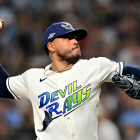
Like us regular folks, MLB front offices love a discount. Trevor Megill, who recorded the last six outs of this year's World Series clincher, has been a tremendous bargain for the Brewers. They got him from the Twins for a player to be named later on April 23, 2023. Megill has since blossomed into an All-Star closer. Shrewd piece of business, that was.
So, on Black Friday, a blessed day of consumerism, we're here to identify four free agents -- two pitchers and two position players -- who could qualify as bargains. The only ground rule is the player must not have ranked among our top 50 free agents. Everyone else is fair game and that allows us to cast a wide net. More than 140 players are free agents right now.
Here, listed alphabetically, are our four Black Friday free agents.
LHP Tyler Alexander


After years as a perfectly cromulent back-end starter/swingman type, Alexander turned in an excellent season as a traditional short reliever with the Rangers in 2026. He pitched in every role. He opened five games, saved four games, set up, matched up against lefties, you name it. That said, only 13 times in 75 appearances did Alexander record more than three outs. He was a one-inning guy.
What makes Alexander, 32, stand out is the breadth of his arsenal and his ability to limit exit velocity. He threw five pitches (sinker, four-seamer, cutter, changeup, sweeper) between 18% and 23% of the time this past season, and that's very rare out of the bullpen. Hitters are used to seeing two, maybe three pitchers from a reliever. Alexander instead plays a five-pitch guessing game.
Alexander's four-seamer and sweeper in particular grade out well analytically, and the five-pitch approach makes him exceedingly difficult to square up. He was among the very best in the game at limiting hard contact. The numbers:
| Alexander | MLB average | |
|---|---|---|
Average exit velocity | 86.7 mph | 88.7 mph |
Hard-hit rate (what's this?) | 33.3% | 38.5% |
Barrel rate (what's this?) | 4.0% | 7.7% |
Alexander struck out 19.2% of the batters he faced this summer, below the 22.4% reliever average, and that's why he's a bargain rather than a premium free agent. Strikeouts are the best outcome for a pitcher, but they are expensive. The next best thing is weak contact and Alexander gets it, particularly on the ground. His 49.5% ground ball rate was well above the 42.0% reliever average.
The elevator pitch says Alexander has never beaten himself with walks, he will get weak ground balls, and his wide arsenal makes him effective against both lefties and righties. You might not want him as your go-to high-leverage guy or even your second- or third-best late-inning option, but Alexander has a skill set that suggests he can get important outs for a World Series contender.
RHP Aaron Civale


It is no coincidence that Civale's first three MLB teams were the analytically inclined Guardians, Rays, and Brewers. He's always been a pitch data darling. The results didn't always match the stuff and that was true this year, when Civale got blasted for 16 home runs in only 74 ⅔ innings with the Athletics. That's exactly one home run every 4 ⅔ innings. Quite bad, in other words.
The A's designated Civale for assignment during the All-Star break and sent him to the Cubs in a minor trade soon thereafter. The Cubs used him exclusively in relief, sometimes for as long as four innings, and the results markedly improved both on the surface and under the hood. Here are the numbers:
| as SP | as RP | |
|---|---|---|
ERA | 5.10 | 2.54 |
FIP | 5.48 | 3.10 |
Expected ERA | 5.25 | 2.87 |
Strikeout rate | 16.5% | 22.3% |
Ground ball rate | 27.5% | 38.4% |
Average fastball velocity | 91.2 mph | 92.6 mph |
There was more to Civale's success with the Cubs than the role change. Chicago cut back on his four-seamer and sinker, upped his cutter usage (the Cubs love pitchers who cut their fastball), and more than doubled his splitter usage. It was a pretty straightforward case of "stop throwing your worst pitches and throw your best pitches more." Sometimes it really is that simple.
Now 31, Civale seems to be at the point where a full-time move into the bullpen gives him the best chance to carve out a lengthy second phase to his career. This is the natural order of things. No. 4-5 type starters, which Civale was earlier in his career, move to the bullpen when their stuff slips and their effectiveness wanes. This is how those guys remain employed.
Modern pitching staffs often include a utility pitcher, the guy who can cover three innings one day and pitch a high-leverage inning the next time out. They want a pitcher who isn't locked into one set role and can instead fill several roles. Civale, with his new pitch mix, seems capable of filling that role, which is not sexy but is something teams need to get to the finish line of 162 games.
OF Ramón Laureano


I understand baseball players and professional athletes are wired differently than us mere mortals, but I'm always amazed to hear about a player playing through a major injury, especially when his performance goes in the tank. That was the case with Laureano this past season. He played through a hip injury that ultimately required season-ending surgery.
"I have no idea why I kept playing," Laureano told The Athletic in September. "I'm such an idiot. Stupid, really. That's some stupid shit right there."
Laureano, 32, played 53 games with the Padres before going on the injured list and was simply dreadful. His mobility, both at the plate and in the field, was clearly diminished, which isn't surprising for a player with a torn hip labrum. Laureano had surgery in early June and the 4-5 month recovery time puts him on track to be ready for the start of spring training.
Laureano has two things going for him. Well, three things when you include his now-repaired hip. First, his contact quality, despite the hip injury, was quite good in his 53 games and right in line with previous years. His 14.3% barrel rate was legitimately excellent and roughly double the MLB average. Laureano was still able to hit the ball hard and in the air.
And second, there is a shortage of quality right-handed hitters in baseball right now. For a variety of reasons, the game is skewing very left-handed at the moment. Here are the percentages of plate appearances taken by left-handed hitters over the last few years:
| PA by LHB | |
|---|---|
2022 | 39.6% |
2023 | 41.1% |
2024 | 42.5% |
2025 | 44.0% |
2026 | 48.7% |
That 48.7% is the highest since at least 1961. Quality right-handed hitters are in short supply and Laureano, who has always hit lefties well, is one year removed from a .281/.342/.512 line with 24 homers for the Orioles and Padres. You needn't look back far to see the last time he was very productive, and the hip injury is a tangible explanation for his terrible 2026.
As an everyday player, Laureano might be a bit stretched, but if you're looking for a right-handed platoon outfielder and don't want to meet Tyrone Taylor's asking price or swim in the Victor Robles/Myles Straw waters, Laureano's track record and contact quality (and healthy hip) could make him a nifty dice roll. Good health can be a market inefficiency.
UTIL Matt Vierling


Unlike the other three players in this post, Vierling is not an Article XX(B) free agent, meaning he didn't reach the six years of service time needed for free agency. He was non-tendered by the Tigers. Detroit opted to cut Vierling loose rather than pay a projected $3.5 million or so through arbitration in 2027. After a poor season, it was an understandable baseball decision.
Vierling, 30, is versatile enough to cover all three outfield positions well and play the non-shortstop infield positions in a pinch. He's a right-handed hitter who's always hit lefties reasonably well (including 2026), and, frankly, the Tigers played him too much. When healthy, Detroit often treated Vierling as an everyday player, not as a platoon guy.
Here are Vierling's plate appearance splits over the last five years. This is simply too many plate appearances against righties:
| vs. RHP | vs. LHP | |
|---|---|---|
2022 | 222 | 135 |
2023 | 383 | 147 |
2024 | 415 | 152 |
2025 | 57 | 43 |
2026 | 172 | 119 |
Playing Vierling, a career .236/.293/.374 hitter against righties, that much against right-handed hitters set him up to fail. I get it. The Tigers were in contention only two of those five years and they gave Vierling a chance to show he can be more than a platoon guy, but they never adjusted his role. Even this year, he played just about every day when healthy.
Multiple injuries, including shoulder and oblique strains in 2025 and a groin strain in 2026, landed Vierling on the injured list for 202 total days over the last two years. Availability is the best ability and Vierling didn't have it the last two years. That surely factored into the decision to non-tender him. All indications are that Vierling will be ready to go for spring training, however.
There is a useful player here. Vierling's ball-tracking data (exit velocity, etc.) has been above average most of his career, he can hit lefties, and he's a versatile defender who can give you coverage at most positions. Sometimes less is more. Vierling has the skill set of a good righty platoon bat who can occupy a bench spot for a contender.