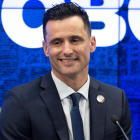
Behind the rise of Paul Toboni, who took over the Nationals front office at 35
Toboni, who played college baseball with Marcus Semien at Cal, rose through the ranks of the Red Sox scouting department

Marcus Semien scanned the bar area inside the Manchester Grand Hyatt in San Diego late one evening during the MLB Winter Meetings. The year was 2019, and Semien, still a member of the Oakland Athletics, had just completed a breakout season, one that helped propel him into the league's elite.
Yet at this moment he wasn't too enamored with his newfound accolades, nor the adulation. In his mind, there was another star on the horizon.
He glanced to his left, then peered out over a sea of baseball executives who claim that bar space each December until he found his person.
"This," he said to one reporter situated in the same vicinity. "This is who you have to meet."
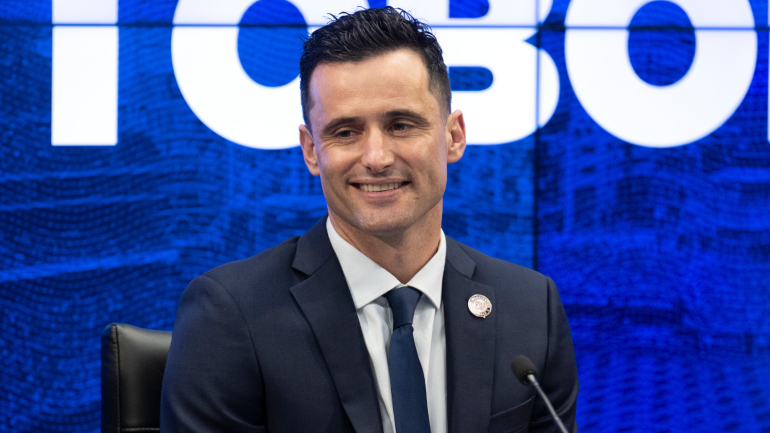
It was Paul Toboni -- long before he claimed the role as the Nationals president of baseball operations at 35.
At the time, Toboni had just been promoted to director of amateur scouting for the Red Sox. He was only 29. Around the game, he was viewed as a rising star. The kind who would run his own team one day.
He had a feel for people. Easy to talk to. Charismatic. Toboni played the game, too. He and Semien were teammates at Cal. He had a scouting background and an understanding for analytics.
Semien understood he wasn't the only future star in the room.
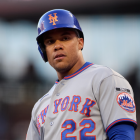
"I watched him as a teammate, a baseball teammate in college, how he worked, whether it was in the weight room or at practice or just his effort on the field," Semien, now with the Mets, told CBS Sports via a phone call earlier this month. "When you play with somebody and you see them doing the hardest thing we're ever going to do, playing the sport, and then he goes into the business world, I knew he was going to do just fine."
Semien wasn't taking a guess. He recognized a peer for his baseball acumen and ability to scout talent.
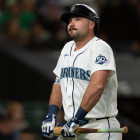
Toboni snatched up Roman Anthony for the Red Sox in the second round of the 2022 MLB Draft. Anthony was the top prospect in baseball before debuting in 2025 and looks bound for stardom.
A year later, he grabbed Kristian Campbell in the fourth round. He was a compensation pick after Xander Bogaerts chose the Padres in free agency. Campbell has had his struggles, but the Sox still view him as a linchpin to their future.
Toboni survived three heads of baseball operations -- Dave Dombrowski, Chaim Bloom and Craig Breslow -- during his time in Boston. It never broke his stride. Toboni kept climbing, eventually reaching the level of assistant general manager with the Sox.
Now, Toboni is running his own club. The Nationals handed him the keys as they try to claw back relevance in the National League East.
"I'm bringing over what I learned in Boston and trying to move us forward," Toboni said. "Early on, you're drinking from a fire hose."
As endearing and engaging as Toboni can be, there's a harder edge underneath.
"I think he has the right balance of remaining rigidly anchored to his beliefs while showing the empathy and humility to bring others along and to admit when he's wrong," Breslow said.
He wasted little time reshaping the front office in D.C., making sweeping changes shortly after arriving. He hired Blake Butera as manager in October. The 33-year-old is MLB's youngest skipper in more than 50 years. Last week, he made his first big player move: trading MacKenzie Gore, the Nats' best starter in 2025, to the Rangers. Shortstop CJ Abrams could be next.
Those around the Red Sox describe Toboni as unwavering. Once he commits to a direction, he doesn't flinch. That approach didn't always sit well with older ways of thinking in Boston. Toboni pushed process. Numbers. Alignment. Data. He played a role in the Red Sox' push toward Driveline Baseball, helping reshape how certain departments operated and where decision-making lived. His scouting background evolved. Less gut. More metrics. Sometimes more spreadsheets than stadium seats.
His playing background mattered. It just didn't dictate the process.
"We have to stay open minded and adapt as the game changes. Having said that, you know, it's still, still something that I really value," Toboni said of his playing days. "I think I just deploy it differently than I did as an area scout."
Toboni starts with the metrics. The model. The valuation. Then he goes hunting for what the model might not show.
"When you see a valuation on a player, you're like, OK, what might the model be missing?" Toboni said. "Your ability to poke holes in a model valuation lends back to how I was trained as an evaluator."
The love for the game, however, has been enduring.
Semien remembers going to Giants games with Toboni while the two were in college, how he already knew the ins and outs of every player on the field. He was immersed.
That carried over on the field, too. Toboni was a preferred walk-on at Cal, appearing in just 24 games combined in 2011 and 2012. The at-bats were limited. The approach never was.
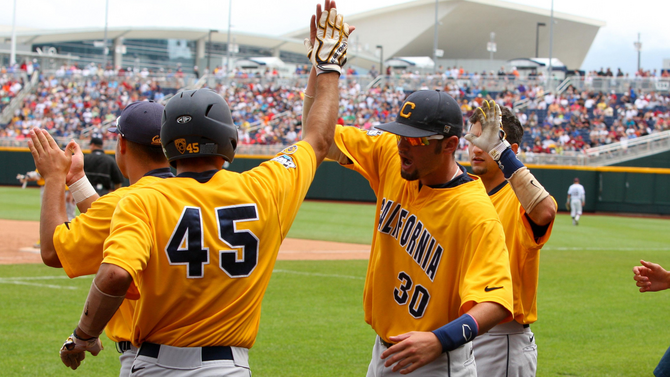
That team wasn't supposed to last. The program was supposed to be cut by the university during the time Toboni and Semien were there. Instead, Cal Baseball was saved, thanks to donors and a surprise run to the 2011 College World Series.
"He was impactful, regardless of how much he played," said his former college coach David Esquer, now the head coach at Stanford.
Toboni is now looking for something else to save in Washington. A team seemingly so far removed from the glory days of 2019 when they lifted their first World Series banner with the likes of Max Scherzer and a 20-year-old Juan Soto.
Toboni, his wife, Danielle, and their four children have settled into one of Washington's older, quieter neighborhoods. Life is still in motion. Boxes unpacked slowly.
The work in the front office, though? Moving fast.
Toboni standing on his own now, at the top. He's no longer just an amateur scouting director in a bar at the Manchester Grand Hyatt.
He's someone you need to know.