
Inside the Celtics' recipe to maintaining their elite offense without Jayson Tatum
The Celtics have been one of the NBA's biggest overachievers so far this season

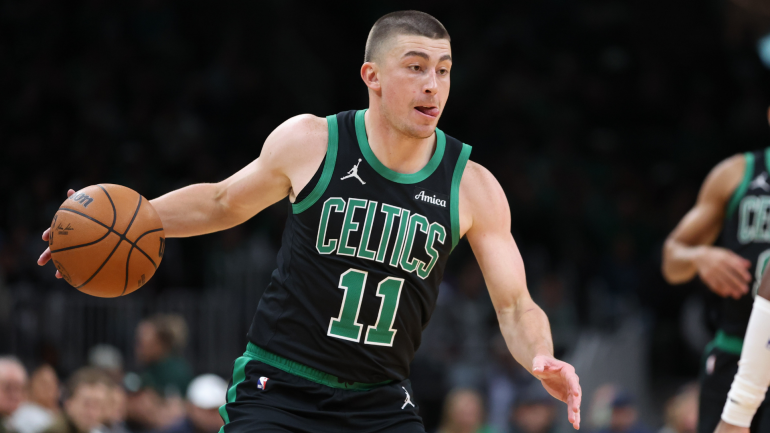
The Boston Celtics have won 10 of their last 12 games with six of the seven most recent victims being the Magic, Pistons, Cavaliers, Knicks, Lakers (albeit without Luka Dončić and LeBron James), and Raptors, whom Boston defeated on Sunday, 121-113, to extend its longest winning streak of the season to five.
Without going back through everyone's schedule, that may be the best stretch of wins for any team this season. Those six teams listed have a combined record of 94-49, and the Celtics dispatched of them by almost 10 points per game on average. The Celtics weren't supposed to be this good. But here they are at 15-9 -- 15-6 since an 0-3 start -- with the league's fifth-best net rating and No. 2 offense.
How are they doing this without Jayson Tatum, one of the best offensive players in the world, and no center to stretch the floor with both Kristaps Porziņģis and Al Horford (along with Jrue Holiday and Luke Kornet for good measure) gone? It's not easy, that's for sure.
On paper, with the notable exception of their clip-emptying 3-point volume, so much about how the Celtics score looks late-90s difficult. Mid-range jumpers for days. Nothing at the rim. They are top five in isolation frequency. The C's are bottom five in assists and assist points. If you subscribe to the make-or-miss theory, then this is pretty simple: The Celtics are making not just a ton of shots, but a ton of traditionally tough shots.
| Shot Type | FGM (per game) | League Rank |
|---|---|---|
Pull-up jumpers | 12.8 | No. 1 |
Mid-range jumpers | 12.9 | No. 2 |
The Celtics have to make a lot of jumpers because they rank bottom five in paint points. Just 23% of their shots come at the rim (inside four feet), per Cleaning the Glass, the lowest frequency in the league.
Add to that a league-high 7.4 shots per game from the 15-19 foot range, otherwise known as the NBA dead zone, and the Celtics have the league's second-worst expected field goal percentage based on the location of their shots, per CTG.
But none of that matters when the shots, no matter how they look on paper, are going in -- which, more and more, they are for the Celtics. They are connecting on 50.3% of their overall shots and 41.2% of their 3s over the past three weeks, which registers as the fourth- and third-best marks in the league, respectively, over that span.
It starts with the 3s
The Celtics have been a high-volume 3-point offense dating back to the end of the Brad Stevens era and the Ime Udoka season, but Joe Mazzulla has taken this to another level.
Under Mazzulla, the Celtics have largely turned their games into 3-point contests. This year that strategy has been even more pronounced. The Celtics are taking 43.8 3s per game (technically No. 3 league wide but effectively the same amount as the No. 1 Cavaliers who are taking 44) and making a league-high 16.
Meanwhile, 40.2% of the non-garbage/heave shots that Boston opponents take are 3-pointers, the sixth-highest mark in the league. This is to say, the Celtics -- who only allow 27.6% of their opponents' shots to come at the rim, the second-lowest frequency in the league, in addition to allowing just 41.7 points in the paint, also the second-lowest mark in the league -- want you to take 3-pointers because they believe they will outshoot you.
They're generally right. When the Celtics make at least 36% of their 3s -- basically the league average -- in a given game, they are 11-0 this year. And this is only going to happen more often as Derrick White, Payton Pritchard and Sam Hauser (all having down 3-point seasons overall) regress to their means. That is already happening for White, who's made 41% of his 3s over his last seven games, and for Hauser, who's at 42.5% in that same stretch.
The Celtics make all varieties of 3-pointers. Their jump-shot diet is a near 50-50 split of catch-and-shoots and off-the-dribble (only the Lakers attempt more, as a percentage, of the latter). The Celtics, meanwhile, lead the league with 9.8 screen assists per game, and it leads to a lot of this.
As for the catch and shoots, it's a lot of bait and kick. Notice that I didn't say "drive and kick" because the Celtics, as a whole, do not drive -- which is defined as "any touch that starts at least 20 feet from the hoop and is dribbled within 10 feet of the hoop excluding fast breaks" -- that much (43.2 times a game, the sixth-lowest mark in the league according to NBA tracking data).
What they do is threaten to drive it. If the paint is a body of water, they are always dribbling right up to the shoreline, maybe dipping their toe in, toying with wing defenders time and again until they finally take the bait and help down even just a few steps. Then boom, they kick to the shooter that was left and fire away.
Here it is again:
This kind of probing can take a while to bear fruit, and the Celtics are fine with that. They're in no rush. On average, they dribble the ball 2.59 times per touch, the second-highest number in the league, and only the Knicks score more points inside the final four seconds of the shot clock. This can be tough sledding and it may not be sustainable, but for now then Celtics have maybe the best tough-shot maker in the league.
Which brings us to ...
Jaylen Brown deserves MVP chatter
Brown, who has scored 102 points over his past three games, is the league's seventh-leading scorer at 29.1 PPG. That's more than a 30% scoring leap from last season and a comfortable career high. He will likely never win MVP, but right now Boston is the most overachieving team in the league and he's the biggest reason why. That has to count for something.


Brown is starting to heat up a bit from 3 (45% over his last five games), but he's basically throwing rocks in the ocean all season from the mid-range -- where he's taking a career- and league-high six shots per game and connecting on them at a 49.6% clip. Nobody other than Kevin Durant has ever shot like this, from these spots, for an entire season.
From CBS Sports' Jack Maloney last week:
Of the 10 players taking at least four mid-range shots per game this season, no one has been more efficient than Brown... Since 1996-97, which is as far back as the NBA's tracking data goes, the only player to shoot 50% or better on at least six mid-range attempts per game for an entire season is Kevin Durant, who did so three times (2022, 2023, 2024).
Brown is having to create more for himself this year for the obvious reason that Tatum, who typically drew the most defensive attention and allowed Brown to attack more against defenses already in rotation, isn't around. His isolation and pick-and-roll frequencies are both career highs, per Synergy.
Almost 64% of Brown's buckets this season have been unassisted (up from 53% last year and 52% in the championship season), and over 76% of them have been off the dribble, per Synergy, another career high by a mile.
Brown has never been on this kind of solo scoring mission, and he's discovering depths in his proverbial bag (particularly with his handle against pressure) that a lot of people, despite the Finals MVP and proven bucket-getting track record, didn't always believe were quite up to superstar standards.
25’-26’ Jaylen Brown self creation scoring pic.twitter.com/PQvst95ez7
— .Slip (@SlipReaper) November 30, 2025
Even when he catches off a screen, he's still often putting the ball on the floor to get to what he feels is a more comfortable spot -- even if modern numbers will tell you he should just stay behind the 3-point line, where he's actually only been a league-average shooter so far.
Jaylen Brown Pin Down Scoring 25/26 pic.twitter.com/9IX6xdBytV
— 英语🌐 (@slidewrldd) December 6, 2025
"A lot of people look at the game analytically, and they look at the percentages or whatever, but for me, to get into a comfort zone on the floor helps make all the other shots so much easier," Brown said earlier this season. "Once you see one go in, once you see them go down, then the 3-ball gets going.
"[The mid-range shot has] always been something that kind of can get me going. But the analytics won't show the potential of somebody getting hot."
Brown, who lives in the middle of the floor and is as effective as anyone at using his body to bump, back and twist his way into premium pull-up position, has certainly been hot this season. But he's not the only Celtic lighting it up from these supposedly inefficient spots.
Payton Pritchard is a 2-point assassin
Stop a hundred random basketball fans on the street and ask them what kind of player Pritchard is and just about every one of them is going to say "3-point shooter." They won't be wrong. Pritchard is a career 39% shooter from deep. He'a already seventh on the Celtics' all-time 3-point list and should pass Ray Allen for No. 6 this season. Last year, 72% of his non-garbage-time shots came from beyond the arc, per CTG, the league's highest frequency among all qualifying point guards.
But Pritchard is a lot more than just a shooter. He's a scorer in every sense. They call him Playground P because he has an And-1 handle and uses it to cook with the sort of spice you would more expect from Kyrie Irving. Here'a a tiny cut of his mix tape.
He's always been deadly from these spots (64% from 2 last season), but this year he's doubled his 2-point volume from three to six per game. Pritchard is making 61.6% of his shots between 4-14 feet, per CTG, the highest clip in the league among all point guards who are taking at least 20% of their shots from that range. Steph Curry, even at a considerably lower volume, is second, which tells you all that you need to know.
It gets even better when you narrow it down to non-restricted-area paint shots.
Payton Pritchard is shooting 64.2% this season on non-restricted area paint shots. It's the best percentage among players who have taken 50 or more of those shots.
— John Karalis 🇬🇷 (@John_Karalis) December 8, 2025
All told, Pritchard is making nearly 60% of his 2-pointers -- including 57.5% of the ones that come off the dribble (50 for 87), per Synergy. For reference, neither Kevin Durant nor Kyrie Irving has ever hit the latter mark for a season. Pritchard has a ways to go, but again, his conversion rate has always been high from this area. He's just doing it more now.
Pritchard isn't Boston's second-best player. That distinction belong to Derrick White (who also does a lot of work in the mid-rage area), but he's definitely the No. 3 and really something of a Co-No. 2 with White as he is putting up career highs in points, rebound and assists. The Celtics wouldn't be close to where they are if Pritchard wasn't playing this well.
The hidden gems
So much for the Celtics not having a center. Neemias Queta, the Kings' second-round pick in 2021 whom many basketball fans wouldn't be able to pick out of a lineup, is the gift that keeps on giving. Defensively, Queta's 31 blocked shots is the 10th highest number in the league (right above Derrick White's 30), which anchors Boston's stingy paint defense.
Welcome to Neemias Queta's block party 💪
— NBA (@NBA) October 16, 2025
4 rejections... in 1 half. pic.twitter.com/u9DRcfZobw
There's been a lot of talk about how many offensive rebounds the Celtics give up because they so often play so small, and it's true, opponents pulling down 12.4 of them per game, the fifth-highest total in the league. But the Celtics are pulling down 13.0 offensive boards of their own, thanks in large part to all the long rebounds off the 3s and, notably, Queta, whose 71 total offensive boards is a top-10 number.
Neemias Queta offensive rebound and slam pic.twitter.com/4Lpz78WOG2
— Danielle Hobeika (@DanielleHobeika) May 15, 2025
He's one of just eight players averaging at least four screen assists per game, and he has a great feel for slips and rolls out of them.
The development of Neemias Queta has been one of my favorite parts of the Celtics season so far. pic.twitter.com/YMw4AIXe32
— Jack Aylmer (@Jack_Aylmer) December 5, 2025
Queta is a long, athletic lob finisher. He hangs in the dunker spot and flashes. He can drop in touch shots off short rolls. His 10 PPG aren't just huge, they are unexpected. He's the kind of surprise a team needs to stumble onto if it's going to cover for its missing All-NBA superstar in the aggregate.
Say the same for Jordan Walsh, who has gone from total unknown to cemented starter clocking 21 minutes per game. Walsh is making over 45% of his 3s at low volume and is, more importantly, is an A1 defender who takes on the toughest assignment every night and makes life hell on some of the best scorers in the world.
Jordan Walsh's defensive résumé over a 10-day stretch 👀
— Taylor Snow (@taylorcsnow) December 7, 2025
💻 @NBCSBoston pic.twitter.com/2BkSi5ahvk
The Celtics are 10-2 with Walsh in the starting lineup. His +7.6 on/off split, per CTG, is the second-best mark on team, trailing only Queta's +19.7. Those are wild impact numbers for two guys that the Celtics didn't come into the season expecting much from.
Throw in 20 combined PPG Anfernee Simons and Sam Hauser, and 20 more PPG from Josh Minott, Luka Garza, Baylor Scheierman and rookie Hugo Gonzalez, and Boston is doing this thing as a true team. Now, there's been arguments that ultimately Boston is hurting itself playing this well when this could've been a golden opportunity to take its way into a potential high lottery pick in a deep 2026 draft class with Tatum sidelined for the year anyway.
But there's another way to look at this. The discovery of Queta and Walsh, neither of whom would have gotten this chance if Tatum and Porzingis were still around, might end up being better than whoever the Celtics might've gotten with a mid-lottery pick.
Nobody could ever say that for sure, but perhaps we should've known this was coming. Mazzulla is a top-flight coach and the Celtics are as proud as any organization in the league. They have a bunch of winners, all of whom can shoot, pass, dribble and defend, and a Finals MVP. Were they really going to bottom out with 15 wins? Probably not.
But that said, it is a surprise that they are this good. And given everything we've covered, there's little reason to believe it won't continue. If it does, get ready to hear Boston's name in a lot of trade rumors. Simons could be an outgoing expiring salary and the Celtics have picks to deal if they want to go after another All-Star to join Brown. Perhaps Ivica Zubac from the Clippers? Queta has been great, but you position a big man the quality of Zubac in this lineup and the Celtics would be an official problem, and that's before we even talk about the possibility of a postseason return for Tatum.
So yeah, things are looking pretty damn good for the Celtics, who are doing all this in addition to getting off the three years and $105 million left on Jrue Holiday's contract without even having to give up a draft pick. Truly incredible work.