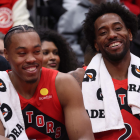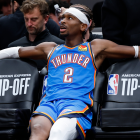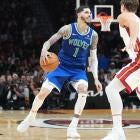


The Los Angeles Lakers pulled off one of the most unlikely comebacks you'll ever see on Friday to take a 3-0 lead over the Houston Rockets, who are falling apart (literally in this game) before our eyes. No team has ever come back from 3-0 deficit to win an NBA playoff series.
Elsewhere, the Celtics and Spurs both took back home-court advantage in their series. San Antonio is up 2-1 on the Blazers after a 120-108 win, and the Celtics outlasted the 76ers 108-100 to go up 2-1 as well.
Let's take a look at the big winners and losers from Friday night's action.
Winner: Celtics' 3-point math
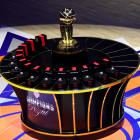
The Boston Celtics are the casino. They know they're going to lose some hands along the way (as they did in Game 2 when they made just 26% of their 50 3-point attempts), but in the end, they trust that the 3-point math will work out in their favor.
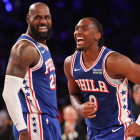
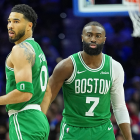
Most of the time, they're right. That was indeed the case again in Game 3 as they made 20 3-pointers (at a 43% clip) to Philadelphia's 12 (at 34%). That's a 24-point disparity in what wound up being an eight-point win that gave them a 2-1 series edge. You do the math.
This is why I wasn't concerned with Philadelphia's Game 2 victory. In that game, the Sixers, a bottom-10 3-point shooting team during the regular season, made 19 3s to Boston's 13. That's just not going to happen multiple times, let alone four times to win a series. That's the drunk guy turning over a blackjack once in a while. If he stays at the table long enough, he's going broke.
Barely two minutes into the second half on Friday, the Celtics had already made more 3s (14) than they made in all of Game 2. It has always begged the question: If the math always works out, then why doesn't everyone launch a million 3s? Because they don't have Boston's personnel.
There's a fine line between a good and bad 3-point attempt these days, and a lot of teams can't get near 50 attempts in a game without taking too many bad ones for the math to work. They don't have enough players who can create the good 3s in the first place, or enough players who can make them. In Boston, everyone can create, and everyone can shoot. On Friday, 10 Celtics made at least one 3-pointer. Philly had four players connect from distance.
Still, the 76ers had a real shot to win this game. They were down two with a little over a minute remaining and had Boston in a straightjacket with the shot clock winding down, only for Payton Pritchard to hit them with an escape-dribble triple to stretch the lead to five.
PRITCHARD GIVES THE CELTICS A 5 POINT LEAD! pic.twitter.com/fkIsAHg5rv
— TSN (@TSN_Sports) April 25, 2026
About 40 seconds later, the Sixers had it back down to three only for Jayson Tatum to deliver this dagger.
JAYSON TATUM DAGGER THREE FOR THE WIN 😤🗡️
— Bleacher Report (@BleacherReport) April 25, 2026
HE'S BACK 🔥 pic.twitter.com/3pMcFOUgWz
This is what the Celtics do. They just have too many guys who can shoot. And over time, the three or four guys on the other side just can't keep up. -- Brad Botkin
Loser: 76ers' late-game rebounding
One of the ways the Celtics generate so many 3-pointers is by grabbing a ton of offensive rebounds, which often lead to either immediate kick-out 3s as shooters are lost in the shuffle, or at least another possession for a team like Boston to get up yet another shot. It killed the Sixers on Friday.
That Tatum 3 above? That never would've happened had the Sixers been able to rebound the initial miss by Nikola Vučević. Instead, Derrick White flew in for the offensive board, and a few seconds later, a three-point Celtics lead turned into six.
Look at Derrick White with the BIGGEST rebound tonight pic.twitter.com/ZZgmZzm1SZ
— Tomek Kordylewski (@Timi_093) April 25, 2026
Earlier in the fourth quarter, Vučević missed from the other corner. But again, the Sixers were unable to corral the board, and again it led to a Celtics second-chance bucket.
Celtics track down the offensive rebound, leading to the Jaylen Brown pullup jumper. JB has 25. pic.twitter.com/70Pu9kgJDI
— Danielle Hobeika (@DanielleHobeika) April 25, 2026
Jaylen Brown's lone 3-pointer of the game? Off an offensive rebound ...
Derrick White's lone 3-pointer of the game? Off an offensive rebound ...
All told, the Sixers allowed Boston to grab 15 offensive rebounds, which led to 22 second-chance points (to be fair, the Sixers had 17 second-chance points of their own, but that's another five-point deficit on top of the 24-point 3-point disparity).
It's not easy to keep Boston off the glass. They're definitely going to get their share, in part because the 3s they take lead to a lot of long caroms that become more loose balls than rebounds. But the two at the end were particular killers. Both times, the Sixers had a chance to get the ball back late in a close game and tie or take the lead, and both times they failed to get the rebound, allowing Boston to convert a second-chance bucket.
Playoff games often come down to a few possessions. Giving Boston two extra ones at this juncture was too much for Philly to overcome. -- Brad Botkin
Winner: The James family
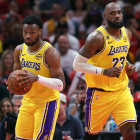
Even by his own lofty standards, Game 3 against Houston was a memorable playoff performance by LeBron James. A game-tying steal and 3-pointer to send the game to overtime. A historic 29-point, 13-rebound, six-assist performance. A 3-0 lead in a series that many assumed the Lakers would lose handily. James doesn't exactly need to burnish his legacy any further. He's already in the eyes of most either the best or second-best player in the history of the sport.
But as his retirement nears, moments and series like this are going to be an effective bookend. He's not the same basketball superhero he once was. He can't singlehandedly lift teams to the Finals anymore. But even now, in his 40s and with a diminished roster, he's still the absolute definition of a winning player, someone who can lift a team further than anyone imagined possible through his immortal basketball genius. He had nothing left in the tank by the end of Game 3, but he got the Lakers across the finish line.
And if you asked him what his most memorable moment from the game was? He'd probably tell you it was the alley-oop that he threw to his son Bronny. Yes, Bronny James, the player critics accused of being a nepo hire, is now playing real, impactful postseason minutes. He scored his first five playoff points in Game 3, and he did well enough in his first-half stint that JJ Redick trusted him to play a few minutes in the fourth quarter. The Lakers won his minutes by four points.
Is he ever going to be the player his dad is? No, but that's an unfair standard for basically anyone. If the goal here is to prove that he can be a real NBA player and sustain a career even after his father retires, well, that's growing more and more achievable by the day. James has always been a capable defensive guard, but he's starting to look more confident as a shooter after dealing with several early offensive issues. He still has work to do, but however small it is, he's surviving on the floor of a playoff series, and that's something he can build on. -- Sam Quinn
Loser: Reed Sheppard
Reed Sheppard has spent this entire season struggling to convince Ime Udoka to put him on the floor. As one of the few genuine shooters on this roster, he's one of the only players capable of making the Rockets look offensively functional. Udoka still needed convincing. Even after the Rockets closed the season with a 17-4 record with Sheppard as the starter, Udoka pulled him after only 11 minutes in Game 2. The Rockets, unsurprisingly, were held below 100 points in an upset loss.
Udoka had no choice in Game 3. With Kevin Durant out, He needed Sheppard's offense, and to Sheppard's credit, his presence did provide a modicum of space in an otherwise cramped paint. Alperen Sengun and Amen Thompson had their best games of the series, combining for 59 efficient points, probably not coincidentally in the same game they were able to share the floor with a high-level shooter.
But Sheppard himself yet again struggled. He shot 6 of 21 from the floor and 4 of 13 from deep while committing five turnovers, including the biggest of the game to set James up for his game-tying 3.
SMART TO JAMES.
— NBA (@NBA) April 25, 2026
JAMES TO KENNARD.
KENNARD TO JAMES.
LEBRON JAMES SENDS THE GAME TO OT 🤯 https://t.co/1nFMhvLtXu pic.twitter.com/z0Z9O1l38w
Udoka's hesitance to give Sheppard consistent playing time is motivated by his defensive limitations. Sheppard is small. He gets picked on. And the Lakers did quite a bit of that yet again in Game 3. Considering how bleak things now look, Udoka probably can't limit Sheppard to 11 minutes again in Game 4 even if Durant is back. But he hardly earned his coach's trust, either. -- Sam Quinn
Winner: Spurs' non-Wemby youth
If any other team had used its last two lottery picks to take Stephon Castle and Dylan Harper, they would be doing organizational cartwheels. That the Spurs have Victor Wembanyama and these two guys is beyond an embarrassment of riches.
With Wembanyama sidelined for Game 3 with a concussion, Castle and Harper combined for 60 points. SIXTY. They shot a collective 63% and made seven of their nine 3s to join Kevin Durant and Russell Westbrook as the only teammates age 21 or younger to each score 25 points in the same playoff game.
Castle is a little more established. He's a starter. He won Rookie of the Year last season. He feels like a 10-year veteran. A no-frills rock on both sides of the ball. He is cut from Jimmy Butler cloth in all the right ways. Same kind of sturdy athlete. Loves to play off two feet. Wins angles and with his body. Competes like crazy. Great footwork. Never sped up. You're forgiven if you had no idea he's just 21 years old as you were watching him put 33 on the Blazers on Friday.
Harper is a little different. Those of us who watch NBA basketball every night have known pretty much since Day 1 that he's awesome, but to the casual fan tuning in for the playoffs, you must've been shocked when Harper started going crazy in the third quarter. Like, who the hell is this guy? He scored 22 of his 27 points in the second half. The dude was a teenager two months ago, and he was in total control of an NBA playoff game in the most poised fashion imaginable.
DYLAN HARPER SHOWED OUT IN GAME 3!
— NBA (@NBA) April 25, 2026
🔥 27 PTS (22 in 2H)
🔥 10 REB
🔥 4 3PM
🔥 SPURS W
He becomes the second youngest player to score 20+ PTS off the bench in a postseason game since 1970-71!
The youngest?
Kobe Bryant (2x) pic.twitter.com/OkaKM7IeDb
Let's take another look at that baseline hammer. My god.
DYLAN HARPER?!?
— NBA (@NBA) April 25, 2026
WOAH 😳 pic.twitter.com/XIxB5Ynaks
Harper is going to be so good so quickly. It's already happening, but the leap is going to come fast. Throw in Carter Bryant, San Antonio's second lottery pick from last summer (No. 14 overall), and now it's just silly how bright San Antonio's future looks. Bryant was a plus-17 in 23 minutes on Friday. He defended all over the floor and tallied six rebounds and four assists. He only made one shot, but man was it a beauty.
Carter Bryant has not disappointed. He has brought energy and is doing everything on both ends of the floor, including shooting with confidence when he has the chance. Go Carter Go! pic.twitter.com/RNuaCjfrZj
— SpursRΞPORTΞR (@SpursReporter) April 25, 2026
That these three guys and Wembanyama are all under 22 years old is hilarious. Good luck, every other team in the NBA over the next decade. You're going to need it. -- Brad Botkin