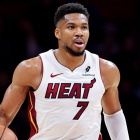
Giannis Antetokounmpo will face the Milwaukee Bucks for the first time as an opponent on Wednesday, but it's a game that feels as though it's a half-decade or more in the making. The Miami Heat were a rumored suitor for Antetokounmpo, who played his first 13 NBA seasons in Milwaukee, as far back as the buildup to his possible 2021 free agency, which the Bucks averted by trading for Jrue Holiday and ultimately winning a championship.
The Bucks kept kicking the can down the road. They secured another extension with Antetokounmpo in 2023 by trading for Damian Lillard. They stuck their fingers in their ears and pretended everything was fine when Lillard tore his Achilles in 2025, in the process bypassing the chance to trade Antetokounmpo with multiple years left on his contract when they could have maximized his trade value. In the end, though, Heat president Pat Riley did what he has done so many times before: he got his man.
Now, Antetokounmpo plays for the Heat while the Bucks are in no man's land. We have around four weeks of data on how these teams are going to look after one of the bigger blockbusters in recent NBA history, so with their first head-to-head bout at hand, let's regrade the trade based on everything we now know.

Miami Heat: C+
June grade: B+
Let's start with the obvious positive: despite age- and injury-related fears, Antetokounmpo is still mostly himself. He is, by both the counting stats and the all-in-ones, playing either at the level of his Milwaukee peak or somewhere relatively close. He has at the very least been a top 10 player in the NBA this season, and you could argue him into the top five. Miami paid an All-NBA price and has gotten an All-NBA player.
There are slight signs of slipping in his age-32 season that merit some examination, though they don't come close to triggering any real alarms. His free-throw rate is lower than it's been since 2018, for instance, but it's still near the top of the league. He's scoring 1.38 points per possession when shooting at the rim -- a very good figure that rates him in the 82nd percentile league-wide, per Synergy Sports. We just judge Antetokounmpo on a curve because he was in the 95th percentile last season and generally hovered around the mid-90s when he was winning MVPs and his 2021 championship.


This is, again, not a significant concern. He's still great, and he's supplementing his rim finishing with significant improvement from mid-range. After shooting below 39% from mid-range over the past five seasons combined, he's above 51% so far this season. We can say pretty safely at this point that the 3-point shot is never coming for Antetokounmpo, so this shot will be his pathway to both aging gracefully and combating the walls he'll see at the rim in the playoffs. If this is sustainable, it extends his prime another year or two and makes him close to unguardable while he remains near his physical peak. Thus far, last year's calf injuries have not recurred.
He's slipped defensively. That's almost undeniable. He contested around nine shots per game when he won Defensive Player of the Year in 2020. He's down to around six this season, and opponents are shooting 6% worse within six feet of the basket against Antetokounmpo than they are otherwise, per NBA.com tracking data. That figure was 20.4% in 2020. The all-in-ones share this basic opinion: still good, no longer great. The tape shows an older player who paces himself defensively. He can still summon greatness for stretches, but he's not in the All-Defense mix seriously anymore.
That brings us to the bigger picture. When you trade as much as Miami did, the question is never just whether the player is good enough to justify the cost, but whether the team is. Heat fans would point to the team's ongoing 8-2 stretch following its 0-4 start to suggest that it was. Count me as a remaining skeptic.
Most of those victories came against either the bottom of the league -- the Kings, the Jazz, they needed overtime to beat the Clippers! -- or injured opponents. No Tyrese Haliburton in the Pacers win. No Jalen Duren against the Pistons. No Evan Mobley against the Cavaliers. No Amen Thompson against the Rockets, playing the second night of a back-to-back. They've faced only two true heavy hitters at full strength, the Lakers and Timberwolves, and they stood no chance against either.
The theory of this team relies on a top-five defense. The offense is simply too reliant on shot creation out of its bigs -- Antetokounmpo and Bam Adebayo -- to be the leading unit for a champion. The early defensive returns have thus far been discouraging, though in fairness, no team has been unluckier on wide-open opponents' 3s. Even during the 8-2 stretch, they're allowing 48.4 points in the paint per game, a well-below-average figure. Their transition defense is nothing special and they're so-so rebounders. They've hung their hat on turnover-generation, but they're by no means elite on that front. The raw numbers are bad. The truth is closer to fine when you factor in luck. They haven't been great, which is what they need to be.
Part of the problem is that they need to play defensively deficient players -- most notably Klay Thompson and, if he eventually re-earns his rotation spot, Tim Hardaway Jr. -- in order to survive offensively. You can get away with that if everyone else is great. Antetokounmpo has taken a step back. Andrew Wiggins has been a mess. Erik Spoelstra is a defensive miracle worker, but the players here just haven't lived up to expectations. Davion Mitchell has become so important offensively that even he's slipped a bit on that end.
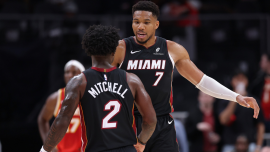
Mitchell's playmaking has been a godsend, and a pretty surprising one in context. The Heat tried and failed to get the Bucks to take Mitchell instead of Kasparas Jakučionis in the trade. There's no telling how bad things would be without Mitchell at this stage, but we're still talking about a pretty limited scorer who nearly doubled his 3-point volume and free throw attempt rate in a single season. Miami probably can't expect him to carry this sort of burden forever. Pelle Larsson is more of a connector than a creator in his own right. Down the line, another guard who can create off of the dribble is probably needed here, especially without a strong Antetokounmpo-Adebayo two-man game forming thus far.
The paths to improvement here are narrow here. The Heat are pressed up against a first-apron hard cap, and they'd need Charlotte's cooperation to amend the protection on their 2027 selection if they wanted to trade even a single first-round pick at this deadline. It's going to take a little while to meaningfully upgrade the supporting talent here, and the rest of the Heat offseason reflected that.
They could have perhaps generated the cap flexibility to retain Norman Powell. They elected instead to let him walk, and when they extended Wiggins, they chose to front-load the deal by using his player option rather than spreading the money out to create more immediate hard cap room. Rather than signing a mid-level free agent to a multi-year deal, they added the older Hardaway on just a one-year contract, presumably to maintain optionality going into next summer.
If Antetokounmpo were 28, this patience might make sense. He turns 32 in less than a month. The time to go all-in around him is now. It's an ironic middle ground that the Heat have put themselves in. Miami could justify the cost it paid for Antetokounmpo only through immediate contention, yet they're slow-playing the roster build in what you would expect, just based on the standard aging curve, to be the best individual season left in his career. It really doesn't make sense to do this halfway.
We're talking about the Heat here. They've made the Finals with less talent than they have now, and they are organizationally opposed to intentional rebuilds. There was never a conversation here about, say, trading Adebayo and starting over as opposed to pushing chips in for someone like Antetokounmpo. But if a few years pass and the Heat don't at least make the conference finals with this core, it's going to be worth wondering if that's the path they should have taken. The early returns here are mixed. The Heat bet their future on a single player. He may be good enough to warrant that investment, but the jury's still out on whether their team actually is.

Milwaukee Bucks: D-
June grade: C-
The Bucks dug themselves an enormous hole by refusing to trade Antetokounmpo when the whole world knew they should have. It was over the moment Lillard tore his Achilles. At that point, Antetokounmpo had two years left on his contract, so hypothetical rental trades would have been feasible. He was younger and he hadn't yet lost a year to calf injuries, so his value was higher. Asset-rich teams like the Spurs and Rockets might have been interested. Had the Bucks moved Antetokounmpo in 2025, they would have gotten substantially more than they wound up getting. Instead, they made the disastrous decision not only to keep him but also to waive and stretch Lillard to sign Myles Turner. Yikes.
When the Bucks finally realized they'd reached the point of no return, Antetokounmpo, as an expiring contract, had complete control of the situation. At least four teams with strong offers were turned away because Antetokounmpo simply wasn't interested in extending with them, according to ESPN. He only wanted the Heat or Celtics. Given those circumstances, the Bucks still managed the negotiations as well as they reasonably could have. They used the Celtics as an effective scare tactic to compel Miami to give up pretty much all of its available draft capital, plus Jakučionis instead of Mitchell.
You can win a negotiation and still lose a trade, though, when most of the things the other team had to give in a trade just weren't that valuable. The big swing piece here was Kel'El Ware, an extremely high-risk, high-reward young big man with star-level raw talent and a pretty iffy reputation when it comes to his motor and commitment. The Bucks, thus far, have gotten the worst version of him. He's playing less in his third season with the Bucks than he did in two years with the Heat despite being on the worst roster of his career. He's missing shots everywhere, his defense has been miserable, and if he's ever going to reach that sky-high ceiling, it's probably going to have to come on his third team.


That, in a nutshell, is the problem here. The Bucks traded the greatest player in franchise history, one of the 25 or so best players the league has ever seen, and got no one who could credibly be considered a cornerstone moving forward. Ware looks like a swing and a miss. It's too early to say much on Nate Ament, but he's a No. 13 overall draft pick, so odds are, he's going to be fine and not much better. Tyler Herro and Jaime Jaquez Jr. are both about what they expected, but both will need to be paid next summer. Herro's presence exacerbates a preexisting glut of guards. His presence has forced last year's breakout guard, Ryan Rollins, to the bench. Maybe that makes him a bit cheaper as a free agent next summer. It also probably sours him on a future in Milwaukee.
Speaking of the guard glut, the Gary Trent Jr. investigation looms large over this trade. The NBA set a notable precedent in the Kawhi Leonard case that it is willing to strip teams of draft picks acquired through trade. This is notable because the Bucks have so little control over their own first-round picks moving forward. The picks they got from the Heat in 2031 and 2033, at least for now, are the crown jewels of this trade. Both of them are theoretically vulnerable if the NBA finds that the Bucks circumvented the salary cap.
It's even worth wondering if the Bucks should or could have used the Antetokounmpo situation as an escape hatch on any preexisting agreements with Trent, if one actually existed. If the Bucks felt an obligation to pay Trent more than the market suggested he was worth, and if they knew they had so many guards that he was unlikely to factor into their rotation (he played less than 40 total minutes before bizarrely leading the Bucks in playing time in Sunday's loss to the Hawks despite coming off the bench), then why not use the leverage Antetokounmpo's availability granted them to foist Trent on Miami through a sign-and-trade? Of course, if the Bucks had the foresight to do this, they probably wouldn't be in this situation in the first place. For now, the investigation is ongoing and we know little beyond the sheer ridiculousness of the contract itself.
The Bucks are 1-13 as of this writing. That, roughly, was to be expected. This was a bad team with Antetokounmpo, so inevitably, removing an MVP candidate was going to make it far worse. But to leave a trade involving a player of that caliber without a single blue-chip player or draft pick is frankly embarrassing.
The Bucks bungled this Antetokounmpo saga for a year, and even if they managed its end stages properly, they'd dug themselves so deep a hole that there was just no obvious way out of it. Now, it seems they may well have made the situation worse with Trent after the fact. This was an organization-wide debacle.