Justin Herbert still hasn't won a playoff game. How much is his fault, and how can the Chargers change that?
Herbert's playoff numbers are unsightly

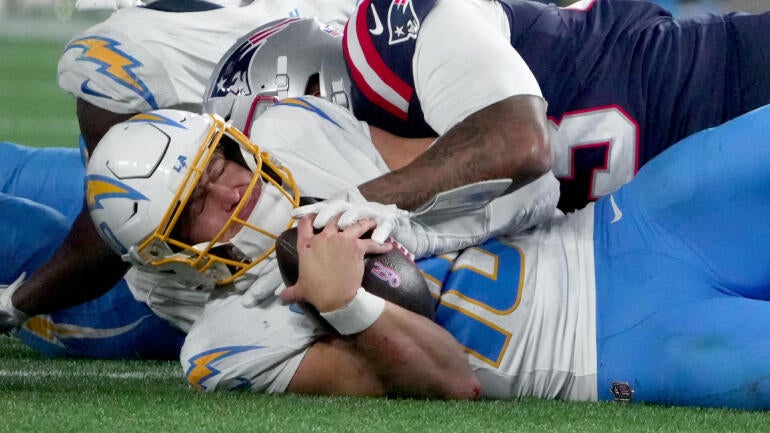
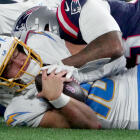
Justin Herbert's two defining plays of the season both ended up with him crumpled on the ground.
The first came in Week 3, when he evaded multiple defenders and somehow fired a 20-yard touchdown strike to Keenan Allen to tie the game late against the Denver Broncos. The Los Angeles Chargers then forced a punt, Herbert led the offense into field goal range, Cameron Dicker nailed a 43-yarder, and Los Angeles was 3-0, with all three wins against AFC West rivals. They were on top of the standings and, for the moment, the football world.
HERBERT BREAKS THE SACK AND FINDS KEENAN ALLEN FOR THE TD ⚡️
— NFL (@NFL) September 21, 2025
DENvsLAC on CBS/Paramount+https://t.co/HkKw7uXVnt pic.twitter.com/f95wNegDdP
Nearly four months later, on the opposite side of the country and worlds away from that post-Week 3 high, Milton Williams beat two Chargers offensive lineman and crunched Herbert to the Gillette Stadium turf, the final dagger in a miserable 16-3 wild card loss to the New England Patriots.
Milton Williams with the exclamation point!
— NFL (@NFL) January 12, 2026
LACvsNE on NBC
Stream on @NFLPlus + Peacock pic.twitter.com/3AdWbXrtax
Herbert has more passing yards through six seasons than anyone other than Peyton Manning. He has two Pro Bowl selections, two top-10 MVP finishes and an Offensive Rookie of the Year award.
And he does not have a playoff win.
There are turning points in every franchise quarterback's career, but for Herbert's career, those turning points have more often been breaking points. After Herbert's rookie year, the Chargers fired Anthony Lynn. With defensive-minded Brandon Staley taking over, the Chargers surged and became a playoff team in 2022, only to blow a 27-0 lead in a wild card loss to the Jacksonville Jaguars. That wasn't quite another breaking point, but it foreshadowed one. Staley's defenses continued to struggle, Herbert landed on IR late in the season, and two days later, a nationally televised 63-21 embarrassment against the Las Vegas Raiders was the straw that broke the camel's back. The Chargers fired Staley and finished 5-12.
In came Jim Harbaugh, fresh off a national championship at Michigan. Harbaugh brought over defensive coordinator/whiz kid Jesse Minter from Michigan and reunited with offensive coordinator/run game guru Greg Roman. No more embarrassment. No more collapses. The Chargers demanded to be taken seriously.
"We're going to earn our winning as a tough team, a resilient team, a relentless team, a physical team," Harbaugh said in his introductory press conference. "That is what we're going to aspire to be."
And the Chargers became that. Despite enormous financial obstacles in what looked like a rebuilding/transition year, Los Angeles made the playoffs in 2024 on Harbaugh's desired characteristics. The defense was tough and opportunistic. Herbert took care of the ball, and the run-first approach worked well enough.
The Chargers promptly got stomped on by the Houston Texans 32-12, with Herbert throwing four interceptions and completing just 44% of his passes.
That led to this year. The Chargers hoped to revamp the rushing department with rookie Omarion Hampton adding some explosiveness. They had their cornerstone tackles -- Rashawn Slater and Joe Alt -- back and had added Mekhi Becton to fortify the interior. A young, ascending defense was still in place.
But then Slater got hurt in the preseason and never played. Alt was lost for the year in Week 9. Sunday, it all came crashing down on Herbert in the playoffs again: 19 for 31 for 159 yards, no touchdowns, one lost fumble and six sacks taken.
These are the types of losses that lead to big questions ... big moves. Two days after the loss, Harbaugh fired Roman and offensive line coach Mike Devlin. They're the first two moves of what should be a busy offseason.
How much of the collapse is on Herbert? On Roman? On Harbaugh? On bad luck? They all played a role. The honeymoon period with Harbaugh is over. When he took the job, he said the first priority was protecting Herbert. Through two seasons, he has failed. But Herbert has also failed when the lights have been brightest, too.
Justin Herbert's playoff resume is ugly
There's no two ways about it. Herbert has not been good enough in the postseason, and it hasn't been particularly close. Over the past four seasons, Herbert ranks near the bottom in pretty much every major statistical category.
- He has thrown just two touchdown passes and four interceptions, tied with Joe Flacco and Skylar Thompson for the worst ratio in the NFL.
- His 5.5 net yards per attempt is 25th out of 28 quarterbacks with at least one playoff start over that span
- His 10.9% sack rate is also 25th out of 28.
- His 18.9% off-target rate is 27th, only ahead of Tagovailoa.
(NOTE: Ranks were entering "Monday Night Football.)
Sunday's performance was particularly disappointing. Herbert was wildly off-target (19.4% off-target rate, 11.8% even when not pressured) and missed several potential big play opportunities. He produced just one play of 20+ yards. That's despite him taking an average of 3.41 seconds to throw and him an average of 2.72 seconds before pressure. That second number was his second-longest all year. ESPN's Benjamin Solak pointed out a couple of times Herbert could have taken a shot downfield.
2nd snap of the game. Probably a touchdown if Herbert gets it to Ladd.
— Benjamin Solak (@BenjaminSolak) January 12, 2026
(Ladd looking around like "was there a safety behind me???!" is killing me) pic.twitter.com/GTSipx3Mn0
3rd and 12 here. Herbert gets Tampa 2 with Ladd on the seam. Field safety gets REAL wide. Lotta space to hang this ball up there.
— Benjamin Solak (@BenjaminSolak) January 12, 2026
Herbert was ubercautious in this game early. Left too much meat on the bone, and when they needed big plays late, pass rush was up. pic.twitter.com/0DKnurwu9M
"I didn't play well enough and didn't make any plays," Herbert said postgame.
That's the one thing, above all, that Herbert had done all year. The offense was inconsistent. The sacks were plentiful. The running game was spotty. But Herbert could make it all right with a superhero play -- a big throw, a big run, a pressure avoided. Highlight-reel stuff.
That's who Herbert is. He has misses. He makes mistakes. He can hold onto the ball too long. He can have stretches where he tries to make too many plays, and he can have stretches when he's too conservative. There were times this year in where he was hopeless behind his offensive line, and there were times when he was seemingly anticipating pressure before it was there -- perhaps a result of being so used to being under duress so often. But when he's on, he's as good as it gets.
Those "on" stretches simply haven't happened in playoff games. He was asked why.
"Yeah, I don't I haven't figured it out yet, and it hasn't happened, so we'll have to re-evaluate and see what happens."
The offensive line was a mess
The Chargers finished 31st in pass blocking and 32nd in run blocking in Pro Football Focus' grades. For reference, the second-worst pass blocking team to make the playoffs was the Texans all at 23rd. The second-worst run blocking team to make the playoffs was the Green Bay Packers at 20th.
No matter how you view Herbert's playoff struggles, there is absolutely no denying the surroundings were a mess.
Chargers OL who played at least 500 snaps this season | PFF position rank |
T-55th out of 70 | |
OT Trey Pipkins | 67th out of 70 |
OT Bobby Hart | 68th out of 70 |
70th out of 70 | |
OG Zion Johnson | 47th out of 66 |
56th out of 66 | |
OG Mekhi Becton | 65th out of 66 |
C Bradley Bozeman | 34th out of 34 |
Put another way, the Chargers played three of the NFL's four worst tackles, its second-worst guard and its worst center significant snaps.
The tackles struggles were egregious. The injuries to Slater and Alt set the Chargers up to struggle, but for it to be this bad no matter who they tried on the edges was an indictment on the entire operation.
The interior struggles were even more damning considering the Chargers got 17 games from Johnson, 16 games from Bozeman and 15 games from Becton -- all hand-picked to try to lead the interior. Johnson was a 2022 first-round pick. Bozeman came over as one of Harbaugh's key additions in his first offseason with Los Angeles, Becton the same in Harbaugh's second.
They've all been swings and misses when they needed to be hits, even if not home runs. Herbert took 54 sacks -- one shy of the league lead -- and was pressured on an NFL-high 42.8% of his dropbacks.
This has to be priority No. 1 this offseason. Johnson, Penning, Pipkins, Deculus and Salyer are all free agents-to-be. The team can get out of the Bozeman and Becton contracts with minimal financial ramifications if it wishes.
The Chargers are projected to have the most cap space in the NFL this offseason. Over The Cap's "effective cap space" -- which takes into account teams filling out their rosters and projected rookie class -- projects $86 million available. After two quiet offseasons trying to dig the team out of some tricky financial situations with dead money, it's time (really, past time) for GM Joe Hortiz to address the offensive line. He has to get it right.
Moving on from Greg Roman
Roman's connection to Harbaugh goes back to their time at Stanford. Harbaugh then brought Roman along to the San Francisco 49ers as the offensive coordinator. Roman then had stints as the Buffalo Bills' offensive coordinator and the Baltimore Ravens' offensive coordinator (under Jim's brother, John) before reuniting with Jim in Los Angeles.
Those run-heavy offenses are good for mobile quarterbacks and can be especially helpful for young ones. It worked for Colin Kaepernick in San Francisco, Tyrod Taylor in Buffalo and Lamar Jackson in Baltimore. But the common theme? All three of those teams eventually move on. More precisely, they outgrow the offense.
It was time for Los Angeles to determine it had done the same. In a year when the offensive line was atrocious, Roman didn't use Herbert's athleticism on rollouts nearly enough. He didn't create enough easy outlets for Herbert by getting running backs involved. While some of this may be due to Herbert's aggressive tendencies, it's been a characteristic of every quarterback under Roman.
NFL offenses with Greg Roman as OC | RB target share | NFL rank |
2024-25 Chargers | 12.4% | 31st |
2019-22 Ravens | 13.9% | 31st |
2015-16 Bills | 18.4% | 17th |
2011-14 49ers | 15.4% | 28th |
The running game that's been Roman's calling card wasn't good enough either; the Chargers ranked 23rd in running back rushing success rate.
The Roman offense can be a good starting point with a reasonable floor, but Herbert can handle a heavier and more nuanced passing scheme, one that uses every position in the passing game. There are plenty of up-and-coming play callers getting looks this offseason; Harbaugh has long favored familiarity, but a three-point performance to cap a difficult offensive season should force his hand to think outside the box.
The consensus on Herbert: Not good enough in big moments, but neither are his surroundings
There seems to be a notion that one must fall into one of two camps. The first says Herbert is the king of the "If" scenarios: that it's always "If he only had this or that, he'd be better," that he gets too much leeway for his poor performances. The second says the Chargers have failed Herbert: that his offensive line has been a disaster and, before that, his defense and coaching was poor.
The truth lies somewhere in between. Herbert's inaccuracy and other inconsistencies are maddening. His hero ball is as good as it gets. He needs much better support around him, but not all of his struggles are due solely to that.
Two things are clear, though: Herbert at his best is terrific, and the Chargers must make significant investments to help him be at his best more often. The Roman and Devlin firings can only be a start. This offseason and the 2026 season will be a referendum on Herbert and on the Chargers' willingness and ability to elevate him.