Just because your college football head coach has a contract that says he's owed a certain amount in buyout money doesn't mean it's what he actually gets in the end. The easiest way to reduce a buyout number is for the coach to take a new job, which they often do shortly after being let go.
When they do, it kicks in what's called an offset clause, where the buyout owed by the school can be canceled out essentially by the coach's new salary (sometimes at a dollar-for-dollar rate), and there are contractual mandates for coaches to seek work in many deals referred to as a duty to mitigate.
There are also ways to be creative in a coach's exit packages. As an agent told CBS Sports, "buyouts are often starting points in negotiations."
Sometimes a coach will take a heavy up-front payment for tax purposes or if the school wants it off the books sooner. There is also horse trading involved sometimes, when a coach trades some money owed to get something in return (like the school waiving its requirement to seek work). It's all part of the complex dynamics of a unique industry. And the 2025 coaching cycle featured multiple shocking buyout numbers on their face.
They were headline-grabbing at the time, but in the end, how much of the top 10 buyouts owed in 2025 to coaches were actually paid out?

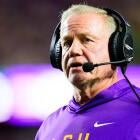
Brian Kelly, LSU
Original buyout: $54 million
LSU and Kelly's divorce was deeply contentious. He was contractually owed $54 million. The school ended up in a legal battle with Kelly and claimed that it hadn't formally terminated him initially. The school tried to fire him for cause to get out of that buyout and even claimed that athletic director Scott Woodward did not have the authority to fire Kelly
In the end, around Thanksgiving, Kelly was, in fact, formally terminated without cause, as evidenced by a letter obtained by CBS Sports. He would receive his full buyout as long as he fulfilled his obligation to secure another job. Kelly is currently an analyst for CBS Sports. Actual buyout: $54 million

James Franklin, Penn State
Original buyout: $49 million
Franklin was owed that sum of money over six years, but it was clear almost immediately that Franklin would be seeking work to return to college football. Franklin's buyout was the second-largest in college athletics history when the school fired him, but in the end, Virginia Tech is essentially offsetting the cost owed. Penn State and Franklin settled on a significantly lower number before he took the Virginia Tech job.
Franklin admitted it was a tough pill to swallow in an interview with USA Today, but in the end, he agreed.
"You go through that deal, and you're thinking, I don't want to let them off the hook financially," Franklin said. "That's something you're struggling with. But it wasn't about me penalizing Penn State. At that point, it was about what do I need to do for my family and for myself to be happy and move on?"
Penn State essentially got a win because athletic director Pat Kraft was able to message that they were not, in fact, on the hook for a gigantic buyout. Just picture every year when Franklin's buyout would be paid: a bunch of the same Bobby Bonilla Day headlines that plague the New York Mets every year. Both sides just moved on. Actual buyout: $9 million

Mark Stoops, Kentucky
Original buyout: $37.7 million
Stoops will get what's owed to him, but when he gets it, it will be restructured in a way that benefits both parties in the long term. The original way Stoops' buyout was set up meant he would get all of it within 60 days of his firing, which was an absolutely massive hit for UK to take (especially as they reoriented their athletic department to more of an LLC model to try to keep up with the Joneses in the SEC after falling behind).
Instead, Stoops received nearly $4 million up front by December 16, 2025 (he was fired on December 1, 2025), with the remaining balance paid out quarterly through April 1, 2031. Essentially, $6.7 million annually.
There is no offset language for Stoops. There is also a mutual non-disparagement agreement in the separation package, along with cooperation requirements, should there be future NCAA inquiries into Stoops' tenure. Stoops is currently a special assistant at Texas. Actual buyout: $37.7 million

Jonathan Smith, Michigan State
Original buyout: $33.5 million
Smith was owed 85% of his remaining deal through 2030, but it did include a mitigation clause. Smith does have offset language, but he has yet to take another coaching job that meets the offset criteria. In his contract, Smith is required to actively seek and obtain comparable employment as an NFL or Division I coach, but he is not required to accept a job "if such position is not in the best interest" of his coaching career.
The contract also offers some coverage regarding creative contract structures.
"[Smith] shall not structure nor time compensation in any new employment in a manner to avoid mitigation. The Coach shall provide the University on an ongoing basis with information relating to the efforts undertaken to secure other employment and respond to any inquiries that the University may make relating to those efforts."
As one industry source told CBS Sports, think of the school like a bank.
"You need to be nice to the bank so you can withdraw money out right over the course of your contract," the source said. "Schools have gotten really sharp lately by introducing language that doesn't allow you to game the offset."
Smith's contract allows Michigan State to suspend the buyout if he is not communicative about his future employment. Actual buyout: $33.5 million … for now

Billy Napier, Florida
Original buyout: $21 million
Napier's contract contained no offset or mitigation, and half of it was due within 30 days of his 2025 firing.
The buyout allows James Madison to get Napier at something of a discount. His salary is middle of the road in FBS overall. It's near the top of the market in the Group of Six, but he is not the highest-paid G6 coach in the country, which he might have been able to negotiate, given that JMU is one of the top G6 jobs on the market. Actual buyout: $21 million

Hugh Freeze, Auburn
Original buyout: $15.4 million
Freeze also had no offset or mitigation from Auburn. He's not currently coaching anywhere, and will receive every penny owed. Actual buyout: $15.4 million

Mike Gundy, Oklahoma State
Original buyout: $15 million
Gundy's contract is offset by future employment, but he's not currently coaching. The terms of the contract say Gundy has to make:
"reasonable and diligent efforts to obtain comparable employment (i.e., in the football industry), including, but not limited to, a coaching position at a university or professional team or other similar employment involving athletics, as soon as reasonably possible after termination of this Contract by University without just cause."
He has been working as an analyst for TNT Sports. Actual buyout: $15 million

Justin Wilcox, California
Original buyout: $10.9 million
Wilcox has also not taken another job, but if he does, and it falls into this category …
"services as a football coach, coordinator, or an athletics administrator or as an officer in an organization that may regulate or oversee football competition (such as the National Football League, the NCAA, or an athletics conference)"
… offset language exists in his deal for any amount paid. Actual buyout: $10.9 million … for now

Sam Pittman, Arkansas
Original buyout: $9.8 million
Sam Pittman negotiated a slightly reduced buyout. He took $1.5 million less than was originally owed in exchange for getting the clause that would compel him to seek work until he was 65 removed.
He was paid 62.5% of his remaining salary instead of 75% initially owed. Pittman was also owed the 75% number because, at the time, he was over .500 as the Hogs' head coach. Had the school waited, and his struggling team continued to lose, dropping him below .500, the school would have owed him only 50% of his remaining salary. The number they arrived at was essentially a middle ground. Actual buyout: $8.3 million

Brent Pry, Virginia Tech
Original buyout: $6 million
Pry's situation with Virginia Tech is one of the more bizarre in recent memory. The school fired him as head coach and then re-hired him as defensive coordinator under Franklin in December. His buyout was reworked when he was rehired.
Pry's initial buyout was set to pay him through 2027, and he was set to make just over $6 million. The buyout was amended to $3.1 million. His defensive coordinator salary in 2026 and 2027 amounts to around $3 million.
Essentially, the school is still on the hook for roughly the same amount, just through different means, and Pry could come out ahead with performance bonuses plus his $2 million salary for 2028. Actual buyout: $3.1 million (technically)