SEC football power rankings 2026: Texas, Georgia lead the way as Alabama slides down league's pecking order
Where things stand in the nation's deepest conference after transfer portal season


The SEC hasn't been on top of the mountain in three years, but the depth of the conference continues to pace every conference in college football. Life doesn't get much easier next season as the SEC moves from eight to nine conference games after many expected an expanded playoff to help the conference land more three-loss teams in the postseason.
The SEC's heavyweights are built to chase a national title next season. The question is whether they can survive the weekly grind of the deepest conference in the country.
The familiar powers remain at the top. Texas leads the way at No. 1 after opening the 2025 season as the preseason No. 1 nationally. The Longhorns supplemented veteran playmakers with proven portal production, giving them the most complete roster in our way-too-early SEC power rankings.
Below the contenders, volatility reigns. The league's depth -- combined with six new head coaches -- creates real uncertainty in the bottom half. Florida could flash with lowered expectations and a rebuilt roster. Auburn could surprise behind experienced production following Alex Golesh from South Florida. Kentucky may spring an upset or two after assembling one of the most impressive transfer hauls in the conference.
The prediction here in February: a team ranked here today in the bottom half of the SEC will finish among the top seven. Still, it's too early to push any one program that far up the board before spring practice begins and new staffs get their hands on these rosters. I'll be more willing to do that in May, so stay tuned.
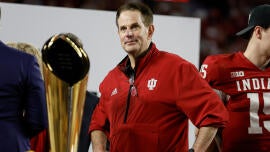
With seven months (!) still to go before the 2026 season kicks off, here's how the SEC stacks up -- for now.

1. Texas
We'll keep saying it until Texas actually wins the national title, but Steve Sarkisian has built yet another contender. Quarterback Arch Manning was excellent down the stretch last season, and adding five-star receiver Cam Coleman alongside running backs Hollywood Smothers and Raleek Brown gives Texas arguably the best offense in the SEC. The defense is loaded, too, with former Pittsburgh linebacker Rasheem Biles stepping in to lead Will Muschamp's unit. The Longhorns look poised to strike this fall.
2. Georgia
Georgia won the SEC title for a second straight season -- and third in the last four -- and has become the mainstay in Atlanta with eight league championship game appearances in the last nine years. The Bulldogs will be national contenders again with an experienced offensive backfield returning (QB Gunner Stockton; RB Nate Frazier). Still, something is holding Georgia back from winning the national title. I hit on it following the Bulldogs' loss to Alabama in the regular season: the pass rush is nowhere near what it was just a few years ago. If that improves, the Bulldogs will win the SEC again and advance beyond the CFP quarterfinals.
3. Texas A&M
Texas A&M returns some popular names -- QB Marcel Reed and WR Mario Craver -- but loses the majority of its offensive and defensive lines, and top receiver KC Concepcion after last season. A lot of folks will sell stock on the Aggies this offseason after losing both coordinators and navigating an "easy" schedule to start 11-0 in 2025 before falling flat against Texas and Miami, but the nucleus for success is still intact.
4. Oklahoma
Brent Venables bet on himself, took over play-calling duties and revitalized the Sooners' defense last season. Grabbing the package of quarterback John Mateer and coordinator Ben Arbuckle did not pan out as expected, but another year and some added weapons like former Texas receiver Parker Livingstone should help, right? Just imagine what the Sooners could have accomplished with a top-25 offense (they finished 90th) last season.
5. LSU
LSU went all-in on Lane Kiffin, and The Portal King delivered a revamped roster capable of contending again in the SEC. Forty new additions from the portal, including 14 blue-chip prospects led by the likes of QB Sam Leavitt, offensive tackle Jordan Seaton and, my personal favorite, Kansas State receiver Jayce Brown, will have the Tigers revved up. Kiffin also got a big win by retaining defensive coordinator Blake Baker.
6. Alabama
We might not be talking enough about how much Alabama could fall off in Kalen DeBoer's third year. The Tide had zero identity last season and looked more finesse than substance in most games, particularly with a terrible rushing scheme. Replacing quarterback Ty Simpson, who was a huge gamer, is also a gigantic task this offseason. Still, the talent is there. I like the defense. I like receiver Ryan Williams, even if he was more inconsistent last fall. Heck, I'm a big believer in Austin Mack and Keelon Russell if either wins the QB job, too. But I have a weird feeling about the buy-in in Tuscaloosa, which was only amplified by NC State RB transfer Hollywood Smothers opting to transfer to Texas after initially committing to the Tide in January.
7. Ole Miss
We might be too hard on Ole Miss in the post-Kiffin era, but with the uncertainty surrounding QB Trinidad Chambliss' eligibility case and a revamped offensive staff, it's OK to exercise some caution with the Rebels. The biggest news is the return of running back Kewan Lacy. If he had not gotten injured in the Fiesta Bowl, the Rebels might have beaten Miami and played Indiana in the national championship game.

8. Missouri
Don't be shocked if Mizzou starts 5-0 for a second straight year. The key difference is two wins could come against Florida and Texas A&M, which could be ranked when they travel to Columbia in back-to-back weeks. The knock on Mizzou has been its navigable schedule. The Tigers were 0-5 against ranked teams last fall. But don't get lost in the big picture. Mizzou was down to its third quarterback most of the season, allowing teams to focus on slowing top-tier RB Ahmad Hardy. A healthy Mizzou next fall is a top-20 team.
9. South Carolina
I ranked South Carolina at the bottom of my way-too-early top 25 in January. Sounds crazy? Yes, but I'm a big believer in Shane Beamer when he has his back against the wall. LaNorris Sellers returning to South Carolina doesn't quite have the same newsmaking impact as many of us believed it would a few months ago, but the Gamecocks should be happy they have potentially one of the most explosive quarterbacks in the SEC returning. South Carolina also got some much-needed help in the trenches from the portal with NC State offensive tackle Jacarrius Peak and Illinois defensive tackle Tomiwa Durojaiye.
10. Florida
Jon Sumrall arrives with a major rebuild on his hands in Gainesville. The former Tulane and Troy coach has never won less than 10 games in a single season, but make sure to temper your expectations for Year 1 in the SEC. He had to overhaul a roster depleted by transfers, and we don't quite know what to expect with Georgia Tech transfer Aaron Philo battling Tramell Jones Jr. at quarterback. Still, Sumrall has the magic touch and knows how to build rosters. He also hired a top-tier staff. The Gators could be in the top half of the SEC this season, but we need to see more this spring and summer to better gauge the Gators.
11. Tennessee
Does Tennessee's outlook change if Joey Aguilar wins his court case against the NCAA for an additional year of eligibility? Probably. Even so, I'm more curious about the Vols hiring former Penn State and Ohio State defensive coordinator Jim Knowles. He is a mastermind and one of the best in the game, but he typically needs two to three years to implement his system and players before hitting a stride.
12. Auburn
Auburn will look more like USF North than the Auburn of old under Alex Golesh, and that's not a bad thing. Quarterback transfer Byrum Brown will partner with returning RB Jeremiah Cobb to mold one of the more underrated backfields in the SEC, but can the Tigers get the production they need to replace the upside of a Cam Coleman with a trio of WR transfers from USF? Auburn must also replace its entire offensive line.
13. Kentucky
I'm putting this out into the universe today: the Wildcats have the most upside of any team in the SEC. Will Stein arrived from Oregon and built a stellar, top-10 transfer class, landing Notre Dame QB Kenny Minchey to go along with two top-100 players along the offensive line. If Stein works his QB magic like he did at Oregon, the Wildcats will be entertaining and a threat to rise quickly in the SEC ranks.

14. Vanderbilt
What does Vanderbilt look like in a post-Diego Pavia world? Do the Commodores slide back to the bottom half of the SEC, or did Clark Lea build and develop enough depth to make the Commodores a consistent threat? Leaning on freshman Jared Curtis at quarterback would be fascinating. I trust Vandy's eye for talent in the portal, but there could be some growing pains in 2026.
15. Arkansas
Anything is better than what the Razorbacks went through last season. Memphis' Ryan Silverfield was brought in to blow up the roster and rebuild, and he's going to need time to develop and show he can follow through on some much-needed retention for a program that has led the SEC in attrition the last three portal cycles. Adding Memphis QB AJ Hill and North Carolina LB Khmori House provide nice pillars.
16. Mississippi State
Mississippi State's transfer class ranked second-to-last in the SEC. More concerning is how the Bulldogs performed when they went off script on offense last season. Hot starts usually crumbled as defenses adjusted. Still, the 4-0 start -- and a road win at Arkansas -- provides a proof of concept for Jeff Lebby as he heads into a critical third season leading the Bulldogs.