MLB arbitration: Tarik Skubal, Tigers unable to reach deal as Anthony Volpe, Gunnar Henderson, more get raises
Dozens of other players agreed to 2026 contracts ahead of Thursday's deadline

Thursday marks arbitration salary filing day in Major League Baseball, the deadline for teams and their arbitration-eligible players to file salary figures for the 2025 season.
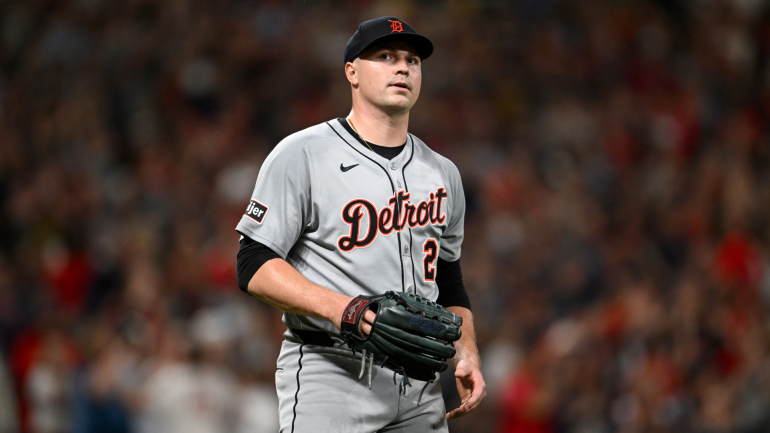
Tarik Skubal and the Tigers were unable to agree on a dollar figure for the season, so the team and the back-to-back AL Cy Young winner will head to an arbitration hearing. Detroit is a file-and-trial team, meaning they will not negotiate on a one-year deal before the hearing. That means the two sides are likely headed for a possibly contentious arbitration hearing that could impact extension talks. Skubal's camp filed for a $32 million salary for 2026 while the Tigers filed at $19 million, a $13 million gap that represents the largest difference in arbitration history, according to ESPN. The record for a pitcher in arbitration is $19.75 million, but that was in 2015 (David Price). Skubal's filing of $32 million would beat Juan Soto's record ($31 million) in arbitration.
By way of reminder, players with 3-6 years of MLB service time are eligible for salary arbitration. As well, players in the top 22% of service time between 2-3 years are also eligible. Those latter players are called Super Twos and go through arbitration four times rather than the usual three before being in line for free agency.
Other big names eligible for arbitration this time around who reached settlements include Randy Arozarena of the Mariners, Hunter Brown of the Astros, Gunnar Henderson and Adley Rutschman of the Orioles, and Jazz Chisholm Jr. of the Yankees, among others. Eighteen players, including the aforementioned Skubal, William Contreras of the Brewers, Joe Ryan of the Twins, and Isaac Paredes of the Astros, were unable to reach a settlement.
As for how the arbitration deadline works, players file the salary they believe they should be paid in 2026 and teams file the salary they believe the players should be paid for the upcoming season. If the two sides are unable to agree on a figure, they will go to an arbitration hearing where each side will state their case, and a three-person panel will pick either the salary the player filed or the salary the team filed. There's no splitting the difference between the two figures or picking one out of thin air. As such, the system is designed to promote negotiation, and that's typically what happens before a trial is held. Indeed, the vast majority of arbitration-eligible players sign one-year contracts for the coming season prior to the filing deadline. Only a handful actually file salary figures and even fewer go to a hearing. Neither side wants to go to a hearing because the process necessarily entails, on the team side, emphasizing a player's flaws and shortcomings in the name of winning. That can lead to acrimony and a frayed relationship between team and player.
Generally speaking, arbitration salaries are based on comparable players at the same service time level. A player with three years of service time who outperformed a player with six years of service time could have a lower 2025 salary because of, well, service time. Service time matters in arbitration. It's not purely about performance. That means the biggest arb-eligible salaries belong to those players who are in the final year of arbitration. Here are the record arbitration salaries heading into this year's deadline:
- Juan Soto, 2024 Yankees: $31 million
- Shohei Ohtani, 2023 Angels: $30 million
- Vladimir Guerrero Jr., 2025 Blue Jays: 28.5 million
- Mookie Betts, 2020 Dodgers: $27 million
- Nolan Arenado, 2019 Rockies: $26 million
Here now are some of the notable signings from Thursday's arbitration salary filing deadline.
- Oneil Cruz, Pirates, $3.3 million (FanSided)
- Anthony Volpe, Yankees, $3.475 million (YES)
- Ernie Clement, Blue Jays, $4.6 million (FanSided)
- CJ Abrams, Nationals, $5.2 million (FanSided)
- Riley Greene, Tigers, $5 million (Detroit Free Press)
- Gavin Lux, Reds, $5.525 million (New York Post)
- Shea Langeliers, A's, $5.25 million (FanSided)
- MacKenzie Gore, Nationals, $5.6 million (FanSided)
- Hunter Brown, Astros, $5.71 million (MLB.com)
- Brendan Donovan, Cardinals, $5.8 million (St. Louis Post-Dispatch)
- Bryson Stott, Phillies, $5.9 million (FanSided)
- George Kirby, Mariners, $6.55 million (FanSided)
- Jesús Sánchez, Astros, $6.8 million (MLB.com)
- Adley Rutschman, Orioles, $7.25 million (FanSided)
- Jhoan Duran, Phillies, $7.5 million (The Athletic)
- Steven Kwan, Guardians, $7.725 million (FanSided)
- David Peterson, Mets, $8.1 million (FanSided)
- Gunnar Henderson, Orioles, $8.5 million (Baltimore Banner)
- Jeremy Peña, Astros, $9.475 million (MLB.com)
- Alec Bohm, Phillies, $10.2 million (The Athletic)
- Jazz Chisholm Jr., Yankees, $10.2 million (YES)
- Daulton Varsho, Blue Jays, $10.75 million (New York Post)
- Jesus Luzardo, Phillies, $11 million (Philadelphia Inquirer)
- Taylor Ward, Orioles, $12.175 million (FanSided)
- Randy Arozarena, Mariners, $15.65 million (FanSided)
Failed to agree to deal
- Tarik Skubal, Tigers; player filed at $32 million, team filed at $19 million (MLB.com)
- Eric Lauer, Blue Jays; player filed at $5.75 million, team filed at $4.4 million (Sportsnet)
- William Contreras, Brewers; player filed at $9.9 million, team filed at $8.55 million (MLB.com)
- Joe Ryan, Twins; player filed at $6.35 million, team filed at $5.85 million (MLB.com)
- Isaac Paredes, Astros; player filed at $9.95 million, team filed at $8.75 million (MLB.com)
- Kris Bubic, Royals; player filed at $6.15 million, team filed at $5.15 million (MLB.com)
- Vinnie Pasqantino, Royals; player filed at $4.5 million, team filed at $4 million (MLB.com)
- Tyler Stephenson, Reds; player filed at $6.8 million, team filed at $6.55 million (MLB.com)
- Graham Ashcraft, Reds; player filed at $1.75 million, team filed at $1.25 million (MLB.com)
- Keegan Akin, Orioles; player filed at $3.375 million, team filed at $2.975 million (MLB.com)
- Kyle Bradish, Orioles; player filed at $3.55 million, team filed at $2.875 million (MLB.com)
- Cade Cavalli, Nationals; player filed at $900,000, team filed at $825,000 (MLB.com)
- Reid Detmers, Angels; player filed at $2.925 million, team filed at $2.625 million (MLB.com)
- Yainer Diaz, Astros; player filed at $4.5 million, team filed at $3 million (MLB.com)
- Bryce Miller, Mariners; player filed at $2.625 million, team filed at $2.25 million (MLB.com)
- Edwin Uceta, Rays; player filed at $1.525 million, team filed at $1.2 million (MLB.com)
- Dylan Lee, Braves; player filed at $2.2 million, team filed at $2 million (MLB.com)
- Calvin Faucher, Marlins; player filed at $2.05 million, team filed at $1.8 million (MLB.com)