NBA trade deadline winners and losers: Celtics in strong spot, Heat join Kings as disappointments
The 2026 NBA trade deadline has come and gone, here are the biggest winners and losers of trade season

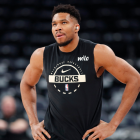
The 2026 NBA trade deadline has come and gone, and while Giannis Antetokounmpo may still be a Milwaukee Buck, there are plenty of other big names on the move. Many of them are headed for unconventional destinations. Usually, when a big name moves, it's because some team ready to win right away makes an all-in push to get him. But think of where the five recent All-Stars who got traded actually landed:
- Two of them, Trae Young and Anthony Davis, now play for the 13-36 Wizards.
- A third, Jaren Jackson Jr., now plays for the 16-35 Jazz.
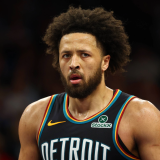
- The final two, James Harden and Darius Garland, got traded for one another despite their 10-year age gap.
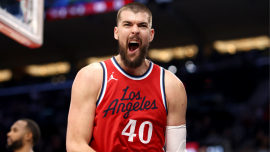
You could make an argument that the single player who netted the most at the deadline was Ivica Zubac. He went to the 13-38 Pacers. Most of the trades at this year's deadline won't affect the 2026 championship race, but plenty of them will have significant ramifications for the longer haul. So let's pick some winners and losers from the last month or so of movement.
Winner: Pacers or Clippers (lottery-dependent)
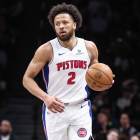
You could argue that, no matter how things shake out in May, both the Pacers and Clippers were trade deadline winners. The Clippers turned a 36-year-old All-Star into a 26-year-old All-Star and a center at the peak of his value into a good young wing and multiple first-round picks. The Pacers improved on Myles Turner with a better player and contract in Ivica Zubac, setting them up to jump right back into the championship picture next season. Both teams got what they wanted.
But one of them is going to get a whole lot more out of this deadline than they now have. As part of the Zubac trade, the Clippers will receive Indiana's 2026 first-round pick... protected between No. 1 and No. 4 and No. 10 and No. 30. If it lands between No. 5 and 9, it goes to the Clippers. If not, it stays in Indiana, with a 2031 unprotected pick headed west instead.
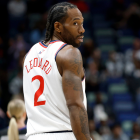
So here's where we now sit: if Indiana gets in the top four, it has not only set itself up to return to the championship picture next season, but to add a possible franchise player in the process. They could not ask for a better use of this lost, Tyrese Haliburton-less season. And if the pick lands between No. 5 and No. 9, the Clippers, in symbolically appropriate timing considering this year represents the final pick they are set to send Oklahoma City in the Paul George trade, gets access to exactly the sort of young talent it needs to rebuild after the Kawhi Leonard era ends in the near future.
At this moment, Indiana has a 52.1% chance at keeping the pick. The Clippers have a 47.9% chance of claiming it. It is, in effect, the highest stakes coin flip of the 2026 offseason. One of these teams is going to walk away from the deadline in reasonably good shape. The other is arguably its biggest winner.
Loser: Wizards
The Wizards clearly wanted to get better next season, when they no longer need to worry about owing a top-eight protected pick to the New York Knicks. That's a reasonable goal. Teams rarely want to waste more than three years in the tank. You could argue getting Trae Young was an appropriate step in that direction. Young is a well-known floor-raiser given his stellar pick-and-roll shot-creation. Having a veteran to keep the offense organized stood to benefit the younger players even if it cost them shots, and as Young has only one year left on his contract and cost no picks, the risk was minimal.
Had the Wizards moved forward just with Young, they still would have brought max cap space into the offseason. They could have used that to add multiple, younger free agents. They could have tried to use a front-loaded offer sheet to try to steal a restricted free agent (say, Peyton Watson in Denver, or Walker Kessler in Utah). They could have gotten picks to take on bad money. Cap space can be used in a variety of ways. There aren't many ways you can go wrong with it. One of them is bringing a soon-to-be 33-year-old with two supermax years left on his contract and literally hundreds of injuries on his résumé onto a team that's several years away from winning seriously in the playoffs.
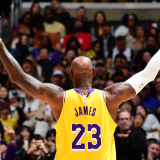
That's what Washington did with Anthony Davis. They'll pay him roughly $120 million over the next two years without having much of a clue about how often he'll be able to play for them. Even if he defies the odds and stays healthy, Washington has suddenly added two very high-usage players onto a young core that needs touches to develop. The Young-Davis pick-and-roll should be dangerous. I'm not sure how helpful watching it will be for Alex Sarr, Kyshawn George and Tre Johnson.
The Wizards spent years stuck in the middle. Wasn't the point of the 2023 teardown to prevent that from happening again? Now, if the Wizards land a top-three pick in the lottery, they might get someone so good none of this matters. But as it stands, it looks like they've added two former All-Stars whose best days are behind them to lead the way for a few years. By the time Sarr, George and Johnson are ready to win seriously, Davis at least will be past his prime, and Young will be such a defensive liability that he likely won't be worth a significant salary if those recent draft picks have developed enough to lead the offense. The basic idea of getting better next season wasn't crazy. Doing so in this manner is ultimately going to be counterproductive. There were a number of ways they could have used their cap flexibility to improve in both the present and the future. Instead they went for the older famous guy whose durability issues might prevent him from helping either timeline.
Winner: Celtics
In June, the Celtics were staring down the barrel of a half-billion dollar payroll. In the eight months or so since, they managed to go from far above the second apron to out of the luxury tax entirely, saving around $325 million in total payroll for this season. They did so without giving up a single first-round pick and they are currently tied for the No. 2 seed in the Eastern Conference, exactly where they finished last year, when, in addition to a bigger payroll, they also had a healthy Jayson Tatum.
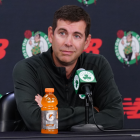
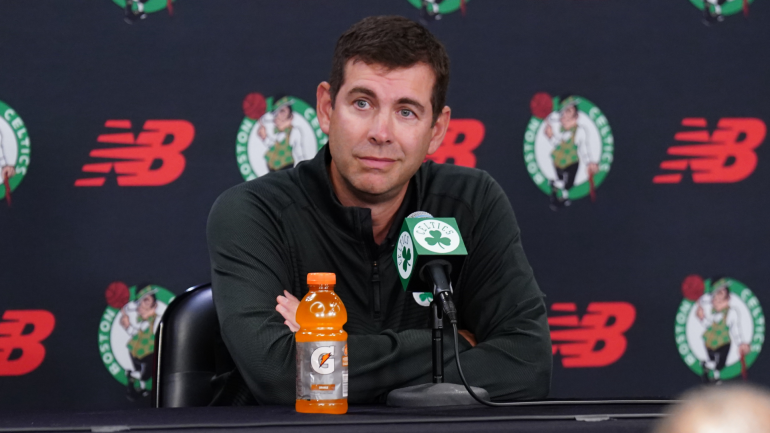
This is some of the most incredible cap work a front office has ever done. Now, you might not care if Bill Chisholm saves a bunch of money, but I assure you, it matters in the long run. The Celtics are a repeat taxpayer. That comes with incredibly punitive multipliers on their tax bill. If Tatum were healthy, the Celtics likely would have bit the bullet, kept last year's team together and figured it out later. But with him out, they had a golden opportunity. Ducking the tax this year and next year means that Boston resets its repeater clock entirely.
That means that between 2028 and 2030, the Celtics can effectively spend with impunity. They'll be taxpayers, of course, but they won't have to worry about to downright draconian rates the repeater tax imposes. This is notable because key 2026 discoveries Neemias Queta and Jordan Walsh are free agents after the 2026-27 season. If the Celtics stay below the tax line next year, they can re-sign both without fear of long-term consequences. Tatum and Jaylen Brown are still young enough to compete for championships for a long time. Boston's championship odds were always going to be at their lowest in the year Tatum mostly or entirely missed with a torn Achilles and his first full year back. Now they're positioned to maximize the years in their early 30s when both should be close to full strength.
Oh, and the cherry on top? They needed a center who could shoot and they got one in Nikola Vučević. He's past his prime at this point, but still an effective player who offers a nice stylistic shift compared to Queta at center. He'll help the Celtics this year. But the future is what really matters.
Loser: Kings
Did the Kings get a first-round pick for Domantas Sabonis? Sadly, no. Talks with the Raptors seemingly fizzled out over the inclusion of Jakob Poeltl's albatross contract. Did they get off of the last year of Zach LaVine's deal? Sadly, no. There had been some buzz that the Bucks were desperate enough to add him, but such a deal never materialized. Did they at least manage to trade away DeMar DeRozan, who has $10 million guaranteed next season? Come on, they're in the loser category, you know where this is going.
So what did the Kings do? Well, they used Keon Ellis, a valuable young guard that several contenders wanted, to dump Dennis Schröder's contract... which they themselves signed eight months ago. The irony to that is that they could have signed Ellis to a team-friendly long-term deal last summer, but instead set him up for unrestricted free agency by picking up his cheap team option because they needed the extra savings for Schröder. Great work.
All of this ends with the Kings taking in De'Andre Hunter, a player who's struggled enough this season that the win-now Cavaliers were eager to dump him. Doing so increased their payroll significantly next season, so now, the Kings, depending on where they draft, should expect to be more than $10 million above the luxury tax line. If they can't find a big trade over the summer, they might need to waive DeRozan and eat that $10 million guarantee just to duck the tax. And of course, if Hunter plays well for the Kings, he only helps them win games they should really be trying to lose with an incredible draft class incoming. There's no version of this trade that works out for Sacramento. As always, we're left completely bewildered by the Kings.
Winner: Timberwolves
Over the summer, the Timberwolves lost key reserve Nickeil Alexander-Walker because re-signing him would have taken them above the second apron. Minnesota perhaps could have cleared the room to keep him by dumping Mike Conley, but they elected to keep their veteran point guard, and now Alexander-Walker is having a breakout season in Atlanta. The Timberwolves haven't been able to replace him internally, so they did so externally.
Ayo Dosunmu shares many traits with Alexander-Walker. He's an athletic, defensive-minded guard whose jump shot came along later in his career, and like Alexander-Walker, he's spent most of his early career on uncompetitive teams. Now he gets to show what he can do on a winner. Minnesota traded Conley as part of the cap maneuvering to get Dosunmu... but here's the kicker: he's probably coming back. NBA rules prevent a player from rejoining a team that traded him if he is waived by his new team during that same league year. However, that rule only applies to the most recent team that traded for the player. Chicago got Conley, but then traded him again to Charlotte. This lifts Minnesota's reacquisition restriction, and sure enough, Conley has since been waived. The Timberwolves are getting their Alexander-Walker replacement without losing their beloved point guard.
All of this maneuvering did cost the Timberwolves former No. 8 pick Rob Dillingham. That stings. The Timberwolves played a monstrous premium to get that pick: a top-1 protected 2030 first-round swap as well as an unprotected 2031 first-round pick. But Dillingham had no path to consistent playing time in Minnesota, and just ask Golden State what happens when you hold onto a player like that for too long. The Wolves acted quickly enough to get value for Dillingham, and it puts them in a better position to compete this postseason.
Loser: Heat
The Heat are headed for their fourth straight Play-In Tournament. In that time, they have swung and missed on several possible star trades, most notably Damian Lillard, Kevin Durant and now, Giannis Antetokounmpo. They were a rumored suitor for Ja Morant at the deadline as a consolation prize, but couldn't seal that deal either. None of their recent draft picks have popped as genuine difference-makers like Bam Adebayo and Tyler Herro once did, and Kel'El Ware, the highest-upside youngster on the team, has recently seen his playing time fluctuate quite a bit. The revamped, Noah LaRoche-inspired offense has flopped after a hot start. Their vaunted culture was pierced last season by Jimmy Butler's ugly exit.
If this were any other team, we'd be saying it's time for the Heat to tear things down and rebuild. People make jokes about Chicago's annual Play-In loss to the Heat... but the Heat are also in those Play-In games. This is a team seemingly trapped in the middle, and we're just supposed to pretend that isn't a problem because they're the Heat, and they've dug themselves out of similar holes in the past.
Well, sooner or later they're going to have to actually take a swing. This roster doesn't have it, and there's no use hovering around .500 every year if you have no path to greater upside beyond hoping "maybe this is the year the No. 15 pick gives us another Adebayo." Maybe they don't need a teardown quite yet, but their failure to make any impact addition at this year's deadline should raise a red flag. One way or another, this era of Heat basketball should end soon.