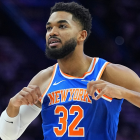


James Dolan is an easy target. He's long been the NBA's poster owner for the rich and obnoxious. The New York Knicks winning their first championship since 1973 bought him some grace, but now that Karl-Anthony Towns is being squeezed on his next contract extension, Dolan is back in the public crosshairs as the man seemingly intent on poking holes in a ship that has finally set sail.
Is that actually true? That's a matter of opinion, but I would argue no. Dolan is a lot of things, but he's never been cheap. Over the years, the Knicks have handed out as much stupid money as anyone. But since Leon Rose took over as team president in 2020, the Knicks have been one of the league's most well-run organizations, and Dolan has, at least from a personnel and staffing standpoint, mostly sat back and allowed that to happen.
He still does plenty of strange stuff. He just brought back Isiah Thomas, who was unceremoniously ousted from his positions as team president and coach following a disastrous on-court tenure and a sexual harassment suit that ultimately cost Dolan and MSG close to $12 million in punitive damages, to the organization as part of its newly formed board of directors.
He's been at war with Charles Oakley for going on a decade. He's reportedly turned Madison Square Garden into a sort of shadow surveillance center, as detailed by Wired magazine -- which noted earlier this year, among other bombshells, that "fans who've been critical of Dolan have had their faces captured and then put on watch lists."
But the idea that Dolan is suddenly ready, or even eager, to chop the legs out from beneath a championship roster for which he actually, finally, has gotten some credit just to put a few more million bucks in his pocket seems more based in reputation than reality.
Again, he's an easy target for this kind of criticism, and frankly, it's a twisted sort of fun to start pointing fingers at someone like Dolan. But the truth is likely much closer to what lords over every NBA franchise. It's called the second apron.
For the Knicks, this isn't just about Towns
If you're sick of hearing about the second apron, you're not alone. Most of us are sick of writing about it, too. But the simple truth is crossing this total team salary line -- set at $221 million this season -- is too punishing to mess with. Shortly after the Knicks won the title, Dolan went on local radio and stated unequivocally that New York would not be going past the second apron in its quest to keep this roster together. He deemed a second-apron breach, in fact, to be "suicidal" and, in a basketball sense, he wasn't far off.
The well-chronicled roster-building restrictions that come with crossing the second apron are severe. The Knicks are not alone in seeking to avoid it. Last season, only one team, the Cleveland Cavaliers (who the Knicks swept in the conference finals), operated above the second apron. The Boston Celtics traded Jaylen Brown to stay away from it in future seasons, because you have to get years ahead of this, as you do with roster construction in general.
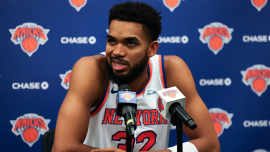
In the case of the Knicks, this isn't just about Towns, who is eligible to sign a four-year extension worth up to $276 million, but is, per multiple reports, only being offered around $200 million at the moment. That's quite a haircut the Knicks are asking Towns to take after he just helped carry the team to a title. And indeed, Towns, entering the final guaranteed year of his deal, said on Monday that the chances of an extension getting done before the start of the season "don't look good," but it doesn't mean they don't properly value Towns. It just means they also value Josh Hart, and to a lesser degree, Miles McBride.
Hart has a $22.3 million team option next season. Let's say the Knicks, who right now stand to have roughly $93 million in room below the second apron, exercise that option, and Towns, unable to reach an extension, does the same with his $61 million player option for 2027-28. That would leave the Knicks with about $10 million in space below the second apron with four players to fill out the roster and McBride, whose rookie deal expires after this year, still unsigned.
You can see the squeeze, and that's before things get really tough in 2028. That's when Jalen Brunson, who has already taken his discount, and OG Anunoby will be due for new contracts. Mikal Bridges the year after that. If the Knicks pay Towns what he wants, what he has earned, the only way they'll be able to make good on their second-apron cutoff, eventually, is to short, or even entirely discard, someone else.
Who's it going to be? Don't bet on Towns. If this extension isn't done by Oct. 19 (and Fred Katz of The Athletic has laid out why it should), it will get done at some point. Towns has become an irreplaceable player. His stretch shooting and high-hub playmaking unlocked New York's postseason offense. He was arguably New York's best player during that championship run, all things considered, and right now he might be Victor Wembanyama's chief nemesis.
How long can the Knicks keep their title core together?
Towns will likely give New York a discount, as Brunson did on his current contract, but it sounds like New York is going to have to increase its offer. Every bit they come up is likely money off Hart's next deal, and every dollar Hart gets could be a dollar McBride loses. Hart, given his age and lack of shooting, could end up being the odd man out, but the safe bet would still be that he works something out after Towns is settled with McBride as the likeliest casualty.
There's a reason why the Knicks brought in Ochai Agbaji, Bruce Brown and John Konchar for training camp. They are all wings in competition for the last roster spot (along with James Wiseman and Drew Eubanks). Last season, they landed Landry Shamet by way of a training camp battle and he played a real role in the championship.
But more than helping out this year, one of these guys could be a replacement for McBride if the Knicks try to get ahead of this and trade him before the deadline; the Knicks having to fold on McBride feels a lot like the Oklahoma City Thunder parting with Lu Dort, Aaron Wiggins and Isaiah Joe this summer in preparation for the paydays they have coming for the likes of Ajay Mitchell and Cason Wallace. Oklahoma City won a title in 2025, identified its core, and had to cut a few pieces of fat to keep it intact.
All of this is on the table in New York, but it's hard to figure out where and how to shuffle the plates around to make sure everyone eats as well as possible until Towns is fed. Again, that's going to get done. It would be an absolute shock if it didn't. But the Knicks not throwing the full $277 million at him (or whatever number Towns would be happy with) isn't Dolan cheaping out, as easy as that story is to sell.
It's just the reality of this second-apron era. Even championships don't guarantee max contracts.
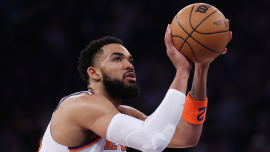
Also consider that if Towns waives his 2027-28 player option and begins his eventual four-year extension next season, he'll be 35 by the end of that deal and making north of $50 million per year. That's dicey. An NBA contract is supposed to be about future performance. As crass as it sounds, Towns may have just played the best basketball of his life. He may never reach that level again. Paying guys this kind of money on the merits of past production is a recipe for regret when they're on the wrong side of 30.
The Donovan Mitchell extension is a good example. He's great. He's likely going to be great for at least a few more years. But there's a chance the last few years of that deal look pretty bad. Towns doesn't have the injury concerns of Joel Embiid or Paul George, but those guys were All-NBA players once, too. Now they're merely being paid as such. Brunson and Anunoby will also both be well into their 30s in the middle of their next deals.
These are good problems to have, of course. We're talking about keeping a championship core intact. This isn't the Cavs last year pumping out second-apron cash for a non-championship team. The Knicks, at the very least, are going to have the chance to take a swing at a second championship this season with everyone back except Mitchell Robinson. And chances are, they'll figure it out for the years after, too. But it's not easy. Sacrifices are a part of every championship formula, both on and off the court, and that has never been truer than in today's financial climate. Towns is simply feeling how cold this business has been forced to get.