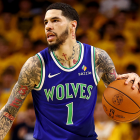


In late June, the Oklahoma City Thunder re-signed Isaiah Hartenstein to a three-year, $75 million contract. On the surface, it was a pretty standard deal for a high-end starting center -- until you looked at the fine print. Included was a mutual option for the 2028-29 season, the final year of the deal. ESPN's Bobby Marks told Jake Fischer that it was the first mutual option he could remember in a contract since the Toronto Raptors gave Jerome Williams one in 2001. In fact, according to Fischer, several teams didn't even know such options were possible.
And yet, as he so often has, Thunder general manager Sam Presti has once again become a roster-building trailblazer. We've seen five mutual options come since Hartenstein's, and they land all across the contractual spectrum:
- Keon Ellis has a mutual option for the 2027-28 season on his two-year, $18 million deal with the Brooklyn Nets.
- Moe Wagner has a mutual option for the 2027-28 season on his two-year, $18.5 million deal with the Nets.
- Pelle Larsson has a mutual option for the 2030-31 season on his four-year, $60 million deal with the Miami Heat.
- Brandin Podziemski has a mutual option for the 2031-32 season on his five-year, $110 million deal with the Golden State Warriors.
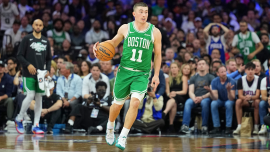
- Payton Pritchard has a mutual option for the 2029-30 season on his two-year, $44 million extension with the Boston Celtics.
In the span of a single offseason, we have gone from 25 years without mutual options to mutual options becoming a burgeoning industry standard. So how did that happen? How do these options work? And could they become an antidote to the daunting luxury tax aprons that have so dominated roster-building discourse over the past several years? Let's dig into the NBA's newest contractual trend.
How do mutual options work? When should they be used?
A typical option gives one party the power to decide whether to continue the contract into its final year. A player option allows the player to decide whether to stay with the team at his predetermined salary or become a free agent, while a team option gives that power to the team. Pretty straightforward.
In the case of a mutual option, either party can unilaterally decide whether to continue the contract. If the player feels he cannot get a better deal in free agency, he can elect to stay and the team cannot object. But if the team feels the player is a bargain on his option number, it can elect to keep him at that figure regardless of how the player feels. The player only becomes a free agent if both sides elect to make him one.
There are two pretty clear use cases for mutual options. The first is when a team and a player are simply sick of each other and want a separation that a trade, for whatever reason, cannot offer. Expect such uses of mutual options to be rarer. More often, they will be a tool for collaboration rather than separation. When both sides want to continue their relationship, these options allow them to renegotiate on terms that make sense for both sides, with the security of knowing that if a mutually beneficial arrangement cannot be found, either side can simply elect to keep their existing deal intact.
Most lower-level contracts today include team options simply because teams have the leverage to negotiate more favorable terms with less accomplished players. Teams with enough financial flexibility can also essentially buy team options from players they're negotiating with by offering more money up front. On the other end of the spectrum, many superstar contracts (or... well... Lakers contracts) include player options for the opposite reason. Stars have the leverage to demand player options because they know their teams won't risk upsetting them by denying them. Occasionally, there's also a give-and-take in which a player can buy a player option by leaving a bit of money on the table.
But you could theoretically argue that every middle-class contract would be better served ending in a mutual option rather than a standard, guaranteed season. Why wouldn't both sides want the flexibility to renegotiate while knowing they wouldn't have to do so? The only downside, which is far outweighed by the benefits, would be the risk of damaging your relationship with a player by refusing to renegotiate if and when he wants to. A standard guaranteed season offers plausible deniability to teams in those situations. We'd love to pay you more now, but our hands are tied by the CBA, so we'll have to wait until next year.
Again, the benefits outweigh that specific risk. There's a reason these options are becoming so popular. In fact, they might be the most powerful weapon front offices have yet created to combat the aprons.
Can mutual options be an apron antidote?
NBA contracts are extremely rigid. They're unlike NFL contracts, in which players and teams can renegotiate at nearly any time. If a player has a guaranteed option-free year on his contract, there is nothing he can do to change his salary unless his team has the cap space to renegotiate and extend him. When he wants to extend, there are specific terms in the CBA dictating how much he is allowed to make in that extension. Free agency, if only in name, is the only real path to genuine flexibility for players and teams.
The aprons are similarly rigid. The number is set at the beginning of the league year. If you trigger a hard cap, you are not allowed to exceed it for any reason. Even without a hard cap, finishing the season one dollar above the second apron still freezes a first-round pick just as finishing tens of millions of dollars above the line would. These numbers are fixed. Mutual options make it so a player's cap figure underneath those fixed aprons don't need to be.
Take the Hartenstein example. The Thunder entered this offseason roughly $40 million above the second apron. Hartenstein had a team option, and he used it to lower his 2026-27 salary by around $5.4 million. The Thunder currently are around $6.9 million below the second apron. Essentially, Hartenstein gave the Thunder extra wiggle room, but in exchange, he got two more years of long-term security.
Let's apply this framework to his mutual option two summers from now. By that point, the Thunder will be paying most of their key players market-rate salaries. Cason Wallace and Jared McCain will no longer be on rookie contracts. Either Ajay Mitchell's cheap extension will have ended or he will have signed a new deal through his 2027-28 team option by then. Shai Gilgeous-Alexander's supermax contract will have kicked in, and Chet Holmgren and Jalen Williams will be in the middle of their own 25% max contracts.
Hard decisions are coming for Oklahoma City at that point. Inevitably, players will be moved and the Thunder will almost certainly be above the second apron by then. Yet they still might want to keep Hartenstein, and Hartenstein seems as though he'd prefer to keep playing for the Thunder. Having the mutual option allows both sides to get what they need. The Thunder could lower Hartenstein's immediate cap hit early in order to ease their luxury tax and apron burdens. Hartenstein could give himself more years of long-term security. And if the two sides are far apart on negotiations? Either one could simply decide, "let's stick with what we have and try again in a year."
You can apply this framework to virtually any notable salary cap threshold. A team is $5 million above the second apron, but has a mutual option on a player it wants to keep long-term? Great. Take the $5 million pay cut, get below the second apron and tack a few years onto the back end of the contract. A team needs cap space to sign a marquee free agent? Same idea.
We could even apply this principle in reverse. Say a team knows it has immediate flexibility, but is worried about its future. It could use a mutual option to give a player a raise... but then have his salary decline in future years or carry a team option when one is needed. If a team hopes to keep a budding star or key supporting piece ahead of an impending free agency, a mutual option offers access to contract structures that extensions may not.
Take the Deni Avdija situation in Portland. His cap figure is so low that he's virtually impossible to extend without generating the cap space needed to renegotiate. If he had a mutual option, Portland could simply agree to new terms with him (that would likely be below his fair-market value, but far above what he would otherwise make), and then use the option to make a free agent. With full Bird Rights, they'd effectively be side-stepping the league's strict rules on how much a player is allowed to make in an extension.
Mutual options represent largely risk-free flexibility in both a league that has always minimized flexibility and an era in which maximizing it is paramount. That's why these options are getting more popular. The potential rewards simply outweigh the plausible risks.
When shouldn't mutual options be used?
As a matter of course, players should always seek player options when they have the flexibility to do so, while teams should do the same under the same circumstances. Every contract negotiation is unique. These options will inevitably be a compromise.
That means that teams should only really use them when they need to compromise. Ironically, the team most questionable in using mutual options this offseason is the only one to give out more than one. The Nets were the first team to follow Oklahoma City's lead by offering mutual options to both Moe Wagner and Keon Ellis. The difference is in their respective cap situations. The Thunder have the NBA's best roster and a cap sheet that reflects it. The Nets entered the offseason with max cap space.
While we can't say anything definitively, the implication of having that space is that they could have simply used it to buy team options. They're paying both Ellis and Wagner $9 million this season. They had the flexibility to go up to, say, $11-12 million in exchange for more favorable second-year terms, but elected not to do so. Considering their cap flexibility, the Nets simply wouldn't have had trouble re-signing either of those players even if they'd signed them to one-year deals. They took on the risk of getting stuck with bad money without an obvious reward.
This is still such a new tool that Brooklyn might become something of a test case for the field. Maybe in a year, those mutual options make sense for reasons we can't currently predict and other cap space teams use them similarly. Maybe they become a cautionary tale. We're in mostly uncharted waters here, and how this first batch of mutual options works out will go a long way toward informing how the rest of the league wields them moving forward.