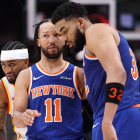


The New York Knicks are your 2025-26 NBA champions. I'll say it again, because I'm sure we're all very much still getting used to the way that sounds: the New York Knicks are your 2025-26 NBA champions. The 53-year drought is over. The streets of New York are flooding with tears of joy. The team Leon Rose has spent the past six years building has officially reached the mountaintop.
And now that it has, we can put to rest any rumors that he might try to drastically alter it. After a year of Giannis Antetokounmpo rumors, that story can officially die. The Knicks don't need to rock the boat with a blockbuster trade. They have everything they need to defend their title. The name of the game here will be retention.
Predictably for a veteran team that just won a championship, the Knicks are expensive. They are only going to get more expensive in the years to come. So let's take a closer look at their finances and their free agents and figure out just how much of this team they'll be able to run back both next season and beyond. To do that, we're going to have to go back a few years and cover how the Knicks built this roster.
Jalen Brunson's discount and the four-year plan
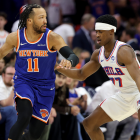
This version of the New York Knicks was born out of cap space. The Knicks carved out enough of it to sign an ascending backup point guard named Jalen Brunson to a four-year, $104 million contract in the summer of 2022. That contract will go down as one of the greatest signed in the history of free agency for a multitude of reasons. It led the Knicks to a championship and gave them perhaps the most important player in their franchise's history. But its structure also set the Knicks up to build the team they have now.
Most contracts start at their lowest possible point and increase annually. Brunson's was structured in reverse. It started at $27.7 million and descended annually from there. For the 2024-25 season, last year, he earned just under $25 million. This critical detail matters because most contract extensions are limited by the amount the player made on his previous contract. Brunson, as a standard, veteran extension candidate, could earn only a 40% raise on his previous salary starting in the 2025-26 season, which was an option year.
This is where Brunson's famous discount comes into play. Had Brunson merely waited a year to decline his 2025-26 player option and become a free agent, he could have re-signed for five years on a standard max deal that, at the time, projected to come in at around $269 million. Instead, he took the 40% raise to extend a year early on a four-year, $156.5 million contract. In practical terms, the discount was closer to $37 million over a three-year span than the much bandied about $113 million figure, but it was still vital for what came next.
Just before training camp, the Knicks traded for Karl-Anthony Towns. While Brunson's salary was already set for the 2024-25 season before the extension, locking him in below market value afterward gave the Knicks the latitude to acquire Towns while staying below the second apron for the 2025-26 season.
This means quite a bit because, while the second apron does impose immediate, roster-building restrictions, its worst effects are felt once a team has spent two years above the line. If it spends a third year there within a five-year span, a future first-round pick (seven years after the initial crossing of the threshold) drops to No. 30 in the first round. The longer you spend above the line, the more picks drop. This creates a bit of a Hokey Pokey situation for teams and the second apron. You put your right foot in for two years, but you'd better take your left foot by the third. Thus far, no team has proven willing to drop a future pick to No. 30.
Had Brunson not given the Knicks that discount, they might not have felt comfortable acquiring Towns. Doing so would have made them so expensive in the 2025-26 season that the apron-induced restrictions might have locked them into a roster they weren't yet sure was championship-caliber. Remember, the Knicks did have at least exploratory talks with the Bucks for Antetokounmpo last offseason.
Being below the second apron this season gave them critical flexibility to make even smaller moves last offseason. Remember, even though he's no longer on the team, the Knicks did use the taxpayer mid-level exception to sign Guerschon Yabusele last summer. That wouldn't have been legal above the second apron, and the signing was necessary because Yabusele was eventually traded for Dalen Terry, who was quickly turned into the matching salary traded for Jose Alvarado, a Finals hero. Had the Knicks been above the second apron, they wouldn't have had Yabusele to trade, and they also would not legally have been allowed to aggregate salary. That would have functionally prevented them from getting Alvarado.
So Brunson's discount facilitated most of what followed over the next two years. The Knicks were able to delay the second-apron clock by a year, and that flexibility is a big part of what made this championship possible. But the clock is probably going to start next season. We'll get into the nitty-gritty shortly. For now, let's focus on the endpoint.
Remember the two-year Hokey Pokey? Well, there's a reason the Knicks were more comfortable starting the clock in the 2026-27 season: the contracts of both Towns and Josh Hart are set to expire by the summer of 2028, turning the 2028-29 season into a possible pivot point for this roster. The Knicks acquired Towns in 2025 probably expecting to stay below the second apron for his first two years in New York, go above it in his next two, and then, in some way or another, duck back below it after his fourth Knicks season and potentially reset the roster and the books thereafter.
Had they needed flexibility to pursue Antetokounmpo this summer, they might have tried delaying the second-apron clock one extra year. Now that that's presumably off the table, it seems likely that the Knicks just go above the line and try to keep this team together. How doable is that?
New York's finances this summer and beyond
At this moment, the Knicks have eight players under contract for next season: Brunson, Towns, Hart, OG Anunoby, Mikal Bridges, Deuce McBride, Tyler Kolek and Pacôme Dadiet. They have the No. 24 overall pick in the NBA Draft, and Alvarado has a $4.5 million player option that we'll discuss more shortly. So all told, that's 10 players with either guaranteed contracts or cap figures we need to keep in mind.
With all of them accounted for, the Knicks have just under $209 million in salary obligations on their books. That leaves them with roughly $13 million in room below the projected second apron. Could they conceivably duck the second apron again? Yes. Signing four veteran-minimum salaries, or three while using the taxpayer mid-level exception, could do so.
But you'll notice we didn't cover several important bench players from the championship roster. The two most notable are Mitchell Robinson and Landry Shamet. We'll get into their specific situations momentarily. For now, the assumption should be that in order to keep this team together, the Knicks will go above the second apron to keep most of this team together.
We've covered the second apron and the likelihood that the Knicks will try to get back beneath the line in time for the 2028-29 season, but there are other anti-spending mechanisms we need to address as well. Those would be the luxury tax, and more importantly, the dreaded repeater penalty.
James Dolan has historically proven very willing to pay what it takes to win. Put aside players for a moment. How many coaches has he fired with multiple years left on their contracts? This season will mark the 12th total time Dolan has paid the luxury tax since its institution in the 2002-03 season. Notably, though, more than half of those payments came before the formula was altered into its more punitive form in the 2011 CBA. The Knicks are projected to owe roughly $45 million in luxury taxes for this season, according to Spotrac. That would be the highest bill Dolan has ever paid... and the numbers are about to get much higher.
The 2023 CBA altered the luxury tax formula yet again. It did so in ways that were friendly to teams only slightly going above the line... but much, much harsher to teams who bolt far beyond it. We can't project exactly what New York's payment would be without knowing exactly how much they're paying their bench, but just to put this into perspective: a non-repeat payer going exactly up to the second apron line, based on the currently projected tax brackets, would owe around $49 million in taxes. Keeping everyone would take the Knicks far above the second apron, and their tax bill would therefore be substantially higher. The deeper into the tax you go, the costlier each tax bracket becomes.
And here's the scariest part... the Knicks aren't even a repeat-payer yet. If a team has paid the tax in three of the previous four seasons, it is subject to the repeater penalty. This is why you'll so frequently hear about teams, most notably Boston this season, "resetting the repeater clock," because if you can duck the line for two seasons, you start that entire clock over again.
This was the second season of this era in which the Knicks paid the luxury tax. Therefore, assuming they stay above the tax line, they will pay the repeater penalty starting in the 2027-28 season. That means they'll hopefully be able to keep the bulk of this year's roster together for next season's title defense, but things get even more expensive after that.
Again, Dolan has been as willing to spend as almost any owner in the NBA. The Knicks are an enormously high-revenue team, and they literally have a championship roster. If ever there was a team suited to paying big tax bills, it would be this one. But Dolan is also not Steve Ballmer. His wealth is not limitless, and the current CBA was designed to break up teams like the Knicks. There will be teams in the years to come who are annually faced with multi-hundred million dollar tax bills if they want to keep their rosters together.
In other words... a line is probably going to be drawn somewhere. Don't be surprised if there is a loss or two somewhere this summer, and those losses are probably going to mount as time passes. No team is eternal anymore. For now, though, let's focus on this summer's possible free agents.
Retaining free agents
The most notable New York free agent is backup center Mitchell Robinson. The Knicks have full Bird Rights. They can pay him anything up to the max in order to keep him. He is the longest-tenured player on the team. The basketball circumstances are perfect for him. He's not durable enough to play a standard starter's workload. Coming off of the bench makes sense for him.
But he was underpaid on his last deal, and the NBA is a business. He will have interest from several teams at the mid-level exception, and unfortunately, two of the three likely cap space teams, the Lakers and Bulls, need a center. It is entirely possible that someone pays him starter money, and even if he shouldn't be starting for the sake of managing his workload, he's a starting-caliber player when he's on the court and he deserves a payday.
Robinson is unlikely to take a hometown discount, but he's the least replaceable New York free agent. If Shamet goes, the Knicks still have McBride. If Alvarado opts out, Tyler Kolek is ready for a bigger role. But Ariel Hukporti is not ready to do what Robinson does, and the Knicks would have no mechanism to pay a similar player. Expect Robinson to be a priority for the Knicks, but watch out for what they do at No. 24. If they draft a big man, it might be because they're afraid someone is going to outbid them for Robinson's services.
Still, his situation is the simplest. He's just an unrestricted free agent with full Bird Rights. Things start to get more complicated with Shamet, who only has Early Bird Rights. Cap-savy Knicks fans hear those words and get a flash of PTSD over the loss of Isaiah Hartenstein, but there's little reason to fear on that front. The situations aren't all that analogous. Early Bird Rights allow a team to pay a player up to 105% of the average player's salary in the first year of a deal. However, if a team goes above that price point, the Knicks would have no mechanism for matching the offer. They're limited by those rights. That's how they lost Hartenstein.
That is fortunately unlikely in Shamet's case. One of the cap space teams would have to value him at above the mid-level exception. That just seems unlikely for a 29-year-old who played around 16 minutes per game in the playoffs. He is a spectacular reserve. He'd probably be overburdened in a starter's role, so I wouldn't expect the Lakers, Bulls or Nets to blow him away with their cap space. If the Knicks want to keep Shamet, doing so is probably doable.
Alvarado's $4.5 million player option is another step up in terms of complexity. He is worth more than $4.5 million. A strategy the Knicks have taken in the past -- most notably with Josh Hart -- is to have a player with a player option opt in, and then extend on top of that figure to keep the present cost down. If the Knicks are worried about the 2026-27 tax bill, this would be an option. Note that Alvarado is represented by CAA, Rose's former agency. New York likely has some inkling of what his contract demands will be. Starting in late September, he is eligible for a four-year extension worth up to around $94 million, though his next deal will come in well below that figure.
However, as we just addressed, the Knicks have Kolek in the building. He acquitted himself reasonably well before Alvarado's arrival, most notably helping the Knicks win the NBA Cup over their eventual Finals opponent from San Antonio. If Alvarado wants to test free agency, or if the two sides are just far apart on an extension, Kolek is a viable, in-house replacement. If they do this, don't be surprised if they try to lock Kolek into a multi-year extension over the summer. When they traded Immanuel Quickley for OG Anunoby, they immediately extended McBride because they knew his role was about to expand. That turned into one of the best contracts in the NBA, so a similar strategy with Kolek could give them cost-certainty at backup point guard.
And then we have Mohamed Diawara. It is not an exaggeration to call this one of the single most complicated contractual situations I have ever encountered in my time covering the NBA salary cap. I highly encourage any cap nerds among you to read Jonas Plaut's excellent breakdown on the nearly one-of-a-kind interaction Diawara has created between the Non-Bird exception, the Gilbert Arenas Provision and the second apron. I'll keep my explanation brief: the Knicks are in danger of losing Diawara.
Diawara is a restricted free agent. Teams retain the right to match offer sheets their restricted free agents sign with other teams. However... they have to be able to actually pay for the contract they're matching. As Diawara was only a rookie this season, he has only been on the Knicks for one year. That means they only have Non-Bird Rights on him, and therefore the right to give him only a 20% raise. They could theoretically use the taxpayer mid-level exception to pay him more, but doing so would create a second apron hard cap. With Robinson, Shamet and Alvarado not yet settled, the Knicks probably aren't eager to do that.
Diawara showed real promise in a decently-sized bench role down the stretch. He didn't play in the playoffs, but he's a big, defensive-minded wing who made almost 37% of an admittedly small sample of 3-pointers (130 attempts for the season). Those are developmental players you want to keep, especially if the Knicks are at all worried about the repeater tax eventually forcing them to give up one of their starting wings.
But the reality here is that unless the Knicks are willing to make major sacrifices elsewhere, their best chance at keeping him is going to come down to his willingness to take a minimum-salary contract. If someone else offers him real money, the Knicks may simply lose him. If they deal with that second-apron hard cap to pay him much more than the minimum, it probably means Robinson and/or Shamet are gone and the Knicks have elected to both delay their second apron clock and go younger on their bench.
Those are the four notable possible free agents here. If the Knicks keep all of them, they'll have 13 players under contract. We'd have then a pretty straightforward option for their 14th roster slot: the No. 31 overall pick, which the Knicks acquired from Washington. New York also has the No. 55 pick, but that will probably go to a two-way player. If the Knicks want to keep another of their free agents like Jordan Clarkson or perhaps sign a minimum player externally, a Dadiet trade could clear out some money to do so. If they lose any of these notable players, they'll have to go into free agency to replace them.
Extensions to watch
Remember that four-year plan we covered above? With a championship now in hand, there's going to be pressure to reconsider components of it. New York's path out of the second apron for the 2028-29 season started with the expiration of the Towns and Hart contracts. Well, they were both just essential parts of a championship team, and they'll both be eligible for contract extensions.
Towns is up first. He is guaranteed $57 million next season, and he has a player option for $61 million a year after. He is eligible to tack three years and $208 million on top of those two years, or to decline his 2027-28 option and sign for $272 million over four years. Realistically, though, it's hard to imagine the Knicks being too eager to extend him at the supermax even after the postseason he just had. He'll turn 31 early next season, and as we covered, the Knicks are headed for repeater tax and second apron hell.
His former Minnesota teammate, Rudy Gobert, might be the model for the Knicks to follow here. He opted out of the last year of his max deal with the Timberwolves, which would have paid him $46.6 million in the 2025-26 season, to instead re-sign for $110 million over three years. He got extra long-term security, but lowered his cap hit to help the Wolves navigate the tax and aprons. Towns is better than Gobert, but that principle could apply here. Rather than opting into the final year of his deal at around 35% of the cap, he could decline that option and extend for multiple years at something closer to, say, 26-28% of the cap. That's probably the fair middle ground as he gets older, and every dollar counts with the aprons and repeater tax.
Hart makes far less than Towns, and he'll be eligible for a much lower extension: $131 million over four years. He's not coming close to that figure. The Knicks have a bit more leverage in Hart's case because he has a team option for the 2027-28 season whereas Towns has a player option. Nonetheless, this could potentially be a messy negotiation.
Hart is perhaps the most popular Knick not named Jalen Brunson. He is the totem of their identity. But he's 31 and plays such a physical style that he may not age especially well. The two other starting wings are higher priorities, and the Knicks showed us at various critical stages of this postseason how dangerous they are when they play with a shooter in Hart's place. Of the five starters, if one does wind up eventually becoming an apron casualty, Hart would be my guess. The Knicks have two years to figure his situation out, though, so if he's open to coming back on something very team-friendly, maybe there's a deal to be made here.
Looming over Hart's situation is Deuce McBride, who is headed into the final year of his comically cheap three-year, $13 million contract. He's not even 26 yet, and his shooting and point of attack defense make him a viable starter if the Knicks do plan to eventually move on from Hart, though he and Brunson would be a tiny backcourt. He can extend for four years at anything up to 140% of the NBA's estimated average salary, but something in the $12-14 million range annually is probably appropriate. That's a bit less than Nickeil Alexander-Walker just got as a high-end bench guard before his Most Improved Player run, but he was a free agent whereas McBride would be extending.
Getting these contracts right is going to be very important moving forward, because the bill is coming due on two players they've thus far underpaid. Part of the reason the Knicks paid five first-round picks for Mikal Bridges was how underpaid he was on the rookie extension he signed in Phoenix. Well, his four-year, $150 million extension kicks in next season.
And that takes us back to the player who started all of this: Brunson. He is still a year away from extension-eligibility, but next summer, he will be eligible for a projected four-year, $257 million extension. If he waits for 2028 free agency, it could get as high as five years and $417 million. He did the Knicks an enormous favor by taking that discount two years ago. Now, it seems like he expects to be rewarded for that.
"Obviously we'd love for them to do right by me," Brunson told Vanity Fair in February. "I think anyone would. I feel like I sacrificed." Considering his godfather runs the team, it feels safe to assume that he will be made whole when his next contract arrives.
What does all of this mean moving forward?
The Knicks have the capability to run back all or at least most of their team for next season's title defense. Doing so will almost certainly take them above the second apron. That always seemed like the plan. If they duck the second apron, it probably means they're going younger on the bench with Diawara returning in a bigger role and Robinson and/or Shamet leaving.
Starting in the 2027-28 season, when the repeater penalty kicks in, you should probably expect the CBA to start chipping away at New York's depth. It's possible that by then, a few key pieces, maybe even a starter, are moved for financial reasons.
Now that the Knicks have a championship under their belt, they may ultimately elect to remain above the second apron for the 2028-29 season. Doing so would push their 2034 first-round pick to No. 30, assuming they stay above it for the next two years as well, but this is a golden era in team history. Maybe keeping this team together past its potential expiration date is worth that. How the next two seasons go will probably inform New York's willingness to do this. There will also be the question of what sort of hometown discount any of the players here are willing to give the team for the sake of keeping the band together. Only time will tell if the players are open to that idea.
Leon Rose did the hard part. He built a championship team. If he hadn't done so, we'd be asking much bigger questions about whether or not this roster was even worth preserving. But the aprons and the tax are going to take a toll eventually, so this summer will be about navigating through that minefield and keeping as much of this group together as possible.