Five increasingly ridiculous trade solutions for Warriors' Jimmy Butler problem
What can the Warriors do after Jimmy Butler's torn ACL? We have some ideas, from the achievable to the absurd

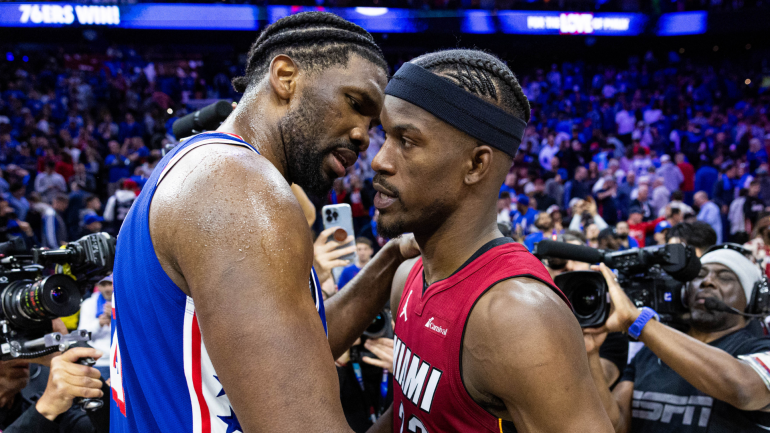
The Golden State Warriors have a Jimmy Butler problem. It's not his fault. Injuries happen. A torn ACL is little more than rotten luck. Butler's knee bent at an unnatural angle and now Golden State's season (and really, the next handful of seasons) is suddenly on the brink of collapse. In the Warriors' first full game without Butler, they lost by 18 at home to the Raptors on Tuesday as Toronto scored 145 points.
Even with Butler, the Warriors were the No. 8 seed in the Western Conference. They weren't championship contenders. Now they'll attempt to navigate life without their second-best player. That's $54.1 million in salary on this year's books going unused, with a good chunk of next year's $56.8 million going to waste as well.
Do nothing and the competitive portion of the Stephen Curry era is effectively over. Do something small and you're basically just shuffling deck chairs. It's going to take something seismic to get the Warriors back on course. So let's explore the trade market. Below, we'll concoct five mock trades to help the Warriors address their Butler problem.
These trades are not necessarily going to be realistic. That's sort of the reality of trading super max contracts. Doing so almost always takes creativity. We're going to be applying a lot of it. We'll start slow, with somewhat plausible maneuvers. But with each trade, we're going to dial the ridiculousness scale up a level. By the end, we'll be so far off the deep end you'll forget where we started. Now enjoy the most irresponsible half-hour I've ever spent on the trade machine.
Trade 1: Butler to for Zach LaVine
- Warriors receive: Zach LaVine, Dario Šarić
- Kings receive: Jimmy Butler, 2030 second-round pick
This is about as straightforward as a Butler trade gets. Golden State receives a player who is worse than Butler, but still valuable in LaVine. Sacramento receives a token draft asset in that second round pick, but really, just hastens its teardown by giving away a healthy player for an injured one, thus helping the Kings tank. Butler almost certainly wouldn't play a game for the Kings, either getting flipped or bought out down the line. Šarić is just here to help make the money work. Butler and LaVine both become free agents in 2027, so there's no long-term financial issue on either side.
There are a number of more interesting constructions you could build with Sacramento. The Kings want Jonathan Kuminga? Great. He can go to Sacramento in exchange for more matching salary (let's say Malik Monk, though he overlaps with LaVine and some incumbent Warriors in terms of skill set) and valuable younger 3-and-D guard Keon Ellis. Would Golden State have any interest in Domantas Sabonis? Take Monk out, add some draft picks and more salary on the Golden State side (let's say Buddy Hield and Moses Moody) and baby we've got a stew going.
Golden State and Sacramento are fairly customizable fake trade partners. Their salaries and needs can overlap in several ways at this point, so there are a variety of potential deals between them. Butler for LaVine is just the simplest. Would LaVine really address Golden State's needs? Probably not. The last thing they need is another small shooting guard. But he's a healthy, useful player. Butler, at the moment, is not. Better to have the wrong sort of player than no player at all, at least if that wrong player is good. It's rare to say that a Kings trade is the sanest in a set, but that's where we are.
Trade 2: Butler for Anthony Davis
- Warriors receive: Anthony Davis, Klay Thompson, Jaden Hardy, Naji Marshall
- Mavericks receive: Jimmy Butler, Jonathan Kuminga, Buddy Hield, lottery-protected 2026 first-round pick
Now we're talking. Golden State had been linked to Davis in the past, but matching salary was the major obstacle. Now that Butler is out, that obstacle has been cleared. Though not helpful for Golden State, Dallas would benefit from turning a hefty three-year contract in Davis into a hefty two-year contract for Butler. The real question is figuring out everything else in the deal.
The value for Dallas would be Kuminga and that lottery-protected first-round pick. Not exactly Luka Dončić, but not bad in light of the wrist injury that almost ended his season and the expensive contract extension Davis reportedly wants. Meanwhile, the Mavericks probably wouldn't mind getting off of Thompson as they pivot towards youth. The Warriors could use him as a PR stunt more than anything, especially with Davis still slated to be out until at least March. If Dwyane Wade and Miami could mend fences and reunite, why couldn't Thompson and the Warriors?
Would Davis fix Golden State? Probably not, just given his own health concerns. But the cost here would be pretty minimal. Kuminga is headed out one way or another, and the lottery protection mitigates the damage that first-round pick could do. The Warriors wouldn't be encumbering themselves deep into the future with this deal, just giving away what would probably be a pick in the middle of the first round over the next few years (we'll have the pick roll over and retain the protection until it conveys, much like the lottery-protected pick Portland traded to Chicago all the way back in 2021). Nabbing Marshall as a big-wing defender to replace Butler would just be the icing on the cake.
Trade 3: Butler for Anthony Davis... and LeBron James
- Warriors receive: Anthony Davis, LeBron James, Bronny James, Dwight Powell
- Lakers receive: Jimmy Butler, Will Richard, 2028 first-round pick (via Warriors)
- Mavericks receive: Draymond Green, Jonathan Kuminga, Buddy Hield, 2026 first-round pick (via Warriors)
I promised you weird trades, didn't I? We've covered Davis to Golden State. The package for Dallas would be similar, albeit with Green coming in the deal in place of Butler. That should suit Dallas just fine. He'd help them compete next season. The questions emerge on the Lakers' side of the trade.
Los Angeles wouldn't just need value for James. Frankly, no 41-year-old making more than $50 million has that much of it. No, that 2028 first-round pick is really payment for renting out their cap space in the summer of 2026. As it stands, the Lakers are slated for max cap space in 2026. Make this trade and instead, they get max cap space in the summer of 2027. There's a world in which that's their preference anyway. If they can get another valuable asset they can flip in a future trade, that delay might be worthwhile. They might even be able to use Butler as an expiring contract as they pursue a star this offseason. With this trade, they'd have four tradable first-round picks by then.
The Warriors sniffed around LeBron in 2023. James told the Lakers he didn't want to go. He has a no-trade clause. He could easily squash another deal. But if James wants to get paid next season, Golden State probably offers a cleaner path than Los Angeles, which might want to spend cap space on free agents and let James walk. A reunion with Davis would surely appeal to both James and his representatives at Klutch Sports, and both would surely enjoy playing with Stephen Curry.
There's real danger in giving away multiple first-round picks for such a short window as the Warriors. The hope is that a James-Davis-Curry trio would be so dangerous (and such a box office draw) that it would be worthwhile even if it only lasted a year or two. You could theoretically protect the picks, though the 2030 pick Golden State owes Washington complicates that idea. That's a solvable problem if it came to that, though. We're officially in 2K mode here. This would be Rich Paul's design as much as it would be the teams', but with Butler now out, it's not an idea that should be dismissed entirely out of hand.
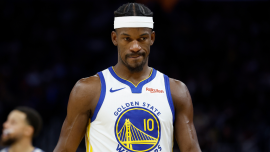
Trade 4: Butler for Joel Embiid
- Warriors receive: Joel Embiid, Quentin Grimes
- 76ers receive: Jimmy Butler, Nikola Vučević, Gary Payton II
- Bulls receive: Buddy Hield, Kelly Oubre Jr., Andre Drummond, four second-round picks (via 76ers)
We're officially in "hear me out" territory here. Very few teams should be open to taking the Embiid risk, but based on where the Warriors are, they're relatively high on that list if anyone truly qualifies. Yes, there is an overwhelming likelihood that injuries prevent him from playing at an MVP level ever again. But the Warriors are so far away that they genuinely need MVP-caliber upside out of the Butler salary slot. After all, they weren't true contenders even with Butler. Embiid has a higher ceiling than any other player in this mix. But in the event that he doesn't reach it, that injuries do indeed ruin the rest of his career, well, that's not the worst thing for Golden State either. At some point in the near future, the Warriors are probably going to have to tank. An injured Embiid on their books probably makes that easier.
They'll be able to say they took a home run swing, but they've actually given up nothing of note. If the Warriors care about the optics of looking like they're trying but ultimately want to preserve their future, well, this is a way to do it. They'd even get Quentin Grimes in the exchange! As loaded as they are at shooting guard, the notion of a perimeter player that can shoot, dribble and defend would be very welcome right about now. If it makes the trade go down any easier, think of it as Butler for Grimes with a lottery ticket attached.
Philadelphia's motives are different from Golden State's. With Tyrese Maxey and VJ Edgecombe, they have a real future to build on. Embiid's long-term contract is standing in the way of that. The 76ers would effectively be paying Butler for the next 15 months as well as whatever Grimes could give them over moving forward for the right to clean up their books by getting Embiid off of them. They'd be turning the page on the Process era once and for all. With plenty of leftover draft picks, Daryl Morey could do quite a bit with that added cap flexibility, potentially building a new winner around those two young guards in the very near future. Golden State's books are far better suited to absorbing Embiid. They're basically blank after 2027.
Chicago is mostly a facilitator here. The 76ers need a center, so we get them Nikola Vučević. We need to park a bit of money there as well, so the Bulls get compensated for their troubles to the tune of four second-round picks. And if Butler is able to return for Philadelphia next season? Then all the better.
There's a far easier version of this trade to be made here. Butler for Paul George is a pretty easy contract match. George is healthy, but his contract goes one year longer. The Warriors pursued George in the summer of 2024. That's the simple version of this trade. The Warriors don't take on two extra years of money, only one. The 76ers don't have to give up Grimes. But the complicated one is higher upside for both sides here. ESPN's Marc Spears has reported that the Warriors don't want to add salary, so this is probably all a moot point anyway, but there's a sensible deal here if you really squint.
Trade 5: The nuclear option
- Warriors receive: Fred VanVleet, Dorian Finney-Smith, Jabari Smith, Reed Sheppard, 2029 first-round pick (most favorable of Suns, Mavericks, Rockets)
- Rockets receive: Stephen Curry
- Nets receive: Buddy Hield, Gui Santos, 2030 first-round pick (top-four protected)
Both of the following are probably true:
- The Golden State Warriors would never trade Stephen Curry unless he directly asked them to. End of story. He's their Tim Duncan or Dirk Nowitzki, an utterly unimpeachable franchise icon. He's not getting dumped in the dead of night like Luka Dončić. Fans would riot.
- In a purely utilitarian world in which nothing mattered except for championship equity, Curry asking for a trade would be a net positive for Golden State.
Again, that second point is purely utilitarian. Warriors fans would rather watch Curry lose for them than win elsewhere. But if you believe this current group has no real championship equity, then purely logically speaking, a Curry trade potentially recouping meaningful assets is the best long-term decision because it could increase championship equity at a point in the future in which actually winning a championship is somewhat more plausible. These ideas are supposed to grow more ridiculous with each passing trade. What's more ridiculous than exploring a Stephen Curry trade? It only happens with his say-so. We're pretending we live in a world in which he's decided he'd rather win elsewhere than lose in Golden State.
So who would be interested in that world? Well, everyone, honestly. But let's narrow it down. It would have to be a team equipped to win the title here and now. He's 37. He's not waiting around. He'd probably go to a team with a ton of defense and a shooting deficit, and there are fortunately plenty such contenders this year. The funniest outcome would be Oklahoma City. The Thunder have so much draft capital that if this ever became real, they could just send Golden State matching salary (say, Isaiah Hartenstein, Lu Dort and Isaiah Joe) along with a mountain of picks and potentially lock up a second-consecutive title or possible even a three-peat without really compromising their future. If Curry has any interest in chasing Michael Jordan's six rings, it'd have to be at least a little tempting. But the Thunder don't act this way, as terrifying as it would be for the rest of the league.
How about Detroit? The Pistons kill opponents in the paint but struggle from deep. Curry obviously corrects that, and he'd clear out the area near the basket for everyone else quite a bit. Detroit controls all of its own first-round picks and has plenty of mid-sized salaries and young players to dangle. They're just so early in their run, it's hard to see them selling out for a player near the end of a Hall of Fame career.
That leaves Houston as the best fit, ironically reuniting him with Kevin Durant. The two would share a starting lineup with Amen Thompson, Alperen Sengun and Tari Eason, creating probably the best single lineup in basketball while preserving Steven Adams as a lethal bench curveball. Golden State still walks away with plenty here: Sheppard and Smith as prospects to groom for the future, plus a very valuable 2029 first-round pick. If Golden State needs more picks, Houston has a surplus to work with, and those young Rockets could be dealt for picks elsewhere if needed. A trade like this would position the Rockets as the probable 2026 championship favorite while setting Golden State up to tank for a few years and then rebuild. In a fictional world in which those are their primary goals, a trade like this makes sense.
But we don't live in that fictional world. Stephen Curry is almost certainly never asking for a trade, so this exercise is purely academic. Even if the Warriors wanted to kick off a rebuild right now... too bad. If the cost of winning four championships is wasting a couple of years meandering with a mediocre roster at the end then so be it. Curry gets to decide how his story ends, and unless we hear otherwise, the assumption should be that it does with the Warriors. Still, it's tantalizing to imagine what sort of market would develop for Curry if that ever changed. I mean... it's Stephen Curry. He's probably the single easiest offensive player to fit onto any team in the history of basketball. Every team remotely interested in winning now would probably register some level of interest.