The Indianapolis Colts have apparently seen enough. Enough of the losing, enough of a roster that hasn't lived up to expectations and, perhaps most tellingly, enough of pretending this thing is headed anywhere.
First came the firing of longtime general manager Chris Ballard. Then, on Tuesday, the Colts shipped eight-time Pro Bowl guard Quenton Nelson to Seattle and three-time Pro Bowl defensive tackle DeForest Buckner to San Francisco. And just like that, the rebuild was officially underway. Two of the franchise's most recognizable players were gone, replaced by three future draft picks, none earlier than the third round.
At 2-5, Indianapolis seems ready to concede that the season is all but over. There's a reasonable argument for moving veterans on expiring contracts rather than watching them leave for nothing in March.
But here's the catch: The Colts traded their 2026 and 2027 first-round picks, along with wide receiver Adonai Mitchell, to the Jets last November for Sauce Gardner. So while they're now tearing down the roster, Indy won't have a first-round pick to show for its struggles in either draft.
Put in much starker terms: The worse the Colts get, the better the Jets' draft pick becomes (what New York does with those picks is another matter entirely). And that raises a bigger question: When NFL teams decide halfway through a season that it's time to blow things up, what happens next? And how often does starting over actually work?
Below are five recent examples that offer some perspective. The results range from remarkable turnarounds to prolonged misery, but they share one unmistakable similarity: Every team eventually used a top-seven draft pick on a quarterback.
That's precisely the opportunity Indianapolis won't have in 2027 unless it finds another way back into Round 1.

2019 Miami Dolphins: All those picks, but where's the payoff?
The Dolphins didn't just move aging veterans in 2019. They traded 25-year-old left tackle Laremy Tunsil, 22-year-old safety Minkah Fitzpatrick, receiver Kenny Stills and running back Kenyan Drake — basically putting the entire roster up for sale.
And the returns were substantial. Miami collected multiple first-round picks, including three from the Tunsil and Fitzpatrick deals. The Dolphins finished 5-11 in 2019, then used the fifth overall pick in the 2020 draft to select Tua Tagovailoa.
Miami improved to 10-6 in Tua's rookie season, and eventually replaced coach Brian Flores with Mike McDaniel in 2022. The Dolphins reached the playoffs in 2022 and 2023 but lost both wild-card games, leaving them with a more talented roster but little postseason success to show for that original teardown.
The Colts connection: Miami had something Indianapolis doesn't: premium draft capital and multiple opportunities to find franchise-changing players. Even with those advantages, turning a collection of picks into a legitimate contender proved a lot harder than simply stockpiling them.

2022 Chicago Bears: Sometimes rebuilding once isn't enough
The Bears started selling in October 2022, dealing Robert Quinn to Philadelphia and Roquan Smith to Baltimore. Chicago eventually finished 3-14, giving GM Ryan Poles the No. 1 overall pick in the 2023 draft and a decision that would reshape the franchise.
Rather than take a quarterback, Poles traded that selection to Carolina for DJ Moore and a package of picks, including the Panthers' 2024 first-rounder. Chicago stuck with Justin Fields for another season, then traded him and selected Caleb Williams first overall in 2024, using the pick acquired from Carolina.
The results weren't immediate. The Bears won seven games in 2023 and managed just five wins in 2024, a season that also saw Matt Eberflus fired. Chicago then hired Ben Johnson, who led the Bears to an 11-6 record and a playoff victory in 2025. And when Caleb Williams has been healthy in 2026, the Bears have looked like one of the most explosive offenses in football.
The Colts connection: Chicago could afford to be patient with Fields because it controlled Carolina's future first-rounder. When the Bears decided to change quarterbacks, they had the ammunition to do it without sacrificing additional assets. Indianapolis has no such luxury.

2023 Washington Commanders: The dream scenario, with a catch
Washington offers perhaps the most tempting blueprint for what the Colts are attempting. At the 2023 deadline, the Commanders traded defensive ends Montez Sweat and Chase Young, collecting second- and third-round picks, a tacit acknowledgment that their season was headed nowhere.
Then, new owner Josh Harris cleaned house, firing Ron Rivera and bringing in Adam Peters to replace Martin Mayhew as GM. Peters helped lead the search that landed Dan Quinn as head coach, and Washington moved on from Sam Howell, who started all 17 games in 2023, before using the No. 2 overall pick on Jayden Daniels.
What happened next was impressive. Washington won 12 games in 2024, won twice more in the playoffs and reached the NFC championship game, accomplishing in one offseason what most rebuilding franchises spend years trying to achieve.
Of course, the team fell to 5-12 in 2025, in large part because Daniels couldn't stay healthy and the defense couldn't tackle a paper bag to the ground. It's a reminder that one magical season doesn't guarantee long-term success.
The Colts connection: Indianapolis has started its own leadership overhaul, beginning with Ballard's dismissal. But Washington had the second overall pick and turned it into Daniels. The Colts could lose enough games to earn a similarly valuable selection in 2027, only to watch the Jets use it.

2022 Carolina Panthers: When the rebuild becomes the problem
If Washington represents the dream, Carolina offers a reminder of just how quickly a rebuild can go off the rails.
The Panthers traded Christian McCaffrey to San Francisco in October 2022, receiving four draft picks, and also sent Robbie Anderson to Arizona. They finished 7-10 after firing Matt Rhule, then decided their best path forward involved an aggressive move for a franchise QB.
Carolina packaged two first-round picks, two second-rounders and DJ Moore to move up to No. 1 in 2023 for Bryce Young. The gamble initially backfired in spectacular fashion. The Panthers went 2-15 in Young's rookie season, fired Frank Reich after just 11 games and eventually replaced GM Scott Fitterer with Dan Morgan.
Dave Canales finally brought some stability. Carolina improved to five wins in 2024 and went 8-9 in 2025, winning the NFC South with a losing record (related: welcome to the NFC South!). Three seasons after trading McCaffrey, the Panthers were back in the playoffs, and now, in Year 4 of the Bryce Young era, there's reason for cautious optimism. Young has taken a significant step forward in 2026, and for the first time in a long time, it feels like Carolina's rebuild might actually be working.
The Colts connection: Carolina traded away established talent, then spent much of its remaining draft capital chasing a quarterback. Indianapolis has already surrendered two first-round picks, except the Colts made that investment in a cornerback. Gardner is an excellent player, but he can't solve the uncertainty at quarterback.

2017 Buffalo Bills: The rebuild that barely looked like one
Buffalo's situation was different from the start. The Bills moved Sammy Watkins, Ronald Darby and Reggie Ragland before the 2017 season, then traded Marcell Dareus in October. Somehow, they still finished 9-7 and made the playoffs with Tyrod Taylor at quarterback.
The biggest difference? Buffalo had already established its leadership structure. Sean McDermott arrived as head coach in January 2017, Brandon Beane followed as GM in May, and both remained in place as the organization reshaped its roster.
Buffalo traded Taylor the following offseason and signed AJ McCarron, but Beane had bigger plans. In the 2018 draft, he sent two second-round picks to Tampa Bay to move up from No. 12 to No. 7, betting the franchise's future on Josh Allen, a supremely gifted but raw quarterback from Wyoming with legitimate accuracy concerns. The gamble paid off in spectacular fashion. By 2020, the Bills were 13-3 and playing in the AFC championship game. Allen, meanwhile, developed into an NFL MVP and one of the league's most dangerous players.
The Colts connection: Buffalo never needed to bottom out completely, but Beane had the draft capital to aggressively pursue his quarterback. Just as important, the Bills found alignment between their coach, GM and young QB, then gave that group time to develop. Indianapolis needs to find its own Josh Allen (turns out, they don't grow on trees), but without a 2027 first-round pick, its next GM faces a much tougher path to making that kind of franchise-changing gamble.
So where does that leave the Colts?
Here's what stands out about these five rebuilds: All five teams eventually drafted quarterbacks with top-seven picks, four changed head coaches after their sell-offs began, and two replaced their general managers. Buffalo had already hired its coach and GM before the roster teardown.
The results certainly weren't uniform. Washington reached the NFC championship game almost immediately, and Buffalo developed into a perennial contender, while Miami, Chicago and Carolina needed longer to reach the playoffs, with varying degrees of success.
But there was one constant: Every team had access to the premium draft capital needed to take a big swing at quarterback.
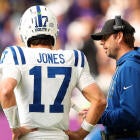
Indianapolis finds itself in a much different position. Ballard is gone, Shane Steichen remains the head coach, and Daniel Jones is still the starting quarterback for now. Ballard already took his big swing at a franchise QB in 2023, drafting Anthony Richardson fourth overall, a raw but supremely gifted prospect whose physical tools drew comparisons to Josh Allen. Unlike Allen, Richardson never developed into the player Indianapolis envisioned and is currently on the bench, having last started an NFL game in 2024.
As of this writing, the Colts have eight selections in 2027, including two third-rounders and two fourth-rounders, but none in the first round.
That doesn't make a successful rebuild impossible. Gardner remains a valuable player, Indianapolis still controls its 2028 first-round selection, and additional trades could provide more draft picks (see Jonathan Taylor, for example). But it does make the path considerably narrower, especially when the organization decides Jones isn't its long-term answer.
And that's what makes this situation so unusual. The Dolphins collected first-round picks before drafting Tagovailoa. Chicago transformed its own No. 1 selection into the assets that eventually delivered Williams. Washington took Daniels second overall, while Buffalo landed Allen at No. 7.
The Colts have begun the same process of dismantling a disappointing roster, except they've already spent the draft capital that helped those other franchises find their way back.
It's one thing to trade away your best players because you've decided it's time to start over. It's another thing entirely to start over knowing somebody else owns the biggest reward for your suffering.