

Jacksonville Jaguars coach Liam Coen is in one of those coach modes, animated, lively, talking offensive football, his passion for the NFL game on full display as he goes from diagramming plays on the white board in his office to using the clicker in his hand to show a play on the big screen across from his desk.
He is a mad scientist at work, trying to help me answer a question that has bothered me in a big way the past few years:
What in the hell has happened to the NFL passing game?
This was a league that once saw 5,000-yard passers, big downfield numbers, quarterbacks who let it fly, and coaches who weren't afraid to let them do it. But last year, the average passing yards per game for NFL teams was the lowest since 2008.
The days of three yards and a cloud of dust aren't quite back, but the bloated passing numbers of a decade ago are gone.
In trying to find the answer, I spoke with a variety of offense-minded coaches and quarterbacks to understand why passing-game numbers have dropped over the past 10 years. Think about this: NFL teams averaged just 209.7 passing yards per game last season, and just 10 years prior to that, teams averaged 243.8 yards per game. That's a significant drop. In 2015, the league averaged 10.8 yards per catch. Last season, it was 10.2.
"There are a lot of reasons," Coen said. "Teams aren't letting you just drop back and get the big plays. Look at the Super Bowl teams that have won it the last two years, both Philly and Seattle. Those two teams play the highest amount of shell coverage, but what can they do? They can rush the passer, right? So they can rush with four and play soft zone coverage. They play deep to short and don't let anything get over their heads. They limit the big plays."
That is spreading throughout the league. Make offenses be patient and make them drive the field. Fans love the big plays. Offensive coaches and players do, too, but getting them now almost means yards after catch rather than the ball in the air.
There are reasons for it. Lots of them. In this story, I will explore five reasons why the beloved passing game isn't what it used to be.
The five reasons are: The Vic Fangio impact, the offensive lines regressing compared to the defensive lines improving, the exotic looks on defense, the quarterback intellect and coaches playing it safe or, as I like to say, playing scared.
Let's take a look at each of these reasons.
The Vic Fangio effect
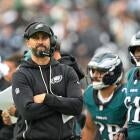
Fangio, the Philadelphia Eagles veteran defensive coordinator, is credited by many as the man responsible for changing the NFL passing game. His two-deep structured defense is designed to prevent big plays.
The more prevalent use of his scheme, which many have copied, followed the trend of offenses figuring out ways to beat the single-high safety looks that the Seattle Seahawks used to dominate on defense in their Legion of Boom days. That style spread with Seattle's success, as more teams adopted it before offenses eventually got the better of it, which led to the Fangio-style taking over.
"It kind of started in '18 and trended '20 '21 and '22," Coen said. "Fangio started playing a lot of shell, so cover four, cover two, versions of cover four and cover two mix, so cover six, which is quarter, quarter, half. We got quarters on one side, half on the other, half on this side, quarters on this side. And he was doing it in both base defense and nickel defense. What he's saying is, 'I'm going to be light in the box, but I'm going to be sound in the pass game. We're going to be deeper, play everything deep to short, and we're not going to let the ball get thrown over our heads. That's why people started to copy that system. They don't want to give up explosives."
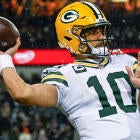
"You see it more and more," Green Bay Packers quarterback Jordan Love said. "They stay in shell and make you drive the field, stay on top of the deep stuff and make you be patient. They will give up the short check downs. As a a quarterback, you can get frustrated throwing check downs all game. And then you get antsy and want to throw it down the field. Then, like against Carolina last year, I am forcing it into triple coverage because we haven't taken any shots."
The key to being good in a defensive style is stopping the run without committing more bodies. If the defense doesn't have to drop a player to stop the run, it can use all those off-coverage looks to limit the passing game.
If the defense can limit the run and still play off coverage, it creates a big-time challenge for the quarterback and the passing game to get big plays. That's why completion percentages are up in the league, and yards-per-pass play are down.
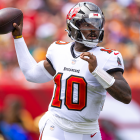
"That Fangio family tree has had a huge effect," Tampa Bay Buccaneers quarterback Baker Mayfield said. "It's hard to face that when you get all those combo coverages and the things they do. They don't make it easy to get big plays. You are not just throwing crap up and getting guys open for big plays. They make it hard."
"That has been a big factor," Jacksonville Jaguars defensive coordinator Anthony Campanile. "And that tree of coaches is growing. So more people are doing it. That philosophy has grown."
So what's the answer?
Run it, the coaches and quarterbacks all said.
"If you can run the ball, just keep doing it," Buffalo Bills quarterback Josh Allen said. "That's the thing that is going to get people out of all these rotations and stuff. Go ahead and rotate. I am handing the ball off to James Cook. Good luck."
"You have to be able to run the football," Packers coach Matt LaFleur said. "Make them pay for playing off. That will change things."
One counter for offenses will be using more 13 personnel, one back and three tight ends. The Rams used it a lot last year to help the run game, but it also helped the passing game. Expect more and more teams to try to copy that this year.
"We can take our time and we can run jumbo," Allen said. "It's a different mindset. I think they've gotten faster on defense, but smaller. You don't see any 240- 250-pound linebackers. You see hybrid players who go side to side. If you run it in 13 personnel, that can switch their mindset to get bigger guys."
Bills first-year coach Joe Brady agrees.
"The game of football is cyclical," Brady said. "Five years ago people were throwing for 5,000 yards. Now they make them earn it. Defenses have changed. That's what teams do. We're not just going to bang our head against the wall against it. If we get favorable looks in the run game, we will run it and get them back in the box."
That, in turn, will also help take the pressure off the offensive line in protection. That leads to our second major issue, hurting the passing game.
Offensive line play
It's easy to see with the naked eye that the defensive linemen in the NFL have improved, especially from a speed standpoint, while the offensive lines have not. That's a challenge of trying to hit big plays in the passing game.
Your quarterback can't throw on his back.
"The pass rushers are so (expletive) good," LaFleur said. "They are so athletic now. That's a challenge for all offensive lines."
"The rushers are getting better and better and better," Jaguars offensive coordinator Grant Udinski said. "The truncation of practice time has also made it a lot tougher for the offensive lines."
It doesn't help that offensive line play takes time for a unit to grow. It takes reps, padded reps. But with limited days in pads in camp and during the season, it makes it a real challenge to get a five-man group that can hold up consistently in protection.
"Protection is No. 1," Mayfield said. "We are lucky we have a good offensive line."
"What drives us nuts as coordinators when it comes to the game plan is what play-action protections are good," said Bucs coordinator Zac Robinson. "Maybe they have one guy who can really rush on the outside, but then it might be one on the outside and one on the inside. Or two on the inside. The rushers have really gotten so good. So as a play caller, can you get enough eligibles down the field to flush coverage to open up a window. Or do we have to protect the edge with two players, which means only two verticals out. That's where the defensive line has helped gain the advantage."
If a line can protect with five, it would make life so much easier. But the tricky part now with that is all the exotic looks teams throw up front as they rush. It's not just line up and go. The line has to be working in unison to pick up stunts and movements. With those doing the moving being so much more athletic, it presents a real challenge for the offensive line.
"You look at Brian Flores in Minnesota, and you look at some of the stuff they're doing," Coen said. "They have guys dropping and blitzing from everywhere, and so it's no longer like back in the day when linebackers only did this, D-linemen only did this, safeties only did this, corners only did that job. Now it's all just Xs. Anybody can play anywhere is kind of how Flores trains his defense, and it's creative. And they do a lot of things to rush the passer. It makes it tough on those guys up front."
"The defenses really do a good job of attacking your protection," Cleveland Browns coach Todd Monken said. "That limits the deep ball to some degree."
The creativity up front has also led to a lot of it on the back end, which takes me to the next thing impacting the passing game.
Exotic looks
Sitting in a room outside the Green Bay Packers locker room in early August, Love was talking about how he sometimes goes back and watches film from 10-15 years ago.
"It was simple Cover-2 looks and you kind of knew what they were going to do," Love said. "Now it's so much more complicated. There are so many crazy coverages, so much disguise. It's not as easy just to say I see Cover-2 or man coverage and just go."
It used to be static on defense. Then again, the offenses were also much more static. Now there is so much movement just before the snap on both sides, but the defensive rotations and movement really make it challenging for passers. Quarterbacks who don't put the work in can be in big trouble.
Detailed film study is a must.
"I was talking to (offensive coordinator) Pete Carmichael about some of the things we used to see back in 2017 when we were in New Orleans," Brady said. "At the time, it was as hard as can be. I look back on it now, and it wasn't that hard compared to what they do today."
"You look at tape from 2017 to now and it looks like a different game in some ways," Udinski said. "The coverages are the same. I am not saying guys invented new football. But the creativity within packages and personnel is different even five years ago. And you have guys who are more specialized in their roles."
Teams show one thing pre-snap, which makes that a read in itself for a quarterback, but then it becomes even tougher with all the post-snap movement.
"They teach the movement at the shot clock," Coen said. "They will say at this second, at this time, they will hold the shell until a certain point if they can, then, boom, they move. They try and hold as long as they can and then they rotate at a certain point. That is challenging for a quarterback. Post snap is the toughest. They show a quarter shell for as long as humanely possible then roll to play two or three, maybe both safeties coming down and corners going deep. It's no longer a safety is a safety, a corner is a corner. They're all just Xs and Os."
That's why player versatility is so important on defense. It's why a player like Baltimore's Kyle Hamilton is such a big part of the Ravens' defense. He can play up near the line, be a good tackler in the run game or a blitzer, or he can play deep and help out with the coverage. Teams are craving players who can be chess pieces on defense.
"Defenses are doing a much better job of being multiple in terms of their complexities," LaFleur said. "It puts so more on the players. They have to be dialed in to every call. But also us in our game planning."
Think about the life of a quarterback. You get a long play call from the coordinator or coach. Then you have to repeat it. Then you break the huddle. Then you look across at the defense to get a pre-snap look. Or at least one you think you are getting.
The play clock is running down. The look isn't what you want. So you call the play. Then they rotate at the snap. Is the play good? What if it isn't? What if you have a man-beater called, and they play zone?
"You have to have all-purpose plays that distribute the field and find completions," Robinson said. "Plays that have answers vs man, single-high zone, two-deep, quarters. And move the football that way. I've been coaching seven years and you've seen it get more and more complex in that short time."
It used to be that if a man went in motion on offense and a defender went with him, that was a man indicator. Not anymore.
"They all throw false tells at you now," Robinson said. "Then they drop into zone."
Said Allen: "It's a marriage between man and zone. The hardest for me is when teams show they are playing zone and play man out of it. It really messes with your indicators. There are ways around it, but it's tough."
Young quarterbacks can get eaten alive by the defensive complexities. They get fooled. But guys like Matthew Stafford with the Rams have been around for so long that they can overcome being fooled, according to the coaches who have worked with him. Experience matters.
"I would say they're probably more complex, but I didn't quite understand it to the full degree as I do now." Jaguars quarterback Trevor Lawerence said. "So you learn a lot from playing, but they're changing a lot too.I mean, it's all designed to stop the pass now. The late movement and all that stuff is a challenge. So you really try and use cadence, try to use motions that look like the ball's going to be snapped to show them something and get them to adjust. I think that's what offenses are moving to now."
That brings us to the next issue facing the passing game:
Quarterback decision-making
Several of the coaches and personnel men I spoke with for this story say the college game isn't preparing quarterbacks for the NFL like it used to. They play in the spread, and many rarely under center. They play calls come from the coach on the sideline at the line in some instances. The reads are more pure progression -- 1-2-3-4 -- rather than reading the coverages.
That's why it's so challenging for young quarterbacks now. They are learning how to play under center, while also reading all the complicated exotic looks coming their way.
"It can be a lot for a young quarterback," Mayfield said. "It's even more complicated now for a guy coming in than when I was a rookie. It's a challenge."
That can limit what an offense can do. That's why good quarterbacks usually grow from Year 1 to Year 2 and Year 2 to Year 3. By the time they are veterans, they've seen it all.
Or at least they used to think they did.
"What they are doing now is so much different and it can mess with a young player," Mayfield said. "You have to be patient. It's not just throwing it up and getting guys open. This is hard."
The last big component, in my mind, in the regression of the passing game is coaches doing something I hate, which is playing not to lose.
Coaches playing scared
If you ever want to see offensive-minded coaches squirm, tell them as a group they have become passive, gun-shy, scared.
To a man, they have the same reply.
"Not me."
But let's be real. The feeling from the way the game is played now is that coaches would rather have their quarterbacks throw for 210 yards, one touchdown and no picks than, like in the old days, 350 yards, three touchdowns and two picks.
Playing it safe seems to be the norm much more than it used to be.
The numbers say so. Interception numbers are down, but those completion percentages are up. Consider this: Of the top-18 all-time single-season completion percentages, nine have occurred in the past six seasons and eight in the past five. The league average for completion percentage was under 60% every year until 2007, and it hasn't come close to being that low since. It just keeps going up. Last season, the league completion percentage was 64.3%.
It used to be "touchdown-checkdown" in the NFL. Now it's "checkdown-checkdown" as teams protect the football.
"You can't turn it over," Brady said.
"The first thing we talk about is taking care of the ball," Robinson said.
"I think that in the quarterback room it's always pushed to us to take are of the ball," Love said. 'It comes down to the trust with the play caller and the quarterback coach understanding I will take care of the ball. But I am still going to push the envelope. I don't want to throw checkdowns all game. You can go in with that mindset, but not be able to push it down the field and make explosive plays. It's not going to be what you want. I want to go down the field and put the pressure on defense. Explosive plays is how you win games."
Thus lies the fine line between pushing the ball and playing it safe. Coaches make a lot of money now. Turning the ball over can lead to losses and lost jobs.
But I still believe that taking chances and maybe making mistakes is better than playing it safe. You can't play not to lose.
The big question now is whether the passing game can come back. Can the deep ball come back?
Telling offensive coaches that the defense is ahead was met with frowns and grimaces. None of them liked to hear that.
"I would say they caught up," LaFleur said. "Not ahead. We will adjust."
"I am not going to say they are ahead," Udinski said. "I won't say that."
"Things will change," Brady said. "They always do."
The quarterbacks are convinced it will change.
"We are going to get it back," Mayfield said.
"It can come back," Love said. "You just have to be patient and then take your shots. The passing game will be back."
Expect teams to do what the Rams did last year by using more 13 personnel with three tight ends on the field. That will help counter some of the exotic looks defenses are using these days, which, in turn, could lead to more big plays.
"Everybody's going to go to so much more heavy personnel, 13, to try and copy that stuff," Coen said. "Teams are going to over-rotate in that direction."
That, though, makes your offense slower. The tight ends are good these days, but they don't run like receivers. That seems like an advantage for the defense yet again.
The days of the long 50-yard go ball might be waning. The big plays now come on deep in-cuts and throws that have a lot of run-after-catch ability.
"When we say a go ball, unless you have Calvin Johnson or somebody that's just a freak in one-on-one, the percentages of the go ball are very small," Coen said. "If I am going to throw the ball 40-45 yards down the field one-on-one, my quarterback has to put it in a perfect spot. That's hard to come by. So find different ways to create explosives."
With that, Coen went back to the TV in his office to show a 20-plus completion from Lawrence to Brian Thomas Jr. from a game last season.
"Watch all the shell coverage on this tape, and this is just a reel of our dagger concept, the in break, the deep in break," Coen said as he used ran the play over and over. "It's like a 20-yard in cut, so you bet your ass this is an explosive play now. Look at the defense. They are just sinking with no vertical threat. So if you want to throw a go-ball here, you can't. So you attack the middle of the field as they get width. You take advantage of what you can win with and what I took away from our self scout was our quarterback's good at throwing seams and ins, and he's really good at it. He's better at throwing seams than he is go balls outside. So you can get the big plays. You just have to get them a different way."
Let's hope so for the sake of the passing game. Nobody, and I mean nobody, loves the checkdown.
It's time for the passing game to come back.