Robert Saleh rightfully gets a second chance with the Titans, but his OC hire will determine success
Saleh struggled to find the right pieces on offense as a first-time coach in New York

•
7 min read
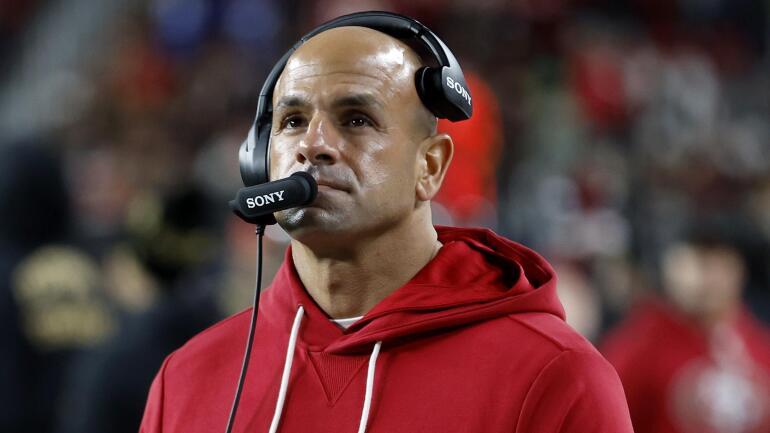
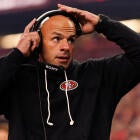
Roughly 15 months after an ignominious midseason firing by the New York Jets, Robert Saleh is a head coach once again with the Tennessee Titans hiring him to save what has been a slowly sinking ship for several seasons.
Saleh got the Titans' job the same way he got the Jets' job: by doing phenomenal work as the San Francisco 49ers' defensive coordinator. No, Saleh's 2025 defense wasn't the dominant force his 2019 and 2020 units were. But given the circumstances, he did a terrific job.
The 49ers lost Nick Bosa to a torn ACL in Week 3 and Fred Warner to a dislocated and fractured right ankle in Week 6. First-round rookie Mykel Williams tore his ACL in Week 9. Injuries ate away not only at the stars, but at the depth, too.
Despite having a dearth of pass rushers and playing rookies and inexperienced backups at every level of the defense, the 49ers buckled down in key scenarios and limited the damage: San Francisco finished 20th in total defense but 13th in scoring defense, in large part thanks to the fourth-best goal-to-go defense in the league.
Now, Saleh will hope his second go 'round as a head coach goes much better than his first. He went 20-36 with the Jets despite having a top five total defense in three of his seasons in the Big Apple. Saleh will call plays for Tennessee defense, according to NFL Media's Mike Garafolo, and there will undoubtedly be several other changes that he'll adapt.
Defense was never been the problem for Saleh, though. It was the offenses. For that aspect, it's worth noting that Saleh impressed the Titans with his "incredibly detailed, comprehensive and team-specific" offensive coordinator plan, according to Sports Illustrated's Conor Orr. That's a good thing because for Saleh to succeed, he needs Cam Ward to succeed -- and for Ward to succeed, he needs the right offensive coordinator.
Saleh's offensive struggles with the Jets
The two biggest aspects Saleh never got right in New York were quarterback and offensive coordinator. The team completely whiffed on 2021 No. 2 overall pick Zach Wilson. There was certainly some bad luck here. Trevor Lawrence went No. 1 overall, and it was a historically disappointing quarterback class thereafter. Five quarterbacks went in the top 15, and only one -- Lawrence -- is a starter. None of Wilson, Trey Lance (No. 3 overall), Justin Fields (No. 11 overall) and Mac Jones (No. 15 overall) made it through his rookie contract with the team that drafted him.
Hindsight, of course, is 20/20, but it's clear that Saleh and general manager Joe Douglas didn't exactly set Wilson up for success either. The Jets' receiving yards leader and rushing yards leader in 2021 were rookies (Elijah Moore and Michael Carter). The team's top two receptions leaders were Jamison Crowder and Braxton Berrios. And leading the entire operation was offensive coordinator Mike LaFleur, whom Saleh brought over from San Francisco and was calling plays for the first time in his career. The defense, bereft of talent, finished dead last in points and yards. It was a mess. The Jets finished 4-13.
The overall product improved in 2022 (7-10 record) thanks to a jump from the defense, which went from the NFL's worst to one of its best. Still, the offense was terrible: Wilson struggling and a poor offensive line in from of him.
So, Saleh overhauled the entire offensive operation in 2023. He parted ways with LaFleur and hired Nathaniel Hackett fresh off a disastrous 15-game run as the Denver Broncos' coach. Hackett, most notably, had coached Aaron Rodgers in Green Bay; a few months later, lo and behold, the Jets traded for Rodgers.
It ended up being a second swing and miss from Saleh and Douglas. Rodgers tore his Achilles minutes into his Jets debut, missed the rest of the season and was never the same. He was back for Week 1 of 2024 but clearly rusty. There were odd sideline exchanges and a disagreement about Rodgers' hard counts (Saleh eventually backtracked). Less than a week later, with Saleh reportedly set to demote Hackett, he got fired.
That's what makes Saleh's offensive coordinator plan vital for his success in Tennessee. He missed on two quarterbacks and two offensive coordinators while with the Jets. The first appeared to be a matter of youth: too much newness between head coach, offensive coordinator, quarterback and supporting cast. The second appeared to be a matter of too much acquiescing to familiarity: Rodgers got his former offensive coordinator and several of his former teammates. There was some bad luck mixed in with Rodgers' injury, but it's clear Saleh's offensive misfires doomed him.
Saleh wouldn't have taken this job (or been offered it) if he didn't firstly believe in Ward and secondly believe he has the right plan for Ward. Unlike his time with the Jets, the young, highly drafted quarterback is already in place. It's up to Saleh to complete the puzzle.
Cam Ward showed real promise down the stretch
Ward was one of the least talked-about No. 1 picks ever on draft night -- the Shedeur Sanders slide, the Travis Hunter trade and the Titans landing spot all contributed -- and remained that way all season.
The Titans were dreadful out of the gate, starting 0-4. Ward then generated the biggest headline of his career thus far by declaring, "We ass." Fitting.
It didn't get much better. The Titans won in Week 5 but lost in Week 6 and fired Brian Callahan. They didn't win again until Week 14. That's an easy way to get lost in the NFL's never-ending shuffle of headlines.
But Ward, mostly out of sight and out of mind from the national perspective, closed the regular season strong. It started, ironically, against the Seattle Seahawks, who own arguably the NFL's best defense. Ward threw for 256 yards and a score, ran for 37 yards and a score, went 4 for 4 for 45 yards and three first downs on fourth down and ran for two first downs on fourth down as well. His 0.16 expected points added per dropback was his best number in a full game this season and the fourth-best number by any player against Seattle.
Cam Ward this season | Week 1-11 | Weeks 12-18 |
TD-Int | 6-6 | 9-1 |
Net yards per attempt | 4.9 | 5.4 |
Comp pct | 58.4% | 62% |
Off-target rate | 14.5% | 12.5% |
Negative play rate | 14.3% | 7.8% |
Sack-to-pressure rate | 28.7% | 16.1% |
Many of the numbers weren't necessarily "good," (Ward's 5.1 net yards per pass attempt this season was dead last) but they were much improved. That's a very positive sign.
Perhaps the most positive sign was the decrease in negative plays, as the bottom three rows of that chart show.
Ward was on track to have one of the worst sack-to-pressure rates on record before his mid-season turnaround. As he learned to evade pressure, he not only avoided negative plays, but he started making some highlight-reel ones, too.
I know Cam Ward was out of the national consciousness by like Week 6, but man did he make some awesome plays down the stretch.
— Zach Pereles (@zach_pereles) January 20, 2026
Robert Saleh has to get his offensive coordinator hire right, because Ward has the goods. pic.twitter.com/0iA5PKb4ts
This is what the Titans offense was down the stretch: far more palatable when digested through highlights than an entire game. The Titans were still 31st in passing success rate and 28th in yards per play from Week 12 onward.
Upgrades for Titans to make
Tennessee likely thought it had made itself a solid landing spot for Ward, and in some respects, it did. Tennessee has poured ample resources into its offensive line, which finished 13th in Pro Football Focus' pass block metrics (23rd in rush blocking). Third-year guard Peter Skoronski graded out well, as did fellow guard Kevin Zeitler. Right tackle JC Latham made a significant jump from his rookie year, especially as a run blocker. Overall, the run game finished solidly.
Saleh, his offensive coordinator and eventually his offensive line coach must have a plan to continue Skoronski's and Latham's upward trajectories while also hoping to get veteran free agents Dan Moore Jr. and Lloyd Cushenberry back on track.
Moore signed a four-year, $82.5 million contract last offseason. He was PFF's No. 56-ranked pass-blocking tackle out of 71 who played at least 500 snaps. He also allowed 46 pressures, second-most in the NFL. Cushenberry was PFF's No. 31 overall center out of 34 with at least 500 snaps. His 24 pressures allowed were third-most among center. If Zeitler leaves, that's another hole to fill.
Tennessee would also do well to add a true No. 1 wide receiver, or at least a high-end, reliable No. 2. Calvin Ridley was limited to just 17 catches across seven games and has struggled with drops. The Titans can get out of his contract this offseason. Rookies Chimere Dike and Elic Ayomanor were intriguing and flashed at times but, like the offense as a whole, were inconsistent.
Tennessee, it should be noted, has the most projected cap space in the NFL.
Of course, few changes will matter if Saleh doesn't get the offensive coordinator right. Ward showed some truly wowing arm talent and creativity while also displaying maturation and improvement as a negative play mitigator. He also showed the ability to run an under-center offense -- something he didn't do in college and something that should serve him well going forward. There's a lot of fun, moldable potential for both him and this offense. They must have the right architect.