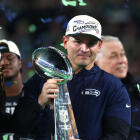
Sam Darnold went from bust to journeyman to Super Bowl starter. What can NFL teams learn from his path?
Plus, are there any former top picks who could make a similar comeback?

The 2018 quarterback draft class will go down as one that changed the NFL. It's one of just two draft classes this millennium that has produced multiple MVP winners.
Those MVPs -- Josh Allen and Lamar Jackson -- have been among the sport's biggest individual superstars. No. 1 pick Baker Mayfield ended a historic playoff drought in Cleveland and has enjoyed a career renaissance in Tampa Bay. But Sam Darnold is the first quarterback from the class to make the Super Bowl.
Darnold's turnaround has been astonishing. The No. 3 overall pick in 2018, Darnold flamed out after three years with the New York Jets and got traded to the Carolina Panthers. After Carolina, like New York two years prior, decided it needed to go in a new direction, Darnold landed with the San Francisco 49ers. His days as a starter appeared to be over.
But things are not always what they seem. The Vikings, needing a bridge quarterback between Kirk Cousins' departure and first-round pick J.J. McCarthy's arrival, signed Darnold to a one-year deal.
Darnold played the best ball of his career, a comeback as stunning as any: 4,319 passing yards, 35 touchdowns, a 14-3 record. He made the Pro Bowl. He earned MVP votes. Yes, this was the same player who was best known for admitting to "seeing ghosts" in a dreadful 2019 loss.
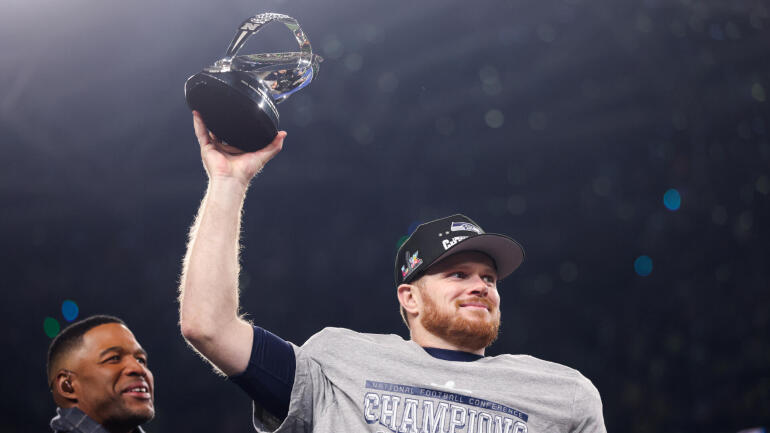
Darnold was once again passed up for a younger quarterback this past offseason, when the Vikings opted to forge forward with McCarthy. With the Seattle Seahawks, Darnold proved 2024 was no aberration. He threw for 4,048 yards and 25 touchdowns, and though his penchant for turning the ball over continued, he also was one of the league's most efficient throwers.
If there's one thing this Super Bowl matchup shows, it's that there's no one way to build a team around a quarterback. On one hand, there's Drake Maye, the No. 3 overall pick in 2024, looking to become the youngest starting quarterback to win a Super Bowl. Then there's Darnold, looking to become the first quarterback to win a Super Bowl when playing for his fifth (or later) NFL team.
But there are some trends that provide hints on team-building strategies around the sport's most important position.
First, let's look at all first-round quarterbacks since 2018:
| 2018 | 2019 | 2020 | 2021 | 2022 | 2023 | 2024 | 2025 |
| B. Mayfield (1st) | K. Murray (1st) | J. Burrow (1st) | T. Lawrence (1st) | K. Pickett (20th) | B. Young (1st) | C. Williams (1st) | C. Ward (1st) |
| S. Darnold (3rd) | D. Jones (6th) | T. Tagovailoa (5th) | Z. Wilson (2nd) | C. Stroud (2nd) | J. Daniels (2nd) | J. Dart (25th) | |
| J. Allen (7th) | D. Haskins (15th) | J. Herbert (6th) | T. Lance (3rd) | A. Richardson (4th) | D. Maye (3rd) | ||
| J. Rosen (10th) | J. Love (26th) | J. Fields (11th) | M. Penix (8th) | ||||
| L. Jackson (32nd) | M. Jones (15th) | J. McCarthy (10th) | |||||
| B. Nix (12th) |
There are a lot of busts. Only one of the five quarterbacks from the 2021 class finished the 2025 season as a starter. Picking a quarterback is really hard.
Here's how the ones who got at least 100 snaps in 2025 performed using expected points added per dropback. It's not a perfect metric, but it's about as comprehensive as it gets.
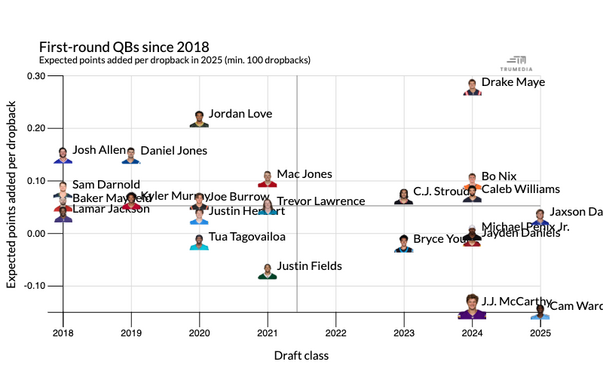
So what can Darnold teach us about the likelihood of a quarterback bouncing back? About when's too early to give up? About what needs to be in place to give a quarterback the best chance of success? Let's dive in.
Why Darnold struggled in New York: Awful surroundings, coach turnover, underwhelming personnel
To say Darnold was dropped into a rough situation in New York is putting it lightly. The team's offensive coordinator in 2018 was Jeremy Bates, who had called plays just once in the NFL, all the way back in 2010, for the Seahawks. Seattle finished 28th in total offense that year, and Bates was let go. He was out of football completely from 2013-16. He was the Jets' quarterbacks coach in 2017, when he oversaw the development (or lack thereof) of Christian Hackenberg and Bryce Petty. He was then elevated to offensive coordinator in 2018.
After Darnold's rookie season, the Jets cleaned house: new GM (Joe Douglas), new coach (Adam Gase), new offensive coordinator (Dowell Loggains). It should be noted that, in typical Jets dysfunctional fashion, previous GM Mike Maccagnan had helped with the hire of Gase, only to be fired a few months later -- after most of free agency and all of the NFL Draft had ended -- amid a reported internal rift between him and Gase. So Darnold now had neither the coach nor the GM who had drafted him, and he didn't even have a GM who had picked his new coach.
That Jets' attempts to upgrade Darnold's surroundings on the field fell flat. New York finished 28th in Pro Football Focus' pass-blocking grades and 30th in its run-blocking grades. The team's leading rusher was Le'Veon Bell, who, having sat out all of 2018, averaged a paltry 3.2 yards per carry in 2019. Darnold's leading receiver was slot man Jamison Crowder; his outside receivers were Robbie Chosen and 32-year-old Demaryius Thomas.
Things bottomed out in 2020. New York had the No. 31 pass-blocking unit per PFF. Jets quarterbacks were pressured on 43% of their dropbacks, by far the highest rate in the league; no other team was above 40%. Bell appeared in two games. Frank Gore (3.5 yards per carry) was the team's leading rusher, Crowder once again the leading wide receiver.
It is, of course, unwise to pin everything on Darnold's surroundings. From 2018-20, he was erratic (11.6% off-target rate, 28th among 38 quarterbacks) and unsafe with the ball (5.0% turnover-worthy throw rate, only better than Jameis Winston). But the combination of poor coaching and poor surroundings can be devastating, and in this case, they were.
The Jets, it should be noted, have continuously missed out on quarterbacks. Owner Woody Johnson received an "F" in the NFLPA survey this season and called it "total bogus." The Athletic reported that Johnson used his sons' insights -- based off of Madden ratings -- to influence his roster decision-making.
None of these scenarios above are unique to Darnold. Several of the first-round quarterbacks who busted were the product of substandard circumstances.
- 2018 draft: After Bruce Arians left, the Cardinals essentially treated 2018 like a throwaway under Steve Wilks. Rosen, playing under a first-time coach in Wilks and a first-time offensive coordinator in Byron Leftwich, struggled, and the team quickly moved onto Kliff Kingsbury, who brought in Murray.
- 2019 draft: After struggling in his first three years, Daniel Jones had a solid 2022 in a training wheels offense: heavy play action, lots of safe throws, few shots downfield, etc. The Giants, instead of seeing if Jones could continue to grow, rewarded him with a four-year, $160 million contract. Haskins was the product of another meddlesome owner: Dan Snyder implored Washington to take him, even though the staff didn't feel the same way.
- 2021 draft: Lance, a raw prospect who hardly played leading up to the draft due to COVID-19, was never an easy fit for Kyle Shanahan's precise, under-center offense. Lance also suffered multiple injuries. Shanahan had reportedly leaned toward drafting Mac Jones in the lead-up to the draft, and, fittingly, Jones played a key role in 2025 as Brock Purdy's injury replacement. Fields fell into a similar situation as Darnold: Drafted by one coach (Matt Nagy) and GM (Ryan Poles), only for the coach to be fired one year later and replaced with Matt Eberflus. With Eberflus at the helm, the Bears had the worst scoring defensive in the NFL in Fields' second year, a bad spot to be for a quarterback who leaned on his athleticism rather than his dropback passing.
- 2022 draft: Pickett was the product of quarterback scarcity as the only quarterback selected in the top 73 picks. The Steelers, who had no succession plan behind Ben Roethlisberger, reached.
Why Darnold has bounced back: Better coaching, better surroundings, easier answers
Darnold deserves enormous praise. The vast majority of players who follow a career path similar to his never regain prominent roles. He also owes his success to his landing spots since Carolina. In San Francisco, Darnold learned under Shanahan, whose under-center attack provides lots of advantages for quarterbacks.
Being under center -- a trend that returned en vogue league-wide this season -- has been the backbone of Darnold's resurgence. Under Kevin O'Connell in Minnesota he was under center on 50% of his plays and 29% of his passes; in Seattle this year under offensive coordinator Klint Kubiak, he was under center on 54% of his plays and 34% of his passes. In New York, he was under center on just 37% of his plays and 18% of his passes.
Being under center is not a cure-all, and many quarterbacks aren't comfortable with it. The college game has shifted to a shotgun, spread attack. But numbers show that under-center passing this season had some clear advantages.
| NFL passing in 2025 | Shotgun | Not shotgun |
| Net yards per attempt | 6.4 | 7.3 |
| Expected points added per dropback | 0.01 | 0.11 |
| Explosove plays per dropback | 7.20% | 10.90% |
| Passing success rate | 44.10% | 49.40% |
| Time to pressure allowed | 2.51 | 2.87 |
Darnold in particular has been terrific in these settings. His 10.1 net yards per attempt from under center led the NFL this season; his 11.3 yards per attempt off under-center play action was also first.
Again, it doesn't fix quarterbacks. Off-target rates were about the same for both under-center and shotgun throws. Overall offensive negative play rates were actually slightly higher when under center. But by giving quarterbacks a lot of easy completions, the under-center, play-action game can provide a higher floor than other systems. You'll notice that O'Connell, Shanahan, Kubiak and others have been able to coax usable play from backups when needed in a pinch.
Darnold isn't perfect. Some of the mistakes that plagued him previously persist. He led the NFL in turnovers this season. He tries to fit too many passes into too small windows. He can trust his arm talent too often and become flustered and risky when pressured. Still, he has the consistency of a reliable play-action game to fall back on.
He's also, simply, been surrounded by better players, especially at wide receiver. He threw to Justin Jefferson last year and Jaxon Smith-Njigba this year. Sometimes it's the X's and the O's. Sometimes it's the Jimmys and the Joes.
What can we learn?
Darnold's journey can teach us a few things.
- Teams ought to strive to surround their young quarterbacks with as much talent as possible. Invest in the offensive line. Have weapons on the outside that are more than "reliable." Have a defense that can at least somewhat hold its own.
- That talent includes coaching staffs. Look at how Ben Johnson helped Caleb Williams in Chicago this year, or how Mike Vrabel and Josh McDaniel elevated Drake Maye's surroundings.
- General manager-coach connection is important. In many cases, a quarterback dropped into a bad situation finds things getting even worse as the GM or coach that selected him departs shortly thereafter.
- It's a lot easier said than done. The NFL is a hard, hard league with tiny margins. The successes of one day are the failures of the next. Hitting on a late-round draft pick or a cheap free agent can provide a huge boost. General managers, the front office, and, for some teams, owners, must construct a roster, a coaching staff and an overall environment in which a young quarterback can thrive.
- Sometimes, even that's not enough. Sometimes, the quarterback just isn't good enough. It's a brutal position to play and perhaps just as difficult to evaluate. Among the 29 quarterbacks drafted in the first round since 2018, there's a reasonably strong correlation between accuracy and future success, but even then, it's not perfect.
Highest off-target rate in first two seasons -- First-round QBs since 2018 | |
Josh Allen | 16.9% |
16.6% | |
16.5% | |
Caleb Williams | 14.9% |
14.7% | |
14.3% | |
Lamar Jackson | 14.0% |
Player development often falls on the player; the passing improvements of Allen and Jackson made them stars. But having the right coaching and talent around them is crucial, too.
Could anyone follow in Darnold's, Mayfield's foosteps?
Ahead of an NFL Draft lacking in top quarterbacks, many teams could look at veteran options for 2026. Four first-round picks since 2018 -- Daniel Jones, Mac Jones, Tagovailoa and Murray -- figure to be in the running for an opening. Both Joneses showed their potential to be the next successful reclamation project, though Daniel Jones' torn Achilles threw a wrench in that trajectory.

Perhaps Murray could be one to turn it around. He is certainly physically talented enough, and his 0.06 expected points added per dropback was higher than Burrow,. Mayfield, Lawrence, Jackson, Herbert and Jalen Hurts. Murray is an unusual candidate, because so much of what he does is the opposite of what's helped Darnold. Murray is not an under-center player, and his stature presents some issues. He does not like to deliver the ball over the middle. But the talent is undeniable, and perhaps the right landing spot could rejuvenate him.
Outside the first-round sphere, Malik Willis looks like a prime candidate to find his footing. After a difficult start to his career with the Titans, Willis showed well in relief for the Packers. He has been under Matt LaFleur -- a creative, flexible play caller and designer -- and showed an impressive combination of athleticism and arm strength that made him such an intriguing prospect in the 2022 draft. Willis would do well to land in a spot with a solid offensive line and running game. So, too, though, would any candidate.