| ||||||||||||
2026 Fantasy Baseball Draft Prep: Sleepers 1.0 for Scott White, featuring Sal Stewart and Kazuma Okamoto
Don't let these 12 slip through the cracks on Draft Day

By
Scott White
•
17 min read
You know what a sleeper is, right?
It's every Fantasy player's first word, like "daddy" or "ball" for a baby, except that they're typing it into a search engine rather than forming it with their mouth. What better way to get ahead than to capture the talent everyone else has overlooked?
- Sleepers 1.0: Scott | Chris | Frank
- Breakouts 1.0: Scott | Chris | Frank
- Busts 1.0: Scott | Chris | Frank
Of course, sleepers are such an essential part of the Fantasy discussion that it's hard to identify any talent that's truly being slept on, which is why, over the years, my sleepers list has depicted less and less the players I'm most excited to draft. If I'm excited to draft them, then so is everyone else. Instead, I have to wade through the players nobody wants and attempt to see the glass half full.
At least for the three rookies on this list, though, I can say in no uncertain terms that I'm excited to draft them.
Ozzie Albies, 2B, Braves


NFBC ADP: 163.8
The outlook for Albies seems to presume that what we've the past two years is what we'll get, but I'm here to tell you it's more complicated than that. Yes, he's missed extensive time due to injuries, playing fewer than 100 games in two of the past four years. Yes, his production the past two years was worse than the early-round standard he once set. So injury-prone and on the decline ... what's left to get excited about?
But that perspective presumes those two developments to be unrelated to each other when I'm of the belief that they are. First of all, Albies is only 29, which is the prime of a player's career and not a point when you'd expect decline to begin. He was remarkably consistent for the first six years of his career, delivering 25-30 homers with 15 or so steals, a solid-to-good batting average, and the kind of run and RBI production that comes with playing 150-plus games a year. Something happened to disrupt that steadiness.
Let's consider the nature of the injuries. The 2025 one was a broken hamate bone on a janky swing. The 2024 one was a fractured wrist on an ill-begotten tag. He's also missed time over the past four years with a broken toe, a broken pinky and a broken foot. These aren't deep tissue injuries but one-time, high-impact events, which is to say not the sort of injuries that you'd expect to be repeated.
But they could have lingering effects. That's especially true of the broken wrist he suffered in 2024. In fact, when he returned that September, he had to abandon switch-hitting to manage the pain, which dragged down his numbers further. He was back to switch-hitting at the start of 2025, but we know the injury still bothered him because his hitting coach told us. Only around midseason did it begin to feel right again, and for a 66-game stretch between July 10 and Sept. 22, he hit .268 (68 for 254) with 10 homers, seven steals and a .762 OPS, a more typical Ozzie Albies line. Then came the fractured hamate bone, ending his season before his numbers could fully improve.
We know the real Albies is still in there because we just saw it for his latest 66-game stretch. Could the hamate bone injury linger into 2026, same as the fractured wrist in 2025? Sure, and a discount is warranted because of that. But a discount to me would be Round 10 in a 12-team league, not Round 14, as his ADP currently shows. The downside risk is greater now, but he could absolutely perform like a third-rounder still at the weakest infield position.
Bryan Reynolds, OF, Pirates
| ||||||||||||


NFBC ADP: 198.2
This one is pretty straightforward, actually. We all knew who Reynolds was prior to 2025. He had put together about the same stat line for four straight years. It wasn't flashy, but it was bankable, and it routinely got him drafted within the first 85 picks.
So what happened in 2025? Well, he stopped being bankable, delivering career lows across the board (leaving out 2020, of course) despite enjoying his usual good health. With that trust broken, he's not even being drafted within the first 185 picks, much less the first 85. But what if I told you he's still the same player he's always been?
Part of what made Reynolds' consistency so noteworthy is that consistency is not the norm in baseball. The huge sample of games goes a long way toward bringing the numbers in line, but there are still so many factors outside of a player's control and so many outcomes that rely on the most precise of movements. A small, almost imperceptible change in the positioning of one's hands can have significant downstream effects. So while the shape of a player's production generally doesn't change so much from one year to the next, the range of outcomes is typically wider than it's been for Reynolds.
Variance, we call it, and it turns out even he's not immune to it. I'm not saying the decline was entirely random -- if you dig around enough, you'll find articles denoting that Reynolds tinkered with his swing more than usual, which may have had some deleterious effects -- but when is variance ever random? The bottom line is that he set career highs for both average and max exit velocity, which wouldn't indicate decline. He may have sacrificed some contact to do so, but his .259 xBA and .447 xSLG were right in line with career norms. And his performance over final two months -- in which he slashed .274/.375/.468 with six homers in 52 games -- was as well.
If the core components remain intact and were good enough to make him a top-100 pick since forever ago, don't let the rare hiccup scare you off of him. Just enjoy the discount.
Carter Jensen, C, Royals
| ||||||||||||


NFBC ADP: 203.8
I had known Jensen was a catcher prospect in the Royals system for a few years now, but I had never considered him for my preseason top 100 or even regarded him as a serious Fantasy asset. It was only after the Royals promoted him in September that I was forced to take a second look, and that look made me an believer.
The biggest eye-opener was the 94 mph average exit velocity at Triple-A. That's a number matched by only five major leaguers, three of which are 50-homer guys Aaron Judge, Shohei Ohtani and Kyle Schwarber. The way Jensen impacts the ball is akin to the elite sluggers in the game, and here's the craziest part: It got better after he reached the majors. His 95.4 mph average exit velocity in 20 games with the Royals was topped by only one qualifying major league hitter, Oneil Cruz.
But there's the rub, right? It's all fun and games when you're comparing Jensen to Judge, but the Cruz comp shows how wrong things could go. Ask yourself, though, why does Cruz fail to deliver on his exit velocities? Two reasons: a lack of contact and a failure to angle properly. Not only are these issues not a problem for Jensen, he's excellent at them. His chase rate was among the best at Triple-A, and his zone-contact rate ranked in the upper 40 percent of the league. He gave back a little in both areas after reaching the majors but still had a 13 percent walk rate vs. a 17 percent strikeout rate, confirming plate discipline to be a strength. His pull-air rate (20.8 percent) was also on the higher end.
I see no flaws in him as a hitter, and it all translated so effortlessly to the majors that I may be willing to call Jensen the most underrated player in Fantasy. I suppose some may question his playing time with Salvador Perez in the fold, but I think the Royals know what they have here. By the final two weeks, Jensen was starting every game alongside Perez. The two can flip flop between catcher and DH and never miss a beat.
Kris Bubic, SP, Royals
| ||||||||||||

NFBC ADP: 218.3
First-and-10, let's do it again. Bubic was my most drafted player last year and one of my clutchest sleeper picks ... for about half a season. He ended up being shut down in July with a strained rotator cuff, but such are the perils of investing in pitching. It's best when you can get a significant impact from a small investment, and that's how it played out for Bubic last year, even with the missed time.
Looks like it could play out that way again. Even though we have proof of concept now that his improvements as a reliever will translate to a starting role, drafters aren't taking him seriously. He had a Head-to-Head point-per-game average (14.4) akin to Framber Valdez, but he's being drafted alongside Jack Flaherty. He had a swinging-strike rate (13.4 percent) on par with Garrett Crochet, but he's being drafted like Merrill Kelly.
I don't know if it's due to concerns over the shoulder, which would seem overblown. There have been no reports of him being delayed for the start of 2026, and it's the sort of injury that shouldn't require any surgical intervention. I suspect it's more of an out-of-sight, out-of-mind situation in which Bubic's disappearance coincided with the arrival of a bunch more interesting arms like Cam Schlittler and Nolan McLean. They're the hot new thing. Bubic is yesterday's news.
But he could be tomorrow's as well. I have a feeling that if he starts piling up strikeouts this spring, he'll fly up draft boards, but I'm happy to accumulate as many shares as I can in the meantime.
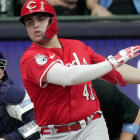
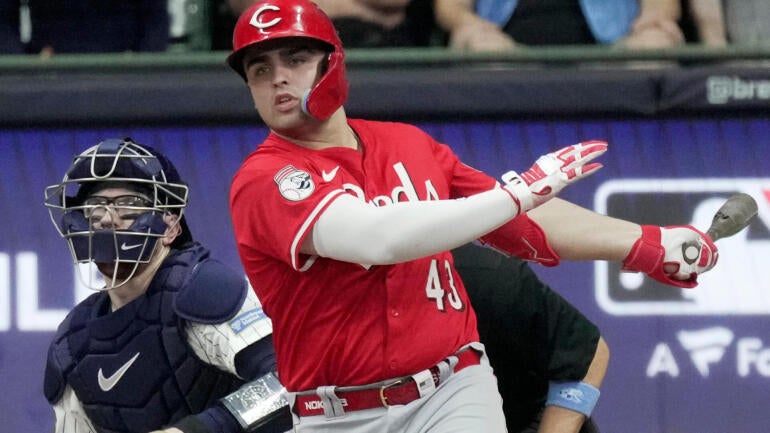
Sal Stewart, 1B, Reds
| ||||||||||||


NFBC ADP: 218.5
From the time the Reds took him in the first round of the 2022 draft, Stewart was a fringe top-100 prospect for his hitterish qualities -- i.e., good plate discipline and a line-drive approach -- and hope for future power. Let's just say that hope has been fulfilled. There were hints of it during his stint at Double-A Chattanooga to begin last year, where he homered 10 times in 80 games, but then after moving up to Triple-A Louisville, where Statcast data is publicly available, it became even clearer what was going on.
Not only did he homer 10 times in 38 games there, slashing .315/.394/.629, but his exit velocities readings measured near the top of the charts, with an average (93.1 mph) and a max (113.7) resembling Fernando Tatis. He maintained those exit velocities after reaching the majors and made an immediate splash with four home runs in his first 11 games. But then manager Terry Francona stopped playing him, even with the Reds fighting for a playoff spot, which prevented Stewart from fully ingratiating himself to Fantasy Baseballers.
Francona's curious choice may have contributed to the front office's decision to deal Gavin Lux this offseason, because if you look at the Reds depth chart now, it seems pretty obvious Stewart will have an everyday role splitting first base and DH duties with Spencer Steer.
There's so much to like here, given the amount and caliber of the contact and the likelihood he'll emerge as more of the on-base threat he was in the minors. I'm envisioning a cross between Josh Naylor and Vinnie Pasquantino, including maybe even a small dose of Naylor's newfound base-stealing ability. And there's a small possibility Stewart can pick up eligibility at second and/or third base, two positions that he also played in the minors.
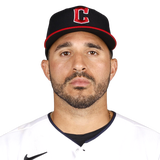
Ramon Laureano, OF, Padres
| ||||||||||||

NFBC ADP: 225.2
Between his first two teams, the Athletics and the Guardians, Laureano developed a reputation as a part-timer with poor on-base skills. He's having a hard time shaking that reputation in Fantasy. How else can you explain the complete disinterest in him despite the way he's performed over the past year and a half?
Sure, I was skeptical when he hit .296 with an .832 OPS in 67 games for the Braves in 2024 (as were they, seeing as they didn't bring him back), but then he hit .290 with an .884 OPS in 82 games for the Orioles and .269 with an .812 OPS in 50 games for the Padres. It adds up to a .286 batting average, 34 home runs and .847 OPS in his past 199 games. His wRC+ during that time is 19th in all of baseball, ahead of Freddie Freeman, Fernando Tatis, Rafael Devers and Julio Rodriguez, to name a few.
There remain obvious flaws in his profile. He's still a low on-base guy (just imagine how high his OPS would be otherwise), and his strikeouts tend to run hot. But be reasonable, guys. He's now sustained this level of production over multiple seasons and across three different environments. I think it's proven to be durable.
That's not to say I'm taking it entirely at face value. San Diego, where he remains, is the most difficult of the three environments where he's excelled. But my initial inclination was to rank him 42nd among outfielders. To see him being drafted 56th among them -- behind the likes of Jordan Beck, for goodness sake -- makes him one of the easiest choices you could make in a five-outfielder league.
Kazuma Okamoto, 3B, Blue Jays
| ||||||||||||


NFBC ADP: 238.8 (since Jan. 1)
The talk of Japan's big free agent class this offseason has centered on either Munetaka Murakami and his prodigious, top-of-the-scales power or Tatsuya Imai and his curiously effective arsenal. But then there's the other guy, Okamoto, who may actually be the most valuable of the three. You can scroll up and see his numbers from an injury-plagued 2025. They may have been inflated somewhat by the small sample but were very much in character. Four times in the past eight years, he's had an OPS over .900. Twice he's batted over .300. Six times he's hit 30 homers or more.
I think most longtime Fantasy Baseballers are still in the habit of adjusting down for players coming over from Japan since the standard of competition there is lower than the majors, but what they may be overlooking is that the NBL has become an incredibly oppressive hitting environment, which analysts sometimes refer to as Japan's dead ball era. In that context, Okamoto's already eye-popping numbers become, frankly, unbelievable. To put it in perspective, his wRC+ in Japan last year was 210, meaning he was more than twice as good as league average (which is 100). Aaron Judge was the major league leader at 204, and no one else was above 172.
Sure, there are other distinctions between the NBL and the majors that make it not an apples-to-apples comparison -- different balls, smaller ballparks, etc. -- but if the reported exit velocity readings are correct, Okamoto's 92.4 mph average and 112.2 mph max would suggest his power will translate to any league. It's not quite on the level of Murakami's, but it's more than enough. Their respective strikeout rates (11.3 percent for Okamoto and 28.6 percent for Murakami) may be the more meaningful distinction between the two.
Bottom line is that Okamoto has the more functional skill set, boasting legitimate thump, supreme bat-to-ball skills and an optimized launch angle. And he may be a godsend at third base, for as weak as that position is shaping up to be. I'd take him ahead of Royce Lewis, Addison Barger and Matt Shaw even though ADP suggests otherwise.
Marcus Semien, 2B, Mets
| ||||||||||||


NFBC ADP: 251.1
Part of the reason I'm OK with waiting at second base despite the shortage of difference-makers at the top of the position is because I think it has two clear bounce-back candidates. One is Albies, who I've already covered. The other is Semien, who's a similar case as a former early-round mainstay whose decline may not be all it appears to be.
That's harder to say because he's 35 and not 29, but the underlying data is unchanged from his youth. The plate discipline remains good. The pull-air rate remains high. The exit velocities aren't great, but they never were. If anything, they're peaking higher now.
One trend we've seen in recent years is the ball playing deader during the coldest months of the year, meaning April into May, and hitters with lower exit velocities are naturally most affected by that. So I find it unremarkable that Semien was hitting .173 with a .485 OPS through May 28 last year. What I find more remarkable is that he hit .270 with 12 homers, eight steals and an .801 OPS in 71 games thereafter. It wasn't enough to restore his full-season numbers, but it did resemble prime Semien. Maybe if he had gotten a full September rather than fracturing his foot on Aug. 21, the narrative concerning him would be different now.
Still not convinced? I might not be either if not for one notable offseason development: He's on the Mets now. Like I said, the exit velocities have always been bad for Semien, but a hitter can make up for that with a high-pull-air rate, which he has, and a more forgiving home venue, which he also now has. Citi Field plays well for right-handed power, especially fringier right-handed power like Semien's. Statcast's expected home runs by ballpark shows that he'd have hit 20 more home runs playing every game there over the past three years.
If it's enough to restore Semien to 20-25 homers to along go with a .240-.250 batting average, good on-base skills and maybe a dozen steals, that's probably better than you're going to get from Jackson Holliday, who's going more than 100 picks earlier.
Joe Musgrove, SP, Padres
| ||||||||||||

NFBC ADP: 260.6
This is less about me being especially high on Musgrove than everyone just forgetting about him, seemingly. If you count yourself among them, let me assure you he didn't retire. He's simply spent the past year and a half recovering from Tommy John surgery, a common procedure with generally favorable outcomes.
Not foolproof, but generally favorable. We used to understand the difference, but I think some recent misses on the Tommy John front have made us more wary of it. I think? It's only a theory. Maybe people just need to be reminded who Musgrove is, so I'll do that right now.
Scroll up and you'll see his numbers from the last time he was active, 2024, which are solid enough. Sort of what you'd expect from Sonny Gray or Tanner Bibee, volume aside. Very useful. Now understand that it was a year impacted by injury. The elbow was barking from the outset, and he didn't go under the knife until after the season. In the three years before 2024, Musgrove had a 3.05 ERA, 1.09 WHIP and 9.5 K/9, going 180-plus innings in two of them. Those numbers are more like we'd expect from, what, Max Fried?
So again, I'll stress that Tommy John surgery isn't foolproof, but generally favorable. You know what helps tip the scales more toward "generally favorable?" Having ample time to recover. Musgrove will have had a full 18 months. He's expected to be full-go in spring training and have no workload limitations this year, according to his manager. So what exactly is the hesitation here? To me, the risk/reward calculation comes out at least 50 picks ahead of where's currently going. If he's looking like himself this spring, it may be more like 100 picks ahead.
Shane Smith, SP, White Sox
| ||||||||||||


NFBC ADP: 291.7
Smith got some attention at various points last season, certainly outperforming expectations for a Rule 5 pick, but in most people's estimation, he settled into being a mid-level starter for a bad team, which would make him just a streamer option in most Fantasy leagues.
But I'm intrigued by what he did in the second half. Following a brief hiatus, he came back to deliver a 3.17 ERA, 1.04 WHIP and 9.7 K/9 in 11 starts, his swinging-strike rate climbing from a Jose Soriano-like 11.3 percent to a Freddy Peralta-like 12.8 percent. Improved strike-throwing was partly to credit for it. So was the continued development of a kick change, an offering the White Sox introduced to him to mimic the downward movement of his curveball. The two played off each other to perfection down the stretch, pushing the whiff rate on Smith's cuveball over 50 percent for the final two months. It ended up at 48 percent for the season, which is about as good as you'll ever see. Among pitchers who threw at least 300 curveballs last year, Smith's whiff rate was the second-highest.
How often do you see a pitcher make those kinds of strides over his rookie season? Between his high-90s fastball and whifftastic cureball, Smith already had some good weapons to work with, and pitching coach Ethan Katz has instilled him with a more cohesive arsenal and clearer method of attack. There may be some unrealized home run risk, judging by his fly-ball rate and exit velocity readings, but all in all, the second-half version of Smith may well be closer to the real one. If nothing else, I would say there's less daylight between him and Ryan Pepiot than the 150 spots in ADP would suggest.