Chris Towers' Busts 1.0: Oneil Cruz checks in as one of the riskiest picks for 2026
A combination of talent and risk could sink several Fantasy rosters

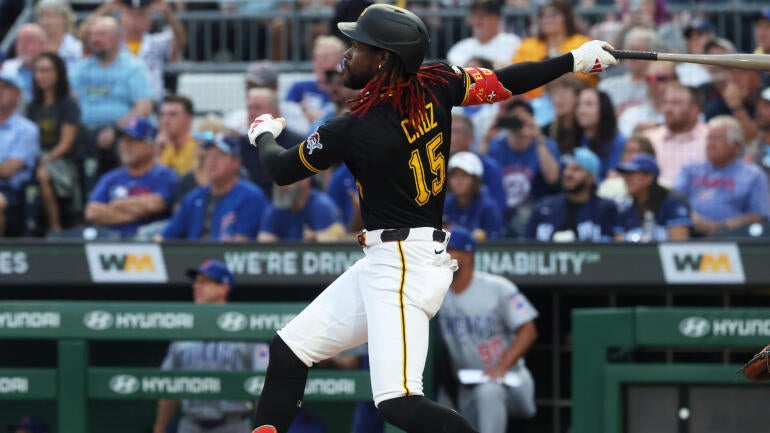
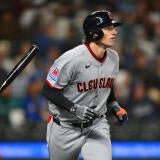
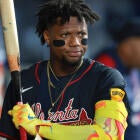
There's two types of bust candidates in this world, and Oneil Cruz is both of them.
On the one hand, you've got the guys who are fine players who just cost way too much in drafts. Cruz, who had 20 homers and 38 steals despite his shortcomings in 2025, certainly counts as a "fine" player, but his cost in drafts (98.6 in NFC drafts to date) is just way too much to justify given his limitations.
And that's where the other hand comes in. Because that other category of busts for Fantasy baseball are the players whose downside is so great that they might not even be worth drafting at any cost. Cruz, who hit .200 with sub-replacement-level totals of 62 runs and 61 RBI, surely counts here, too.
- Sleepers 1.0: Scott | Chris | Frank
- Breakouts 1.0: Scott | Chris | Frank
- Busts 1.0: Scott | Chris | Frank
And it could get worse for him. Sure, I think it's unlikely Cruz is a worse hitter in 2026 than 2025 – his .218 xBA and .324 xwOBA, for instance, suggest he probably deserved better results than he actually got last season. But even if Cruz does hit better than 2025 overall, there's still real risk that he's just a platoon bat coming off a season with a .400 OPS against lefties. He has generally been unplayably bad against lefties throughout his career, and the underlying numbers don't paint an especially rosy picture – among 240 hitters with at least 100 plate appearances against lefties, Cruz's .260 xwOBA was the 20th worst mark in baseball.
And Cruz isn't such a dynamic defender (despite his physical tools) that a team actually trying to win games can justify leaving him in the lineup when he isn't hitting. And, for whatever else you might say about the Pirates, they are actually trying to win games in 2026. They may decide that a fully-realized version of Cruz playing every day is their best chance to actually win games, but they also might come to the realization that playing Cruz against lefties is untenable and banish him to the realm of platoon bats.
Is there upside for Cruz to grow beyond what he's shown so far in his career? Of course there is. Nobody in baseball hits the ball harder than him, and he remains one of the most gifted athletes in the game. But he's also 27 years old, a few years past the point where we're typically giving players a lot of credit for their potential.
So yeah, there's upside. But there's also considerable downside risk for Cruz. He might hit .200 again. He might get benched against lefties. He might be a stolen bases specialist who drags you down in the other four categories (and he might just be outright unplayable in points leagues thanks to his plate discipline). I'd be tempted to take a flier on the upside and see the glass half full if Cruz was sitting there around 150th in a draft. But at a top-100 price? No, the downside is what we should be focusing on there, and Cruz has a ton of it. Among top-100 players, he might be the most likely to prove actively detrimental to your chances of winning in 2026, in fact.
I'm not touching Cruz in 2026 drafts, but he obviously isn't alone. In the rest of today's newsletter, I've got 10 more bust candidates for you, including four whose price makes them busts, and six more whose skill sets are what scares me off of them.
Busts 1.0
Like the player, not the price …
Nick Kurtz, 1B, Athletics
This isn't the first time I've made this point, but it's worth revisiting in light of how historically awesome Kurtz was as a rookie. His 1.002 OPS made him just the sixth player in MLB history with an OPS north of 1.000 with at least 450 plate appearances as a rookie. Here's how the five before him fared in their following season:
- Judge: 1.049 OPS as a rookie; .919 OPS his next season
- Pujols: 1.013 OPS as a rookie; .955 OPS his next season
- Braun: 1.004 OPS as a rookie; .888 OPS his next season
- Williams: 1.045 OPS as a rookie; 1.036 OPS his next season
- Bernie Carbo: 1.004 OPS as a rookie; .677 OPS his next season
That doesn't mean Kurtz is fated to take a step back in 2026, but it's a pretty safe bet. And not just because Bernie Carbo ended up being one of the all-time flashes in the pan. For as good as Kurtz is, he definitely overperformed as a rookie, putting up a .419 wOBA (second-best in baseball) compared to a .371 xwOBA (17th-best in baseball). Now, of course, there's nothing wrong with being the 17th-best hitter in baseball. But when it comes in a package that will probably include a pretty low batting average (.245 xBA as a rookie) and no speed, it makes a second-round investment tough to justify. There's nothing wrong with being Matt Olson, but Matt Olson is just a lot cheaper than Kurtz right now, and I'm not 100% convinced Kurtz is better than him. He's one of the better bets for 35- or even 40-plus homers, so Kurtz should be a very useful Fantasy option. Just not one worth a top-20 pick.
The case for Rice is already pretty strong – he was the No. 5 catcher in Fantasy last season and seems in line to easily exceed last season's 530 plate appearances now that he seems secure as the Yankees' starting first baseman. And if you dig beyond the underlying numbers, the case gets even stronger – his .394 expected wOBA was the eighth-best mark among all hitters in 2025. If he can truly live up to that, we're talking about a guy who could be an impactful Fantasy 1B who also happens to be eligible at catcher. That could be a huge cheat code for your Fantasy team.
The problem is that Rice is already being drafted as if he is that kind of cheat code. Every year, there is at least one player the Fantasy Baseball hive mind pushes up draft boards way more than their track record can justify (last year, it was Lawrence Butler and Wyatt Langford), and Rice seems to be this year's version. Since the start of January, Rice's ADP is up to 46.2, which makes him not just the No. 2 catcher off the board, but also ahead of proven stud first basemen like Bryce Harper, Matt Olson, and Rafael Devers. Rice could be worth that price, but I simply cannot justify taking him over William Contreras, who was the No. 9 hitter at any position in 2024.
Rice might be that good. The underlying numbers certainly support the idea that he has that upside, certainly. But it is worth noting that Rice has now underperformed his underlying numbers in both of his MLB seasons, so there might be something about his swing that holds him back a bit – my best guess is a swing more geared for power to the power alleys than down the line, despite a relatively high pulled-air rate. But the truth is, even if Rice does have the upside to justify his current cost, he isn't the only catcher you can say that about. So why pay the premium for him alone?
Nolan McLean, SP, Mets
This year's class of second-year pitchers is really, really exciting, and McLean is a big part of that. But as with Rice, early drafters have elevated McLean to a point where it just doesn't make a ton of sense to buy into him at this point. Here's where McLean and the other pitchers in his cohort are coming off the board right now:
- Nolan McLean - 104.67 ADP
- Chase Burns - 125.17
- Jacob Misiorowski - 131.8
- Cam Schlittler - 135.74
- Trey Yesavage - 158
- Bubba Chandler - 162.91
I think it's perfectly reasonable to like McLean best of this group, even if my personal favorite is probably Burns. But McLean has a lot going for him coming off a season where he threw 161.2 innings between the minors and majors, put up a 10+ K/9 or better at Double-A, Triple-A, and in his 48 innings in the majors. Add in his elite groundball rates and presence on a Mets team that should have a very good defense, and it's easy to see why people like him so much.
But it's hard to see why people like him so much more than the rest of this group. Burns, for example, tied for the ninth-most double-digit strikeout games in the majors last season in just eight starts; Schlittler put up a 2.96 ERA and 10.4 K/9 before going on to throw up a couple of gems in the postseason; Yesavaga was even more brilliant in the playoffs, striking out 39 and putting up a 3.58 ERA in 27.2 innings while pitching the Blue Jays to the precipice of a World Series title. McLean has a lot going for him, but he's not so much more talented or proven than the rest of this group that it makes sense to draft him two, three, or even five rounds ahead of them.
Blake Snell, SP, Dodgers
At the risk of oversimplifying, there's this:
Blake Snell has finished as a top-five SP in Fantasy two times in 10 MLB seasons. He hasn't even been a top-30 SP in any of his other eight seasons.
The upside is impressive, and he'll go through a two-month stretch seemingly every season where he pitches like one of the three or four best in baseball. And on two separate occasions, he has managed to stay healthy and been just that. The best-case scenario for Snell isn't theoretical; we've seen it, and he reminds us of it at some point every season. And you can make the case that, by the end of the season, the production is good enough to justify drafting him around the 20th SP off the board.
But here's the qualifier: If you're going to draft Snell, you have to know what you're getting into. At this point, you have to know that there will probably be a stretch where he isn't just useless for your Fantasy team, but might just be actively harmful. Snell usually misses time every season (last year it was with a shoulder issue), but even when he's on the mound, he has these stretches where he's just torching your ratios, including an ERA of 5.00 or worse as late as May 25 in each season from 2021 through 2023. If you ride it out, you usually end up with pretty excellent numbers in the end, but the ride to get there is often bumpy, and his injury history raises the risk of both a slow start and no late-season redemption. Or worse: You draft him, eat the ratio-killing months, and then either drop or trade him when his value is at its lowest.
Could Snell be worth a top-20 cost among SPs, with a price inside the top-75 overall? Sure, he could be. It's just not a particularly likely outcome, and at some point, we've gotta stop chasing the good times and accept that Snell is who he is.
The bottom could fall out
Spencer Strider, SP, Braves
I want to be wrong about this one. So badly. Strider at his best was so much fun to watch, and was even more fun to have on your Fantasy team. And maybe he can get back to that level now that he's another full year removed from the internal brace procedure that cost him nearly all of his 2024 and severely limited his effectiveness in 2025.
But here's where I struggle with Strider: He just wasn't close to even being an average pitcher last season. His 4.45 ERA tells that story, but his 4.93 xERA tells it even better. Even at his best, Strider wasn't the kind of pitcher who dominated because he had mastered the art of pitcher; he just overwhelmed you with a dominant fastball and slider combo. His command was iffy, and he had trouble limiting damage on contact, but he overcame that by missing more bats than anyone else.
But the stuff has backed up considerably since the surgery, with his four-seamer losing nearly 3 mph from 2022 and losing multiple inches of ride along with it. He went from an elite fastball to a pretty poor one, and he needs to get a lot of that back to be a viable Fantasy option. Maybe he'll show us that in spring and justify a top-110 price, but it's not like he got better as the season went on, either – Strider had a 2.79 ERA in five September starts, but that came with just a 21% strikeout rate and a walk rate north of 10%.
I'm rooting for Strider to prove me wrong. But I need to see something from him before I have faith in him again.
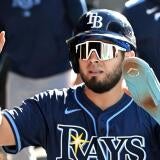
Chandler Simpson, OF, Rays
Simpson is an elite baserunner and one of the best contact hitters in the game, and in theory, those two skills alone should make him an impactful Fantasy option. He's one of the better bets in the majors to hit .300 and one of just a few players with 60-steal upside, and if he does nothing else but those two things, he's going to be a very good pick at a 155.8 ADP.
The problem is, well … he might literally do nothing else but those two things. His contact-heavy approach comes with basically zero power, and his walk rates completely collapsed at both Triple-A and in the majors last season after being at least average earlier in his career. A .326 OBP is fine enough, but Simpson was a below average hitter (88 wRC+ last season) despite hitting .295, because singles are basically all he was capable of producing. His ability to end up on second base after those singles helps mitigate some of those limitations, but even in a best-case scenario, I think you're hoping for a roughly average offensive player in real life terms.
Which brings me to the real reason Simpson is listed on my busts list: He might just not be a good real-life player. At all. His profile is uniquely suited to be impactful for Rotisserie scoring in Fantasy, but an organization as smart as the Rays surely values a lot more than just a nice batting average and a bunch of steals. They value, for instance, defense, and Simpson profiles as a pretty terrible defensive outfielder despite his speed – he ranked 254th out of 299 qualifiers in BaseballSavant'.com's Fielding Run Value stat last season. This is the primary reason he was sent back to Triple-A despite a mostly successful first month in the majors, and it's the reason I think he has a real chance of not even being on the Rays Opening Day roster.
This is a team with a crowded outfield that really values defense, so Simpson needs to significantly improve in that aspect of his game to secure playing time. It's possible he will – his speed certainly gives him the tools to be at least playable in a corner spot. But if he continues to struggle with the glove this spring, I think there's a real chance the Rays opt to leave him on the outside looking in. There's plenty of upside here, but I don't think there's another player with an ADP inside of the top 200 who has this obvious a path to total Fantasy irrelevance by April.
Cedanne Rafaela, OF, Red Sox
I don't like Rafaela's price (124.8 ADP in January so far), and I'd be out on him for that reason alone. But even if he was going 50 picks later, I'm not sure Rafaela would be on my draft board, because I just have severe questions about his skill set. He has some of the worst plate discipline skills of any hitter in baseball, and while he managed to both cut his strikeout rate and nearly double his walk rate last season, the underlying skills are still pretty weak. He swings at over 40% of pitches out of the strike zone, and while he improved his contact skills in 2025, that still leaves him making contact with a lot of balls he probably can't do anything with.
And he does this without premium, or even above-average quality of contact metrics – his .355 xwOBA on contact is solidly below the MLB average of .369. And he doesn't have Pete Crow-Armstrong's ability to elevate the ball to the pull side and hasn't really shown 30-plus steal upside, either. 15 homers and 20 steals have some value, but I don't see much reason to chase that from Rafaela when you have guys like Sal Frelick, Jordan Beck, Otto Lopez, or Dansby Swanson going off the board later who can do the same thing. If there's any regression in Rafaela's profile, he could legitimately be one of the worst hitters in baseball.
Roki Sasaki, SP, Dodgers
I can't argue with the price – 245.2 ADP is basically all upside. The problem is, I just don't really believe in Sasaki carrying much upside at this point. He was a disaster as a starter in his rookie season, and even his move to the bullpen for the playoffs was less impressive than the hype around him might have made you think – he ended up with just one run allowed in 10.2 innings, but he also struck out just six and walked five. The problem comes down to this: Because of his release point, Sasaki's fastball will probably always struggle to be an effective pitch. He can overcome that with premium velocity, but even when he was sitting in the high-90s out of the bullpen, you can see he just wasn't missing many bats.
Sasaki does have that killer splitter, but that's a tough pitch to rely on, especially his version, which often moves unpredictably. With a slider that doesn't look like anything to write home about, we really need to see Sasaki show the ability to sustain premium velocity as a starter, and I just haven't seen any sign that he can do that. Maybe he'll come out in Spring Training averaging 98 like he used to in Japan, but here's the problem: If that happens, Sasaki's price is almost certainly just going to keep rising, taking him out of the "no downside" range of drafts.
Which is all to say: His current price is probably fine, but he hasn't shown the skills to even be worth taking ahead of other, cheaper pitchers like Shane McClanahan, Joe Musgrove, Jack Leiter or Bryce Miller, and if he does start to flash that kind of skill, we're likely to see his price skyrocket to the point where he still isn't a good pick. And the likeliest outcome based on his rookie season might just be that Sasaki is useless for Fantasy.
Shane Bieber, SP, Blue Jays
This is one I want to revisit in Spring Training, because the last we heard of Bieber, he was dealing with a forearm issue that may have led him to pick up his player option instead of hitting free agency, a pretty concerning sign from a guy who might not get another chance at a big payday. He returned from Tommy John surgery last August after some fits and starts and mostly looked okay, but not exactly impactful – he struck out just 37 in 40.1 innings in the regular season, with nine of them coming in six innings in his first start. He struck out less than a batter per inning in the postseason, too, and had a FIP north of 4.00 in both the regular and postseasons.
Now, it's fair to note that Bieber was doing that in his first action since the start of 2024, coming off major elbow surgery, which is why I was initially willing to give him the benefit of the doubt that he would fare better in 2025. But given the uncertainty around the health of his arm – and, more than that, his ability to stay healthy moving forward – I need to get Bieber at a steep discount to justify the risk. In January drafts, his ADP is down to 188.9, so that discount is there, and I'm mostly finding taking a flier on him around 200 as part of a diversified portfolio of pitching risks.
But the risk here is real, and the chances Bieber just cannot pitch effectively – or at all! – cannot be ignored.
Jacob Wilson, SS, Athletics
It's worth noting that, because of his extreme contact skills, Wilson is a better fit for H2H points leagues – though even there, he is a pretty fringe starting option given the generally shallower lineups in those leagues.
But in Roto leagues? I just don't have very much interest in Wilson outside of a very specific team-building scenario, because I think he's basically a one-category player. We just went through this the past few years with Luis Arraez, who is a very useful (though still limited) Fantasy option when he's challenging for batting titles and otherwise is a pretty fringe-y option if he just has a good but not elite batting average. The Wilson boosters will point to his 13 homers in 2025 as proof that Wilson has more impact potential in his bat than Arraez, but I'm not sure that holds up – Wilson had a more or less average HR/FB rate of 10.5% last season despite worse quality of contact metrics than even Arraez, plus a below-average pulled-air rate.
I'll grant two things: Wilson is still young enough to get better, and his home park in Sacramento should help. But he outperformed his expected wOBA by 34 points in 2025, the fourth-biggest mark in baseball. The skill set here just isn't particularly strong, and while there are some factors working in his favor to outrun that, there's no guarantee we get that best-case scenario from him again. And the mid-range outcome here might be shockingly mediocre for Fantasy.
Nick Pivetta, SP, Padres
Are you surprised to learn Pivetta will be 33 on Opening Day? On the one hand, he's been around for a pretty long time, but he also only just turned in his first season ever with an ERA south of 4.00 in 2025, so you could be forgiven for thinking he's younger than that. But betting on a 33-year-old coming off a career year usually isn't a smart policy for Fantasy, and in Pivetta's case, there are some red flags even beyond the typical regression concerns.
For one thing, while Pivetta had his strongest results ever, the underlying skill set showed some real weaknesses, with his strikeout rate dipping to 26.4%, his lowest since 2022, while his quality of contact allowed remained as poor as ever (.392 xwOBA on contact, compared to a .390 career mark). Petco Park can help cover up for that to some extent, but his 3.99 xERA in 2025 suggests there was a lot more that went right for Pivetta than can be accounted for by a better home park. And, given his age, it's not unreasonable to worry there could be even more skills-based decline on the way. With a margin for error as slim as Pivetta's, that's concerning.