You've got thoughts about the All-Star game rosters. You might be upset about the way Blue Jays fans dominated the voting, getting Ernie Clement in as the top vote getter on the American League side. You might be upset about Dylan Cease being tabbed as the starter over Cam Schlittler, or you might share Zack Wheeler's annoyance that he wasn't initially selected to be part of the team.
That's part of the fun of the All-Star game! As fans, a big part of the appeal of sports is the often inane debates we all love to take part in. Does it really matter that Clement made the All-Star game despite ranking 46th in the American League in WAR? Of course it doesn't! It's all supposed to be fun, and getting mad about silly All-Star game stuff is fun!
So now's your opportunity to get mad at me. With the All-Star game set to kick off tonight, now is a good time to introduce another opportunity for inane debates, so here are my picks for the 2026 Fantasy Baseball All-Star rosters. And, in this version of the team, value absolutely matters – if a player is No. 3 at his position but was drafted as the 37th player, that matters to me a lot more than the guy who was drafted second ranking first.
So here's my attempt to go through every position to identify the most impactful players at each one, along with some thoughts on how likely each player is to sustain their incredible first-half production through the finish line.
2026 Fantasy Baseball All-Stars
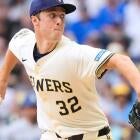
Starting Pitcher: Jacob Misiorowski, Brewers' Cam Schlittler, Yankees; Zack Wheeler, Phillies
Regardless of draft position, the FanGraphs Player Rater has these guys as the top three pitchers in Fantasy so far, which makes the fact that all three were drafted outside of the top 100 on average even more incredible. Misiorowski is obviously the biggest breakout star among pitchers in the entire league, going from "interesting but flawed" to "simply the best pitcher in baseball" seemingly overnight. Misiorowski has been completely overpowering, sporting a 41% whiff rate with his four-seamer, which has leapt to 100.3 mph; the rest of the arsenal looks both deeper and more dominant than last season, too, and his 1.62 ERA is backed up by ERA estimators in the low-2.00s. The risk of injury will always loom over a flamethrower like Misiorowski – not that there are any other flamethrowers quite like Misiorowski – and the fact that his first half ended with arm fatigue is a claxon warning. Let's hope it's as minor as the team seems to think.
Schlittler has shown some vulnerability to the long ball lately, but he's still striking nearly 30% of hitters while walking just 5.3%, nearly half of last season's mark, so you can live with the occasional solo homer. He won't keep up 2.00-ish ERA, but Schlittler's triple-fastball approach shows no other signs of slowing down, and as long as he can sustain the elite velocity, Schlittler is going to remain an absolute ace.
And then there's Wheeler, about whom I just don't even know what to say at this point. He came back from serious surgery on his shoulder/ribs as a 36-year-old and basically looks as good as ever. He's throwing six-plus innings basically every time out, his velocity is almost entirely back, and his 2.63 xERA is the second-best mark of his career and second-best among all starters. I thought last season's injury would mean the end of Wheeler's time as an ace; now I think he's pitching his way into Cooperstown.
I'll be honest: Even as a Marlins fan, I never saw anything like this coming from Meyer. He's never had much feel for anything outside of his breaking balls, so he has opted to just go all-in on what works, throwing his slider and sweeper a combined 55.9% of the time, and both pitches have been exceptional – the slider has the seventh-most run value added among all pitches of that type, per BaseballSavant.com, while the sweeper is eighth. It doesn't all add up to a sub-3.00 ERA and he is seven innings away from matching his career-high (set in 2024), so there's definitely reason to be concerned about how the second half is going to go. But there's nothing to complain about with how it has gone so far.
Catcher: Liam Hicks, Marlins
Hicks was entirely an afterthought in drafts, but he's the No. 3 catcher at the break, thanks to a swing change that saw him add a leg kick and helped him tap into a bit more power by sacrificing his outlier contact skills. The underlying numbers don't quite back up his breakout, and he has certainly slowed down. But he's also top-five at the position in both runs and RBI while ranking second in batting average. From a player who went undrafted in every league, that's a huge win.
Alternate: Dillon Dingler, Tigers – Dingler wasn't going as late as Hicks, but his ADP was around 250 overall and he's behind just Ben Rice, Hunter Goodman and Shea Langeliers at the position with 19 homers. And in his case, the underlying data is actually even better than the actual production, as his .376 expected wOBA is actually behind only Rice at the position. He's a pretty good bet to keep on hitting in the second half.
First Base: Ben Rice, Yankees
I know, you thought he should be the choice at catcher, but he won't be left off the team. He has been the best player at 1B this season, helped along by a late injury and some batting average struggles for Nick Kurtz. You're getting more use out of him at catcher, probably, but he's currently leading all first basemen in homers, RBI and runs while putting up a totally respectable .279 batting average. I'd expect a bit of second-half regression (he started to slow down in June but has come roaring back in July so far), but Rice remains a decent bet to finish the season as the top player at both positions. And he'll still be well worth an early-round pick next season even when he inevitably loses catcher eligibility.
Alternate: Miguel Vargas, White Sox – Josh Naylor isn't the only base-stealer at first base, and Vargas is actually hitting like a first baseman this season, unlike Naylor. He has 11 steals and 21 homers, and his 32 combined actually leads the position. Not bad for a reserve round pick in most drafts.
(I thought about including Luis Garcia here, who is actually the No. 5 first baseman in Roto, but it's really just an incredible month and a half, because he was pretty fringe-y before that.)
Second Base: Otto Lopez, Marlins
Lopez would be a fine pick at either middle infield position, but we'll go with the one where he's actually the No. 1 player right now – see, he's only No. 2 at shortstop, the slacker. Lopez's .334 batting average leads the majors and he's on pace for 15-plus homers and 30-ish steals, basically giving us what we were hoping for from someone like Maikel Garcia. Lopez probably won't win a batting title, but the underlying numbers suggest this is a real breakout, even if some regression is expected.
Alternate: Brandon Lowe, Pirates – I don't really get why Lowe fell into the 190 range in drafts after a 31-homer season. I guess some Fantasy folks really overestimated how much Steinbrenner Field inflated offense (you can see this with the offseason narratives around Junior Caminero, plus how cheap Yandy Diaz was in drafts). Lowe is the best power hitter at second base and has been for a long time, and it wasn't just because of Steinbrenner Field. It was just a question of whether he could stay healthy, and he has.
Third Base: Sal Stewart, Reds
Stewart has slowed down a bit after a hot start that saw him looking like a superstar early on, but he's a top-12 option at three different positions, including third at third base. Junior Caminero has been better, but Stewart's 11 steals help him close the gap some, and his price outside the top 150 in ADP does the rest. Stewart's underlying numbers back up what he's done so far, and while the power seems to have settled in as more "pretty good" than elite, the all-around skill set is extremely strong. The question is whether there's another level he can get to, or if he's just a top-50-ish player.
Alternate: Casey Schmitt, Giants – The underlying data backs up Schmitt's breakout, but I'm not terribly surprised that we've already seen some regression from him. Still, outside of a cold June, he has been worth starting at any one of the roughly dozen or so positions he's eligible for. Even if he isn't a superstar, Schmitt is a fantastic player to have around when you can slot him in literally at any position except catcher.
Shortstop: CJ Abrams, Nationals
After being burned by false starts in three consecutive seasons, pretty much everyone wrote Abrams off as just a solid starting shortstop, but not a particularly exciting one. Well, maybe we underrated the impact of the Nationals' rapid modernization of their front office and coaching staff, because they've managed to coax the best production of Abrams' career in while, crucially, sustaining it for more than just a couple of months. He may still slow down at some point, but Abrams's plate discipline has improved at the same time as his quality of contact, a tough feat to manage. I'm still on guard for the regression we've seen in recent years to catch up to him, but Abrams has been the best shortstop in Fantasy to date and nobody can take that from him.
Alternate: Xavier Edwards, Marlins – Edwards will never be the huge stolen base threat he looked like in 2024, which puts the onus on his batting average skills to carry the profile. Well, he's cut his strikeout rate to a career-low 11.7% while pushing his walk rate up to 12.2%, establishing him as a viable points league or Roto starter. He's a bit more valuable at second base than third, but he's good in either format.
Outfield: James Wood, Nationals; Yordan Alvarez, Astros; Jordan Walker, Cardinals
I'm trying not to just pick the top players at every position for this exercise, but it's kind of unavoidable at outfield, where all three players came into the season with their fair share of detractors. Well, that might not even be fair to say in Walker's case – he had reached the point where Fantasy drafts didn't even think about him at all, with his ADP dipping below 500 in drafts. I don't buy the near-.300 average remaining sustainable, but Walker has taken real steps forward with his contact skills and bat path. His .374 xwOBA is right in line with his actual .380 mark, and he has already stolen a career-high 13 bases.
Alvarez's draft drop was understandable, but it is also a good example of how some of y'all just play scared when it comes to injuries. The thing with Alvarez is, when he falls to around 40th in drafts like he often does, you really only need one thing to go right for him: If he stays healthy, he's going to crush that price. He entered the season second among hitters in wRC+ since his debut behind only Aaron Judge, and he's one of, I think maybe three or four hitters capable of both a .300 average and 50-plus homers in a season. The one thing that has gone right so far, and look at that, he's hitting .318 and is on pace for 50-plus homers. If he gets hurt and doesn't play another game, he's worth the price you paid for him already.
The same could be said for Wood, whose 28 homers, 89 runs, 64 RBI, and 15 steals would represent a pretty good season if he doesn't add a single number in any category. It's hard to shake the memory of last season's near-40% strikeout rate after the All-Star break, but his underlying data is even better than it was last season and suggests he has blossomed into one of the very best players in baseball. There's enough inherent swing and miss risk in his game that it's hard to believe the volatility has gone away forever, but I think it mostly makes sense to buy in at face value here. He's looking like a first-round pick next season, and potentially a top-five one if he avoids the second-half stumble.
Alternate: Bryan Reynolds, Pirates
We'll go a bit further down the rankings and ADP to highlight Reynolds, who is enjoying a vintage season. Actually, that might be understating it – his 143 wRC+ just edges out his 2021 season for the best of his career. He probably won't sustain that .283 batting average, but Reynolds is putting up the best average exit velocity and hard-hit rate of his career without sacrificing much in terms of contact skills, so the rebound looks real. He's a big part of why the Pirates are fighting for a playoff spot.
Designated Hitter: Pete Crow-Armstrong, Cubs
Yeah, I could hear you grumbling about Crow-Armstrong not being mentioned in the outfield section, and yes, I recognize the irony of putting the best defensive player in baseball at DH. Crow-Armstrong ranks just behind the three outfielders chosen (and just ahead of Reynolds) for the season, mostly because he was awful for the first month or so. There's plenty of inherent volatility here in Crow-Armstrong's profile, but he has taken his plate discipline from "worst in baseball" to "merely terrible" and it's had a huge impact on his overall game. Crow-Armstrong is striking out a bit more than last season, but he's making up for it with improved quality of contact metrics and an 11.2% walk rate, nearly triple last season's mark. I'm certainly aware of the risk that this all comes falling apart with another bout of free-swinging abandon, but Crow-Armstrong looks genuinely improved across the board in a way that should insulate him from some of the risk.
Alternate: Andy Pages, Dodgers – Okay, now let's see if Pages can avoid the second-half slump himself. He has already slowed down plenty after flirting with a .900 OPS through the first two months of the season, but like Crow-Armstrong, Pages has continued to improve his plate discipline, which hopefully limits the downside here. The quality of contact here remains more good than great, but with a strikeout rate below 20% and a pulled-air rate near 20%, good is good enough.
Relief Pitcher: Jacob Latz, Rangers
I had a bit of interest in Latz as a SPaRP this spring, and then lost pretty much all interest when he was moved to the bullpen when the Rangers broke camp. Turns out I was missing out on one of the best closers in Fantasy. It took him a while to truly take the job – he was often used as a multi-inning reliever early on, but took over as closer by late April and has just run away with the job. Latz's stuff is playing up in shorter bursts, but he still doesn't get quite as many strikeouts as some of the other elite closers. But even an ERA closer to 3.00 would be great from a guy you added off waivers a month into the season.
Alternate: Louis Varland, Blue Jays – Based on how much they used him in the playoffs last season, I knew the Blue Jays liked Varland. When Jeff Hoffman faltered, I wondered if they would try to stick with Varland as a high-leverage fireman, but he has just proven too dominant not to trust as the closer as well. He'll occasionally still work in some especially important moments before the ninth inning, but Varland got up to 19 first-half saves despite not getting his first until April 21, so they clearly aren't shying away from him in save situations. His dominance feels a bit more sustainable than Latz's, to me.