
How the Blue Jays can rebound after losing out on Kyle Tucker and Bo Bichette
Toronto is coming off an American League pennant and a strong offseason...until now

It had been an offseason of wins for the reigning American League champs in Toronto, but that script has flipped in a matter of hours. First, the Blue Jays' efforts to land Kyle Tucker, the top-ranked free agent on the market this offseason, came to grief on Thursday when he agreed to a deal with the Dodgers. Then on Friday, a perhaps even more crushing blow was absorbed when infielder Bo Bichette -- a Jays lifer, core contributor for years, and a fan favorite in Toronto -- landed with the Mets.
Let's first note that Toronto this winter has done strong work in capitalizing on their successes of 2025 and avoided the stasis that tends to afflict teams who reach a higher tier in the season prior. Since falling to the Dodgers in seven excruciating games in the World Series, the Jays have seen their qualifying offer accepted by Shane Bieber and inked strikeout artist Dylan Cease to a seven-year, $175 million free-agent pact. Cease gives them ace potential in a rotation that already includes Kevin Gausman, and deadline addition Bieber and playoff phenom Trey Yesavage will, health permitting, give Toronto full seasons in the rotation. In the lineup, the Jays added slugger Kazuma Okamoto from Japan with the hope that his thump at the plate will translate from NPB to MLB.
Now, though, the Jays are in need of an offseason capstone to both improve the roster in what's looking like a brutally competitive AL East and relieve some of the sting of the last two days. After the Tucker defeat, the easy pivot would've been to commit resources and energy to retaining Bichette's services, But now that that's no longer possible, what's next for the team that last season came within a hairsbreadth of winning it all? Let's explore some options for the suddenly reeling Jays.
The focus is likely on improving the lineup, and here's what it looks like at present:
C: Alejandro Kirk
1B: Vladimir Guerrero Jr.
2B: Ernie Clement
3B: Kazuma Okamoto
SS: Andrés Giménez
LF: Anthony Santander
CF: Daulton Varsho
RF: Addison Barger/Davis Schneider
DH: George Springer
In the infield, Clement is the moving piece. He's a useful sort, to be sure, but his very modest offensive profile suggests he's best deployed as a frequently used utility man at every infield position. In the outfield, Santander is the unknown. Last season, he was beset by injuries, which raises hopes of a bounceback in 2026 but hardly guarantees one. His poor fielding and lack of on-base skills mean he has to put up power numbers to be playable. Meanwhile, the Barger-Schneider platoon is a solid one but nothing you commit to at the expense of market upgrades. Now for some possible responses to those recent disappointments.
Option 1: Get in the Cody Bellinger market
The 30-year-old Bellinger put up a strong 5.1 WAR for the Yankees last season, which led to his decision to opt out and test the market once more. He played in 152 games last season, and over the last three seasons has an OPS+ of 125 while averaging 24 home runs per campaign. As well, Bellinger remains capable of playing all three outfield positions -- and being a plus at the corners -- in addition to first base. For Toronto, he'd be an upgrade over Santander or the platoon arrangement in right, while also being able to occasionally spell Guerrero at first. To land Bellinger, though, the Jays would need to out-position the Yankees and their incumbent's advantage and also again fend off the Mets, who may have designs on Bellinger even after the Bichette addition.
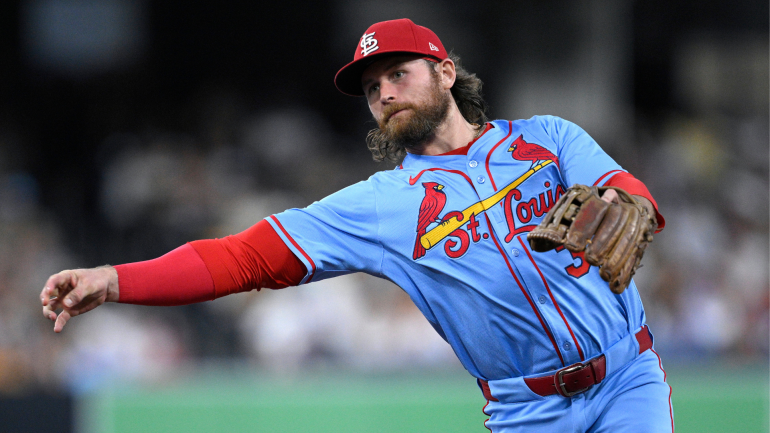
Option 2: Trade for Brendan Donovan
Second base, as noted above, is a potential concern for Toronto, as Ernie Clement might be stretched as a season-long regular at one position. The Mariners, Giants, and Royals are all interested in acquiring Donovan from the Cardinals, who are in turn shopping him as part of their rebuild. Donovan owns a career OPS+ of 119 and he was seemingly on his way to standout 2025 before a lower-half injury sapped his production as he attempted to play through it. Instead, he "merely" wound up producing in line with career norms. Donovan is capable of playing multiple positions, but second base is his strongest. As a lefty bat, Donovan would also pair well with the right-handed-hitting Clement. Donovan can also play left field, should that wind up being the more pressing lineup need. The Jays haven't been prominently mentioned in connection with Donovan -- or Bellinger, for that matter -- but their offseason calculus may have been changed by recent events.
Option 3: Hold steady
In a vacuum, adding the likes of Cease and Okamoto is a respectable offseason by contemporary standards, even for a contender. The timeline of things, though, makes the Jays' work feel like not enough. That aside, the Jays can plausibly survey their roster and decide they can proceed with what they have and still harbor designs on another deep October run. Santander isn't all that far removed from a 44-homer campaign for the Orioles -- the one that motivated the Jays to give him a guaranteed $92.5 million on the market. The platoon in right is, as noted, playable and perhaps useful, and Clement can still be an asset assuming his defensive excellence stays intact as a regular second baseman. There's always, of course, a chance to re-evaluate the roster leading up to the trade deadline, and the improved rotation may buy the necessary time for lineup evaluations and tweaks.
Inspiring? No. Sensible and effective? Possibly. We'll know soon enough whether the Jays' braintrust is thinking along similar lines or cooking up a surprise of some sort.