Ranking the top 20 AL Central prospects: Kevin McGonigle, Chase DeLauter, Walker Jenkins and more
The Tigers' farm system dominates the division

The start of a new year can mean only one thing around these parts: it's time to analyze and rank an unhealthy amount of minor-league prospects. Such is the tradition here at CBS Sports, but while we're upholding that tradition, be aware that we're making some changes to our approach by ranking the top 20 prospects per division, however that breaks down by team. Our belief is that those tweaks will make the coverage better by making it easier for fans to compare how their future players stack up against their top rivals.
These rankings are formed through firsthand observational and statistical analysis; conversations with scouts, analysts, and player development specialists; and an understanding of historical trends. Add in some biases toward and against certain player types and, on occasion, a tiebreaking coin flip, and you have a general idea about how we put these lists together.
Below, you'll find the American League Central list, which is dominated by the Tigers. Not only does Detroit boast the top two prospects in the division, but the Tigers have four of the top 10 players overall. The Guardians have three players in the top 10 and the Twins have two members of the top five. Neither matches Detroit's combination of quality and quantity, however -- and that's bad news for the rest of the division.
On the flip side, the Royals possess the weakest farm system of the bunch. The Royals have just two of the top 20 prospects in the Central and only one who cracks the overall top 100 list (catcher Carter Jensen). To be fair, the Royals have graduated a lot of talent in recent years, including outfielder Jac Caglianone and lefty Noah Cameron just last year.
Now, let's get to the reason why you clicked.

1. Kevin McGonigle, SS, Tigers
- The quick hook: Polished lefty hitter with contact, patience, and strength
- MLB ETA: Summer 2026
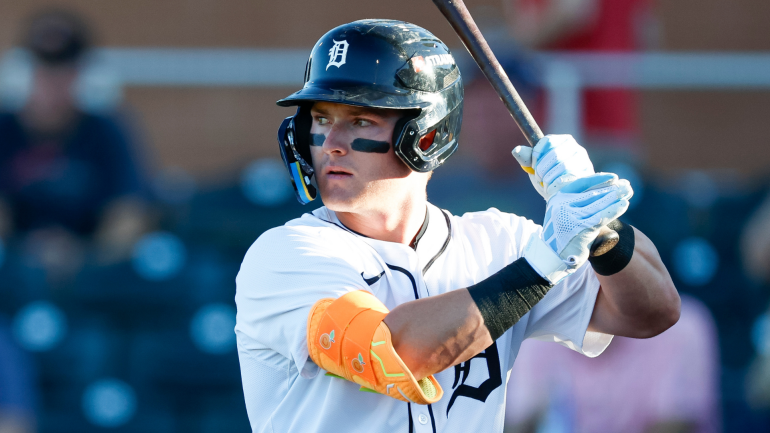
McGonigle is probably the single most polished hitter not already in the majors. He's a lefty who, when he's in his stance, resembles a mirrored version of Jose Altuve. There are some skill-set similarities too. McGonigle can hit the ball wherever, whenever, and often with gusto behind it. He's mindful of the zone, and last year he walked 13 times more than he struck out combined across three levels. McGonigle has shown headiness on the basepaths in the past, though last year he wasn't as successful in volume or efficiency. Defensively, he may play shortstop at the onset of his big-league career as a necessity to get his bat in the lineup. McGonigle seems unlikely to remain at the six much beyond that, however, with second base appearing to be his long-term home. It won't matter. If he hits like he's demonstrated he can throughout his professional career, the Tigers will be pleased all the same.
2. Max Clark, OF, Tigers
- The quick hook: Well-rounded center fielder coming off strong year
- MLB ETA: Late summer 2026
Long compared to Cubs outfielder Pete Crow-Armstrong, Clark split his age-20 season between High- and Double-A and demonstrated that he's a different, and arguably more well-rounded player than his All-Star aspiration. He hit .271/.403/.432 with 14 home runs, 19 stolen bases, and more walks than strikeouts -- the latter being the product of him improving both his strikeout and walk rates from the previous year. He could feature five average or better tools at maturation, including the kind of contact and on-base skills that permit him a lengthy career atop a batting order.

3. Walker Jenkins, OF, Twins
- The quick hook: Potential middle-of-the-order bat who can't stay healthy
- MLB ETA: Summer 2026
Jenkins is an undeniably skilled hitter who should contribute across each of the triple-slash categories. The catch, and you know there's a catch coming with that framing, is he's shown less aptitude for staying on the field. In two and a half seasons since being drafted, he's appeared in fewer than 200 total minor-league games. The Twins, perhaps sensing the need to strike while the iron is available, if not necessarily hot, pushed him to Triple-A to close out 2025. In turn, it's fair to envision Jenkins making his big-league debut in 2026, with the exact timing depending on his health.

4. Travis Bazzana, 2B, Guardians
- The quick hook: Former No. 1 pick can really hit
- MLB ETA: Summer 2026
The No. 1 pick in the 2024 Draft, Bazzana is now positioned to debut sometime in 2026. He split his first full professional season between Double- and Triple-A, hitting .245/.389/.424 with nine home runs and 12 stolen bases in 84 games. The book on him remains the same as when he was drafted: he combines a disciplined approach with above-average contact chops and power output. Indeed, Bazzana atones for pedestrian exit velocities by lifting and pulling the ball at high rates, a combination that ought to play well in Cleveland's ballpark. His comfort with deep counts will ensure he strikes out a fair amount, and he's not going to win a Gold Glove award anytime soon. Even so, Bazzana is a heady player who should justify the Guardians' selection for years to come.
5. Emmanuel Rodriguez, OF, Twins
- The quick hook: Strikeouts and walks and power
- MLB ETA: Spring 2026
Rodriguez is the oddest prospect in the minors: a legitimate centerfielder who is more likely to walk or to strike out than he is to put the ball in play. (That's not a joke, by the way; he took a free pass or punched out in more than 52% of his trips to the plate in 2025.) Rodriguez has excellent strike-zone judgement and well-above-average thump, though the former may be in response to other deficiencies. Indeed, he almost never swings at anything and, when he does, he tends to make a high rate of contact only within a certain path that leaves him prone to swinging and missing elsewhere. His extreme passivity, then, is a useful survival mechanism. Rodriguez is going to walk a lot, he's going to strike out a lot, and he's going to hit for his share of power. He, like seemingly every notable Twins player for the past decade, has had his share of injuries, too. Expect to see him in the majors soon.

6. Caleb Bonemer, SS/3B, White Sox
- The quick hook: Bat-first infielder coming off big first season
- MLB ETA: Summer 2028
The White Sox paid Bonemer $3 million in the summer of 2024 to forgo his commitment to Virginia. After one full season, that looks like a wise investment. He split the year between A-ball affiliates, hitting .281/.401/.473 with 12 home runs and 29 stolen bases in 107 games. Bonemer's swing features minimal hand load, yet he generates power all the same and he's shown an advanced feel for the strike zone. Defensively, he's probably stretched at shortstop, something the White Sox have tacitly acknowledged by giving him a start at the hot corner for every two at the six. Rest assured, they'll find a spot on the infield for him if he continues to provide on-base and slugging value.
7. Chase DeLauter, OF, Guardians
- The quick hook: Talented hitter who cannot stay healthy
- MLB ETA: Already debuted
Last October, DeLauter became the sixth player ever to make his MLB debut in the postseason. What's more is that his maiden appearance in the AL Wild Card Series marked his first game, at any level, in nearly three months. Injuries, particularly to his left foot, have been a constant for DeLauter, limiting him to 138 minor-league games since he was drafted in 2022. That's a shame for a number of reasons, not least among them being that he's a well-rounded hitter who can (and will) provide the Cleveland lineup with a boost for as long as his body permits.
8. Angel Genao, SS, Guardians
- The quick hook: Contact-driven shortstop with power questions
- MLB ETA: Summer 2027
The Guardians have a clear fondness for switch-hitting infielders, from Asdrúbal Cabrera and Francisco Lindor in the past, to José Ramírez, Brayan Rocchio, and Ángel Martínez in the present, to Juan Brito and Genao in the future. That kind of consistency is hard to find, but easy to take comfort in. Anyway, Genao is a contact merchant who connected on roughly 83% of his swings in 2025. The big question with him pertains to his power output. He puts the ball on the ground a lot, particularly when he's batting lefty, and that limits his slugging capacity. If he can make any gains in that respect over the coming year, he'll find himself much higher on the next edition of this list.
9. Bryce Rainer, SS, Tigers
- The quick hook: Strong, disciplined lefty bat with contact concerns
- MLB ETA: Summer 2029
Rainer, the 11th pick in the 2024 Draft, had his first professional season end in June when he suffered a shoulder injury retreating to the bag on a pickoff attempt. Prior to that, he hit .288/.383/.448 with five home runs and nine stolen bases in 35 games, all the while showing off a firm grasp of the strike zone and impressive left-handed power (three times he cleared a 111 mph exit velocity). If there was a non-injury downside to Rainer's season, it was how often he whiffed within the zone. His 75.6% zone contact rating would've been seven percentage points lower than the MLB average. Rainer's other offensive attributes provide him some wiggle room, but he'll need to keep his swing and miss in check as he moves up the ladder.
10. Troy Melton, RHP, Tigers
- The quick hook: Broad arsenal, deception, and control
- MLB ETA: Already debuted
Melton made his big-league debut last July, starting three of his first five appearances before shifting into a multi-inning relief role for almost all of his final 11 outings. Don't let that confuse you: he looks like a starting pitcher, and probably a good one at that. Melton threw six pitches at least 5% of the time in the majors, including an upper-90s heater. They all grade as at least average, per various pitch-quality models. Melton also has deception working in his favor. He generates nearly seven feet of extension from the rubber, allowing him to leverage his low-three-quarters arm slot and release the ball at a 5-foot-5 height. Factor in how Melton has a history of throwing strikes and it's probably reasonable to consider him a Rookie of the Year Award darkhorse if he gets enough starts.

11. Carter Jensen, C, Royals
- The quick hook: Bat-first backstop
- MLB ETA: Already debuted
Jensen put on a show upon his arrival last September, hitting .300/.391/.550 with nine extra-base hits and nearly as many walks as strikeouts in 20 games. He's evolved behind the plate, but the draw here remains what he does at it. He possesses immense strength from the left side, recording a hard-hit percentage around 59% between his Triple-A and big-league stints. He also has a firm grasp of the strike zone, creating leeway for a strikeout rate that was around 25% in the minors. Only six catchers managed at least a 10% walk rate and a .180 ISO in 2025. The Royals will be thrilled if Jensen adds his name to that group heading forward.
12. Noah Schultz, LHP, White Sox
- The quick hook: Giant lefty with platoon problems
- MLB ETA: Spring 2026
Schultz didn't have the best year in 2025, starting 17 combined times between Double- and Triple-A and tallying a 4.68 ERA and a 1.69 strikeout-to-walk ratio. His output may have been compromised by a knee injury that cost him more than a month. Given his ailment and his relative inexperience (he's pitched in 50 professional games), it's probably OK to give him a pass on last year. Of course, that doesn't mean it's reasonable to project Schultz as the next Chris Sale, either. He's a 6-foot-10 southpaw who, nevertheless, has a sub-6-foot release height thanks to his sidearm slot. Predictably, his arsenal has a lot more west-and-east to it than it does north-and-south, with a mid-90s sinker and sweeping slider serving as his main offerings. Also predictably, evaluators have long expressed concerns about his ability to combat right-handed batters. (Horizontal movement is more important against same-handed batters, vertical movement against opposite-handed batters.) Schultz's arm slot makes it tough to generate a lot of rising or sinking action, so he's going to have to forge his four-seamer, cutter, and changeup into effective weapons against right-handed batters to realize his potential.
13. Braden Montgomery, OF, White Sox
- The quick hook: Switch-hitting outfielder with pop
- MLB ETA: Late summer 2026
Montgomery is perhaps best known for what's happened to him over the last few years: first, fracturing his ankle ahead of the draft -- he was still selected No. 12 overall -- and then, months later, being dealt to the White Sox as part of the Garrett Crochet deal. Those headlines shouldn't obscure that he's an intriguing switch-hitting outfield prospect with strength and strike-zone judgment. The keys for Montgomery will be improving his contact rate (something that has dogged him since his collegiate days) or, at least, offsetting his strikeout tendencies by lifting the ball more frequently and upping his power output. He seems more likely than not to make his big-league debut this season, so some on-the-job training may be in order for him to realize his true ceiling.
14. Parker Messick, LHP, Guardians
- The quick hook: Substance over style starter
- MLB ETA: Already debuted
Messick, along with seemingly a dozen other pitchers last season, began his big-league career with an impressive stretch that saw him compile a 155 ERA+ and a 6.33 strikeout-to-walk ratio in seven outings. He's unlikely to maintain that pace, but it's clear that he was underrated as a prospect -- and it's easy to figure why. Messick doesn't throw particularly hard (his rising fastball averaged 92.8 mph) and he doesn't have the most aesthetically pleasing arsenal or delivery. He has a history of getting results, however, behind a good changeup and the deception he creates from an unusual release point. Again, it's not a profile that's going to jump off the screen. It is an effective one all the same.
15. Billy Carlson, SS, White Sox
- The quick hook: Promising, well-rounded shortstop prospect
- MLB ETA: Summer 2029
Carlson, the 10th pick in last summer's draft, is a former two-way prepster who will focus on hitting when he officially begins his professional career in the spring. He has all the requisite traits to be a plus defender at the next level: a strong arm (duh), smooth actions, and soft hands. Carlson is also a promising offensive player, with a line-drive stroke and a pathway to average or better power. You don't have to meditate to realize he could boast five average or better tools at maturation.
16. Josue Briceño, 1B/C, Tigers
- The quick hook: Quality left-handed bat with positional concerns
- MLB ETA: Summer 2027
Briceño is, in the most basic sense, Detroit's answer to Samuel Basallo. Both are strong left-handed hitters with enough going for them behind the plate to see action there in the majors, even if they won't necessarily be popping a squat 100-plus times a season. Basallo is regarded as the superior player, of course, but Briceño's day in the sun is coming soon enough if he can correct his course following an uneven introduction to Double-A.
17. Ralphy Velazquez, 1B, Guardians
- The quick hook: He can hit, but that's all he can do
- MLB ETA: Summer 2028
It's not easy being a first-base prospect in contemporary times. Velazquez still earns placement here after a strong year that began with him notching three 100-plus mph batted balls against MLB pitchers in spring training. He was a well-above-average performer across two levels when the games started to count, leveraging his high-grade thump into 22 home runs and 37 additional extra-base hits. Velazquez kept his strikeout rate in check too, fanning in less than 20% of his plate appearances. He's shown a propensity for both lifting and pulling the ball -- a good sign for his slugging, albeit at the cost of his average -- and for once he was a more productive hitter versus lefties than righties. Add it all together and Velazquez is an interesting, if unidimensional, prospect.
18. Cooper Ingle, C, Guardians
- The quick hook: Singles and walks, singles and walks
- MLB ETA: Summer 2026
Ingle is a small, athletic backstop who has continued to produce year in and out despite well-below-average strength. To wit, his maximum exit velocity during his Triple-A stint last season was 105.6 mph, a figure that 1) was more than two mph above his next highest mark, and yet 2) would have ranked as the third lowest among qualified MLB hitters. Ingle regularly connects on around 85% of his swings and his passive approach spares him from expanding the zone often. It's always fair to wonder how well this sort of profile will port to the next level. There's only one way to find out for sure, but Ingle's ascension will depend on Bo Naylor or Austin Hedges coming down with something.
19. Kaelen Culpepper, SS, Twins
- The quick hook: Pull-side power and a little bit of everything else
- MLB ETA: Late summer 2026
Culpepper spent most of his first full professional season at Double-A, hitting .289/.375/.469 overall with 20 home runs and 25 stolen bases. For as impressive as those marks are, particularly from a shortstop, it's worth noting there are some reasonable concerns to be had about other aspects of his game. Culpepper is a pull-happy hitter who puts the ball on the ground at a high enough frequency to cap his slugging output. He's also a free-swinger at the plate, though to his credit he's kept his strikeouts and walks at healthy frequencies. It's at least possible that Culpepper reaches the majors in 2026 and there's a pathway for him to serve as the Twins' regular shortstop for years to come.
20. Kendry Chourio, RHP, Royals
- The quick hook: Extremely young, intriguing right-hander
- MLB ETA: Late summer 2028
The Royals have some promising young starters, with Chourio and lefty David Shields closing out the season as impressive teenagers in the Columbia Fireflies rotation. Shields has a little less apparent upside, meaning Chourio gets the nod. He threw six times in the Carolina League, all as a 17-year-old, compiling a 6.00 strikeout-to-walk ratio and better underlying metrics than his 5.16 ERA indicated. Chourio isn't particularly large (he's listed at 6-foot, 160 pounds), but he has a loud arsenal that includes a mid-90s heater and a downer curveball. His delivery does feature elbow creep, generally a negative indicator for command, so that'll be worth monitoring heading forward. There's mid-rotation starter potential here if he's able to keep everything on the rails.