Ranking the 15 worst contracts in the NBA: Joel Embiid, Ja Morant, Paul George and more
These contracts aren't just bad this season, but threaten to take up payroll and affect rosters for years to come

Wednesday, we covered the NBA's best contracts. It was a largely positive affair that promoted wise management and financial prudence. Now, things are going to get a bit bleaker.
Managing the finances of an NBA team has never been more difficult. With the luxury tax and aprons bearing down on teams in this post-2023 collective bargaining agreement world we now live in, a bad contract can hurt a team far more than a good one can help it. Case in point, we crowned Deni Avdija as the NBA's best contract, but his team is below .500. Among the reasons why? Its second-highest paid player is the No. 9 player on today's worst contracts list, and its highest paid player was a candidate who just missed out on the top 15.
There are fewer ways for teams to add and accumulate salary than there were a few years ago. Having tens of millions of dollars squatting on your books now can derail years of team-building. We live in a world in which a 27-year-old All-Star like Trae Young can get outright cap-dumped. Teams are more careful when it comes to contracts than ever before.
In evaluating the best deals, we laid out the seven factors that contribute to a contract's quality: salary, length, age, durability, guarantees, portability and structure. I won't go into detail on each again, but there are a few key differences to remember when it comes to bad contracts. First of all, a player option on a good contract generally means the deal is functionally a year shorter, because you'd expect the player to opt out and try to get paid his fair market value. For bad contracts, it's the opposite. That player option is essentially just another year you're stuck ... unless you're so desperate to lower the cap figure that you're willing to extend the player for multiple years.
Portability is probably a bigger concern with bad contracts than it is for good ones. Since good contracts are usually cheap, they're easy enough to trade to almost anyone. Bad contracts are another matter. If someone's raw salary number limits the number of trade possibilities, having a wing who can fit onto any team is far more valuable than a guard who can fit onto few. Durability is going to play a bigger role today than it did yesterday. Many of these players are here because they can't stay on the floor.
We're ranking the 15 worst contracts in the NBA, and unlike with the best contracts, there are no restrictions. Rookie-scale contracts are eligible, but won't show up. Max contracts are also eligible, and quite a few of them will! Since we're already near the end of the 2025-26 season, contract lengths will only look forward, so if a player is listed with two years left on his deal, it means the 2026-27 and 2027-28 campaigns. So with all of this in mind, let's dive in.
15. De'Aaron Fox
Total owed: $223,104,000
Years remaining: Four


There are so many layers to this contract. Remember, the Spurs got Fox on a discount in part because he forced his way to San Antonio. Did he do so with assurances that a contract was coming? San Antonio didn't know Dylan Harper was coming when it got Fox. Would it take a mulligan on the trade if it knew? These are unanswerable questions, but in a vacuum, Fox is only a borderline max player today and almost certainly won't remain at this level as the contract progresses into his 30s. His best trait is his speed. He's not quite as quick or effective near the basket as he was a few years ago. He's made up for it with stellar mid-range shooting, but he's never been consistent from 3, which limits his off-ball utility. He's a fine defender for a high-usage point guard, but nothing special. As San Antonio's younger guards start to progress and his role slowly decreases, this contract is going to start looking worse.
Yet San Antonio surely doesn't regret the deal because of the context he got it under. The Spurs still have one cheap rookie-scale season left for Victor Wembanyama, two for Stephon Castle and three for Dylan Harper. Luke Kornet is on a team-friendly deal and the Spurs will probably be able to ink Julian Champagnie to a team-friendly extension. The only other market-rate long-term contract they have right now is Devin Vassell's. In other words, they can afford this. They're perfectly comfortable with this contract looking iffy on the back end because it opened their championship window at least one year early, if not multiple years. They aren't contenders this season without Fox. That's worth a bit of long-term pain. But the Spurs are unique. This contract isn't especially portable. It's fine for San Antonio. It'd be more of a negative for most teams.
14. Devin Booker
Total owed: $251,351,098
Years remaining: Four


Phoenix had two options last offseason. The first was to trade Booker. I advocated for that. If you're totally cold and rational about it, moving him at close to the peak of his value would probably maximize the very limited championship equity this organization has without control over any of its first-round picks through 2031. But doing so would have meant several years of misery and the horrible optics of handing top draft picks over to rivals. So Phoenix went the other way. They wanted to project whatever minimal stability they could and try to build a culture of competitiveness. Is it going to lead to much more than a series of Play-In berths? No, but the Suns determined that they'd rather be mediocre without their picks than terrible. They'll probably pay for it down the line, but for now, it at least keeps their fans around. If you're going to keep your franchise player engaged in that sort of mediocrity, you have to pay him. That's what Phoenix did.
It's been a feel-good season for the Suns as a team. For Booker, specifically, there are already signs of decline. The last two seasons have been two of his three worst 3-point shooting seasons. His mid-range numbers are slightly down as well, and he's never really gotten to the rim all that much for a scorer of his stature. He's turning 30 right around the beginning of next season. He's a fine-but-unspectacular defender and playmaker. If and when he starts to lose athleticism, he's going to start to lose the ability to generate separation. His shot diet has always been heavy on inefficient jumpers that he makes at efficient rates, but as those shots get more heavily contested, it's going to be harder and harder for him to live off of those looks. He seems to have recognized that to an extent because he's getting to the line more than ever. That's helpful. But as of right now, Booker is set to be the third-highest paid player in the NBA for the 2029-30 season, when he'll be 33. He's never been close to a top-three player in the NBA. He's probably closer to 23rd right now, and that might be 33rd or 43rd in a few years.
13. Jalen Green
Total owed: $72,251,166
Years remaining: Two (player option for 2027-28)

This was something of a speculative contract for Houston when the Rockets signed it. They'd drafted Green No. 2 overall. They hadn't yet made the playoffs or made any serious asset commitments to other players. They wanted to keep Green in the fold to see if he could grow into a player worthy of his draft status, but they didn't want to overcommit in the event that he couldn't. Well, they kept him for another year, realized he was a negative asset on that deal and dumped him on the Suns in the Kevin Durant trade. He's only played 13 games this season, but he's been the most inefficient player in the NBA by a mile in that time. He has a true shooting percentage of 45.8%. That's the worst percentage among players taking at least 10 shots a game by 4.1 percentage points. The gap between him and No. 2 Keegan Murray is bigger than the gap between Murray and No. 19 Jordan Poole.
Now Phoenix is stuck. If things continue on their current course, Green will or at least should be a very highly paid fourth guard. Collin Gillespie has played too well not to be the starting point guard moving forward, and Grayson Allen is still well-paid as this team's designated sniper. If Green manages to turn it around next season, though, he has a 2027-28 player option. Either he's bad and expensive for two years or he's good and the Suns only get one year of value out of the deal before it gets redone.
12. Myles Turner
Total owed: $83,550,318
Years remaining: Three


No, we're not counting the extra $22.5 million in dead money the Bucks added to their books for the next five seasons when they waived Damian Lillard to sign Turner last offseason. Turner's deal makes the list on its own merits, though yikes does that Lillard decision look rough now. Turner spent most of his career on pretty valuable contracts as something of an NBA unicorn. Centers who can both shoot 3s and protect the rim at a high level are rare and prized. Turner still makes his 3s, but outside of Indiana's infrastructure, the rest of his game has lagged meaningfully.
His block rate started declining a few years ago, but with inferior perimeter defenders in front of him in Milwaukee, he hasn't been nearly as effective protecting the basket. His offense inside the arc has essentially disappeared without Tyrese Haliburton to set him up. He's a starting center averaging 28 minutes per game who ranked 228th in the NBA in 2-pointers made per game. He's never rebounded well for his position. His value is derived mostly from the shooting now. That matters, but in an NBA that is increasingly prioritizing physicality and the possession game, that sort of center is less impactful than it was a few years ago and, as he ages, those other gaps in his game are only going to get more significant.
11. Christian Braun
Total owed: $125,000,000
Years remaining: Five


Christian Braun sounds pretty portable as a big wing who defends guards reasonably well, but offensively, he's just too much of a Nikola Jokić merchant. Only 19% of his shots are unassisted this season, and that's right in line with where he's typically been. He scores most of his points in transition or off of cuts. That stuff is really valuable when you have Jokić to set it up and far less so on normal NBA teams. His 3-point percentage has fallen off a cliff this season, but even when the raw percentage was higher in the past, he was never really a valuable spacer because he more or less only took wide-open 3s. Basically three-quarters of his 3-point attempts were wide open a season ago, according to NBA.com. If you're living off the easiest shots and you have Jokić to create them, odds are you'd be less valuable on another team.
Braun shares a number of similarities with another player who signed his rookie extension last offseason, Dyson Daniels. Both extended for $25 million per year, though Daniels only got four years. They're both transition-heavy offensive players who are shaky shooters (though Daniels' shot has been nonexistent this season) and need to get by in the half-court mostly on basketball IQ. So, how did Daniels avoid this list? He's an enormously impactful defender while Braun is merely a good one. Another notable comparison here would be Peyton Watson, drafted by Denver nine spots after Braun in 2022. At this point, Watson is the superior player. But he took longer to develop. Denver paid Braun. Now, there's a real chance someone offers Watson more annually in restricted free agency and the Nuggets lose him. That doesn't factor into Braun's ranking, but it stings.
10. Karl-Anthony Towns
Total owed: $118,093,920
Years remaining: Two


The theory of paying Towns supermax money is that he's such a uniquely valuable offensive player as the self-proclaimed greatest big man shooter of all time that you can pay him anything and still get away with his defensive foibles. The Knicks lived that early last season, when he made 44.9% of his 3s through mid-January. Then there was a report that he had a bone chip in his right thumb. He shot 38.6% on 3s in the rest of the regular season, 35.1% in the playoffs, and is making only 36.7% this season. Whether those things are related or not, I can't say, but it's a notable trend, especially since he's not nearly as explosive now that he's 30 either. He averaged 9.5 drives per game two years ago, but is down to 6.9 this season while shooting worse near the basket than he ever has.
Put all of this together and a once-transformative offensive player is now merely a very good one. It's hard to get away with "very good" on a supermax salary, even with Towns playing some of the better defense of his career this season. We seemingly learned what the league thinks of the Towns deal when the Knicks sniffed around a possible Giannis Antetokounmpo trade at the deadline. The Athletic reported that if the Knicks moved Towns in a multi-team deal, he would likely net "salary-matching players and, maybe, small draft compensation." He's a frustrating player. Reports last year detailed the team's exasperation with his defensive freelancing. There's no excuse for an 11-year veteran to commit the sort of dumb fouls that Towns does. When he signed this deal, all of that was forgivable. I'm not sure it is anymore, at least not at this price.
9. Jerami Grant
Total owed: $70,620,688
Years remaining: Two


The good news is that Jerami Grant is scoring inside the arc again. After bizarrely making just 38% of his 2s last season, he's hovering around 50% in a bounce-back offensive season. The bad news here is that he's owed high-level starter money for two more years, his age-32 and -33 seasons. He doesn't really defend anymore and he's never provided much on offense aside from shot-making.
We covered this in the best contracts story and the lede here, but it's worth the reminder: Portland is getting historic contractual value out of Deni Avdija ... and is wasting it by paying a mountain of cash to older players. In a perfect world, the Blazers would be below the salary cap in the summer of 2027 so they could renegotiate and extend Avdija's contract. So naturally, they owe almost $88 million to Grant in his age-33 season and the Jrue Holiday-Damian Lillard pairing in their age-37 seasons. Lillard's contract is small enough to be mostly inoffensive and while Holiday has struggled with injuries this season, he's been good enough when he's played to avoid this list. Grant wasn't so lucky.
8. Dejounte Murray
Total owed: $63,536,575
Years remaining: Two


It's been a sad downturn for Dejounte Murray. The initial rookie extension he signed with San Antonio was so far below-market that he was limited in what he could legally extend for after getting traded to Atlanta. That meant that the $114 million extension he signed looked like a bargain at the time. It obviously wasn't. Murray's defense fell off as soon as his scoring volume increased and never came back. He was one of the least efficient players in the NBA when he was healthy in New Orleans last season ... and then he tore an Achilles.
He's been a bit better since coming back this season, but as a point guard who doesn't defend or shoot 3s, the bar is incredibly high everywhere else. He hasn't reached it, and now this is a contract the Pelicans may be stuck with even as they developed Jeremiah Fears as the point guard of the future.
7. Patrick Williams
Total owed: $54,000,000
Years remaining: Three


Patrick Williams is a fascinating case study in how draft position warps contract value. Chicago used the No. 4 overall pick on him because he was a big wing with incredible physical tools. At no point in his first four seasons did he prove himself a consistently reliable starting-caliber wing. Meanwhile, five picks later, the Wizards took Deni Avdija, who had less impressive physical traits but who actually played pretty well over the course of his rookie deal. He extended for $55 million over four years after his third season. The Bulls were so scared of missing out on Williams' upside that, after his fourth year, they gave him $90 million in restricted free agency. Now Avdija is a star making less than Williams.
Versions of this story play out almost every year. Think of the Andrew Wiggins rookie max. Teams bank so much on the idea of a player that they pay for who they hope he will be instead of who he actually is. Now it's the sixth season of his career and Williams isn't cracking 20 minutes per game. He's never figured out how to translate those tools into steady production despite overcoming what seemed like it would be the biggest hurdle: his iffy collegiate 3-point shooting.
6. Anthony Davis
Total owed: $121,243,248
Years remaining: Two


Davis and Towns have a fair bit in common as former franchise players starting their declines. There are just a few significant differences that put Davis above Towns on this list:
- Towns has been relatively durable for the past few years and Davis rarely plays. He's been in the news seemingly since the moment the Lakers traded him, yet in all of that time, he's played just 29 games. Towns has missed five games all year.
- Towns may be declining as a shooter, but he's still a good one. Davis is one of the worst reasonably high-volume jump shooters in the NBA. Since those three glorious months in the Orlando bubble, he's made just 132 of 512 3-pointers (25.8%). More than 20% of his shots this season came from the mid-range and he made just 37.8% of them. Getting Davis means signing up for a lot of shots you really don't want him to take.
- Towns is 30. Davis is 32.
Despite all of this, plenty of teams could justify choosing Davis over Towns just because of his defense. He's not the All-Defense force he once was, but he remains a very effective rim-protector who is versatile enough to function on the perimeter in basically any scheme when he's available. If you knew Davis was going to be healthy, if you knew he wasn't going to experience further decline, and if you knew he'd be comfortable operating mostly as a screener and roller, you could probably live with him making supermax money for two more years. I have little faith in any of those "ifs" though, so Davis slides in at No. 6.
5. Domantas Sabonis
Total owed: $94,080,000
Years remaining: Two


Towns signed his contract as a transformative offensive player and has declined into just a very good one. Sabonis signed his contract as a very good offensive player and, at least if this season is any indication, has declined into just a good one. Now, you could argue he was far better last season, though I'd say he still didn't come especially close to Towns' lofty peak, and back injuries often linger, so there's no telling who he'll be when he eventually returns. Without Towns' shot, he lacks the single biggest weapon most offensive players have against the aging curve.
They're both iffy defenders, but Towns has the nifty utility of at least being able to move well enough to play some power forward. He's been a part of good defenses and can fit into more lineups. Sabonis basically has to be a center. Indiana tried pairing him with a high-level rim-protector in Turner and it didn't work. Being pot-committed to a center who doesn't protect the rim is a defensive death sentence. Having Sabonis, unless everything else about your defense is flawless, just puts too much of a playoff ceiling on your roster to justify a contract like this. He makes less than Towns and Davis, but he has far less upside.
4. Paul George
Total owed: $110,713,050
Years remaining: Two


In 2026, Paul George is a role player. An effective role player ... but a role player nonetheless. He remains a very good team-defender who just doesn't have the juice physically to lock down opposing stars anymore. He's still a very good shooter, and he still creates a good number of his own shots, but his rim rate is down and he never gets to the line. He's probably something like a $25 million to $30 million per year player. A lot of teams would love to have a a $25 million to $30 million per year wing. That just isn't what George is making.
And then there's the aging curve. This is George's age-35 season. When the 76ers signed him, they did so hoping to generate enough surplus value at the beginning of the contract to justify a messy end of it. Well, the former didn't happen, and now, who knows what the latter is going to look like. George's durability has been a persistent problem. He's played only 27 games this season. This probably isn't getting better as he gets older. He's a good role player today. It's a coin flip if he will be tomorrow.
3. Ja Morant
Total owed: $87,053,440
Years remaining: Two


George vs. Morant was one of the hardest debates of the list. Morant is still only 26 and theoretically near his physical peak, but the actual on-court evidence suggests otherwise. His rim and free-throw rates have declined precipitously over the past several years, and the entire theory of him as a positive-value NBA player relies on his ability to get to the basket since he's a complete non-shooter who doesn't really defend. So ... would you rather have someone in the right age bracket to potentially become a star again if everything goes right? Or would you rather have someone who maxes out as a high-level role player but has more ways of remaining at least somewhat valuable?
I went with the wing. That's the key. For Morant to become Morant again, some team is going to have to build an offense around the hope that he can do so. Point guard is such an oversaturated position that I'm not sure such a team even exists. The Grizzlies just spent a deadline cycle trying and failing to move him. George may make more money, and he may be older, but I'm reasonably confident almost any team could use him if it could just find a way to pay for him. That's less clear with Morant. He's a lottery ticket at this point. Under the best of circumstances, maybe he could recapture some of his old glory, but it seems likelier that he's just going to be an injury-prone, physically declining player at a position that just can't abide all of his weaknesses.
2. Jakob Poeltl
Total owed: $103,584,000
Years remaining: Four


Find someone who loves you the way the Raptors love Jakob Poeltl. At best, Poeltl peaked as roughly an average starting center. His defense had already started to decline by the time San Antonio traded him. The Raptors gave up a first-round pick that became a No. 8 overall selection for him, then proceeded to pay probably a bit more than market value to retain him afterward. Already, this isn't great process. And then, with two years remaining on his contract last offseason, the Raptors tacked three more years onto his deal with a sizable raise. There was no reason to do this. Poeltl had a player option for the 2025-26 season, sure, and he was coming off of his best scoring season in the NBA, but they extended him basically at the top of the non-max center market when he's probably going to spend a good chunk of this contract as a backup. Who was outbidding them at this price even if he'd replicated last season?
He missed a bunch of time earlier this season with a lower back strain. Rookie Collin Murray-Boyles stated his case as the starting center in that window, and he'll likely claim that job full-time eventually. That offensive growth hasn't showcased itself this season on a stronger roster. Poetl's taking only six shots per game. The high-end rim-protection from the Spurs days has declined. He's already 30 and he's locked up for the rest of the decade. For whatever reason, the Raptors have just been perpetually higher on Poeltl than the rest of the league. When Toronto was linked to big names on the trade market this deadline cycle (many of whom appear on this list), one persistent question was whether or not they'd be able to find someone to take on this contract. It's not clear how close the Raptors came to actually making a deal, but it would have cost them assets to get off of Poeltl in doing so.
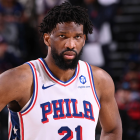
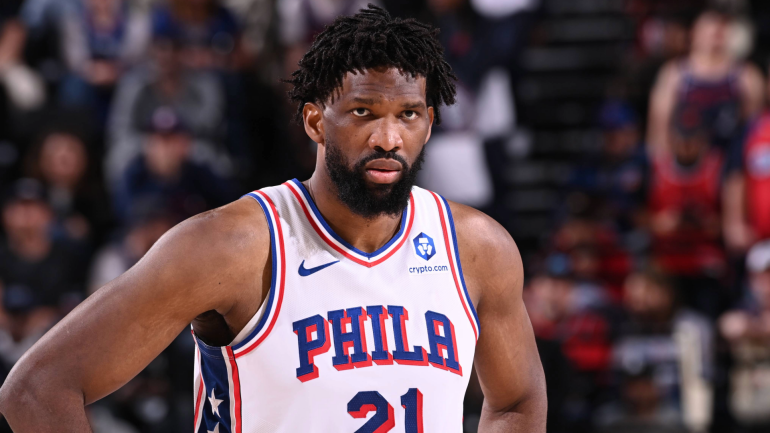
1. Joel Embiid
Total owed: $188,244,000
Years remaining: Three

Joel Embiid has played at a higher level at his best this season than anyone else on this list. From mid-December on, he's played at an All-NBA-level when he's been available. Of course, he'll never make another All-NBA team because he'll never play 65 games again. The back-to-backs alone practically guarantee that. The downside risk here is much greater than just missed back-to-backs. He missed the first two years of his career and then more than half of his third. He's never played 70 games in a season. He missed half of the 2023-24 season. Last year was a lost year. He's only at 33 games played this season, and while there's seemingly hope that his current, oblique-induced absence will be brief, you never quite know with Embiid. It might be a three-game injury. It might be a three-week injury.
Building a team when you owe supermax money to someone with this level of durability concern is almost impossible. The 76ers somehow have to plan around having Embiid play 30 minutes and dominate the offense when available while simultaneously having 48 minutes of quality center play off of their bench at a point in league history when centers are suddenly in vogue again. His deal is so long that Philadelphia won't ever really get to benefit from VJ Edgecombe's cost-controlled rookie deal. Embiid extends right as Edgecombe's rookie extension will kick in. When Embiid is on the court, at least for now, he's a reasonable supermax player. But he's 31. Who knows how much longer that will be the case, and even if he doesn't decline, the games he misses impose greater roster-building restrictions than any other active NBA contract.