| ||||||||||||
2026 Fantasy Baseball Draft Prep: Assessing 10 one-hit wonders and their chances of repeating the feat
Can you trust these 2025 surprises to do it again?

By
Scott White
•
10 min read
You know the sort of players I'm talking about.
They were some of the most consequential in Fantasy Baseball last year, both because they were so good and because they were so cheap. Nobody saw them coming, which made them a godsend when they did, but now that they're known to everyone and commanding a premium on Draft Day, the question of legitimacy is more pressing. Extraordinary claims require extraordinary evidence, and a season's worth of data doesn't quite rise to that level.
Don't hold me to the "one" in "one-hit wonder." I acknowledge that some of these players were just as good in the past. What separates them from the typical bounce-back player, though, is that our hopes for them being that good again had long ago vanished. The 10 players depicted here all came out of left field (I don't mean literally, so don't hold me to that either).
As for their chances of repeating their sudden success, I've chosen to represent that with a sustainability scale that breaks down this way:
⚾⚾⚾⚾ - it's a near certainty
⚾⚾⚾ - it's more likely than not
⚾⚾ - it's basically a coin flip
⚾ - I wouldn't count on it
Cal Raleigh, C, Mariners


Sustainability scale: ⚾⚾⚾
FantasyPros ADP: 14.8
Raleigh already had a reputation as the top power-hitting catcher even before 2025, but 60 home runs went far beyond what he or any other catcher in history had done before. And nobody, least of all me, imagines he'll do it again. Records are records for a reason. It's just too daunting of a number. The more sensible question, then, is whether he hits enough to justify his second-round price tag, and factoring in the liability he represents in batting average and the run and RBI boost he gets from being a true everyday catcher, I would put the target number at about 45.
We know he can get there, because he just hit 60, but his previous high was only 34. It took an outrageous 38.4 percent pull-air rate for him to reach that outrageous home run total, and no one can say at this point how much of that was gained skill and how much was random variance. My general guideline, though, is that if a player would be worth his cost at 80 percent of last year's production, you take him. I'm only asking for 75 percent from Raleigh.
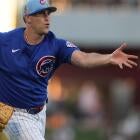
Pete Crow-Armstrong, OF, Cubs
| ||||||||||||


Sustainability scale: ⚾⚾ 1/2
FantasyPros ADP: 29.8
While it's true Crow-Armstrong was a prospect of some stature, his defense had a great deal to do with it, and even the most optimistic about his Fantasy standing (few though they were) weren't counting on MVP-caliber production. But he went nearly 30/30 in the first half alone, and you see where his final numbers ended up. What complicates his situation is that his biggest shortcoming never went away and, in fact, came to fruition in the second half, when he slashed .216/.262/.372 with a near 6-to-1 strikeout-to-walk ratio. Was the book simply out on him at that point, giving pitchers a clear plan of attack against his overly aggressive approach? I have my concerns. They're not so great, though, that I feel like I can pass him over in Round 3 of a Rotisserie league if I've neglected stolen bases up to that point.
Geraldo Perdomo, SS, Diamondbacks
| ||||||||||||


Sustainability scale: ⚾⚾⚾
FantasyPros ADP: 64.6
While a 60-homer catcher was unimaginable prior to last year, Perdomo's breakthrough may have been an even bigger surprise. He went from being undraftable in the majority of leagues (regarded mainly as an obstacle for Jordan Lawlar to overcome) to delivering borderline first-round production. Because his average exit velocity remained poor, climbing from the 14th percentile to only the 16th percentile, you may be inclined to dismiss it out of hand, but Statcast certainly liked something he was doing, putting his xBA and xwOBA both in the top 15 percent of the league. And while Perdomo's 2025 started out too hot to believe, it just kept getting better, taking him from a .265/.370/.413 slash line in the first half to a .325/.417/.533 slash line in the second half.
Normally, outlier seasons don't find a second gear like that, and you could make the argument that Perdomo's second half hints of even better days ahead. I wouldn't go that far, but sticking with my 80 percent rule, I'm willing to give Perdomo a look as early as Round 5, or even Round 4 in a points league thanks to his superlative production.
Hunter Goodman, C, Rockies
| ||||||||||||


Sustainability scale: ⚾⚾⚾ 1/2
FantasyPros ADP: 73.8
Because 2025 was Goodman's first full year in the majors, it may seem unfair to include him here. But the 26-year-old was regarded more as a Quadruple-A type than a legitimate prospect. He had poor plate discipline and appeared to be a catcher in name only. His one hope was to settle in as a super sub on the back of his only marketable skill, power.
There he was, though, starting at catcher on opening day, and he wouldn't come out of the lineup until Game 10. His defensive metrics were more than satisfactory, and his performance remained steady from start to finish, with only one month having a batting average below .260 and only one month with an OPS below .800. He has all the job security you could want from a catcher and the benefit of playing his home games at Coors Field. Even with how loaded catcher is now, I'm inclined to rank him second at the position, behind only Cal Raleigh. He's a couple spots lower in Head-to-Head points, given that he doesn't walk much.
George Springer, OF, Blue Jays
| ||||||||||||


Sustainability scale: ⚾⚾ 1/2
FantasyPros ADP: 79.4
Springer was formerly a Fantasy stud and, therefore, doesn't fit the strictest definition of a one-hit wonder (as is true for a few of these, actually), but he entered last year as a 35-year-old in such evident decline that he was an afterthought in drafts, going around 230th on average. So naturally, he went on to have arguably the best season of his career, with a second-half performance for the ages (a .369 batting average, 16 homers, seven steals and 1.121 OPS in 50 games). What changed? New Blue Jays hitting coach David Popkins encouraged him to unleash his "A" swing, not sacrificing exit velocity just to put the ball in play. That correction yielded the best average exit velocity (90.0 mph) of his entire career -- and without costing him contact, it turns out.
Such improvements at his age naturally invite skepticism, particularly since his second half was quite obviously too good to be true. Still, because Springer wasn't a complete stranger to that kind of production and and is priced well below his top-five finish in the outfield last season, I have no qualms about taking him at cost.
Nick Pivetta, SP, Padres
| ||||||||||||


Sustainability scale: ⚾⚾
FantasyPros ADP: 87.4
Pivetta had pitched to a 4.76 ERA over his eight-year career -- never delivering an ERA below 4.00, in fact -- but last year was his first time calling a pitcher's park home, which figured to make a difference for a fly-ball guy like him. It did. His ERA dropped to 2.87 and his WHIP to 0.99 as he placed among the top 12 pitchers in Fantasy. Unfortunately, he gave back something in the way of swing-and-miss. His K/9 rate, which had hovered around 10 in previous years, dropped to 9.4, including 8.5 in the second half, and his swinging-strike rate dropped to a Dean Kremer-like 10.5 percent. With the erosion of that skill, he went from being a pitcher who underperformed his ERA estimators to one who overperformed them, his xERA settling at 3.97 and his FIP at 3.49.
So now what? The perennial tease finally delivered on his potential, but at the expense of what made him attractive in the first place. There may be a best-of-both-worlds outcome in which he recaptures his swing-and-miss, but skepticism runs high, which is why he drops below his ADP in expert leagues. I'll take him at a discount, if only for the WHIP help.
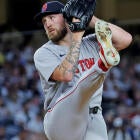
Aroldis Chapman, RP, Red Sox
| ||||||||||||


Sustainability scale: ⚾⚾ ⚾ ⚾
FantasyPros ADP: 92.8
Chapman isn't exactly a one-hit wonder. In fact, he had such a dominant run for the Reds, Yankees and Cubs from 2012 through 2021 that he may well be on a Hall of Fame trajectory. But it had been several years since he performed at that level, leading my Fantasy Baseball Today cohorts to suggest that the one-year sample over which he delivered a 1.17 ERA, 0.70 WHIP and 12.5 K/9 was less convincing than the three-year sample over which he contributed a 3.68 ERA, 1.33 WHIP and 14.0 K/9.
But it's that third number, the K/9, that tells me Chapman never lost the stuff that made him one of the most dominant closers in history. He just lost his command for it, a problem that also plagued him early in his career. Recovering it was a multi-year process. His work with independent pitching coach Hector Berrios over the past few offseasons led him to grip the ball tighter so he could spot it in different parts of the zone rather than just trying to blow it by hitters, and it all came together with the realization last spring that his catcher could now call for a fastball in specific locations rather than just over the plate. The improvement wasn't a fluke. It wasn't a sudden reversal of a decline phase, even. It was a long overdue correction in both his mechanics and approach. And while it's possible Chapman slips back into old habits or begins his true decline at age 38, the more plausible scenario is that he just picks up where he left off. He's an ace reliever in my mind.
Kyle Stowers, OF, Marlins
| ||||||||||||


Sustainability scale: ⚾⚾
FantasyPros ADP: 113.6
Stowers was a pretty good hitter in the minors, but he didn't rise to the level of a top prospect and had flopped in repeated opportunities with the Orioles. So his All-Star turn with the Marlins last year wasn't on anyone's radar, really, and remains a source of skepticism even now. The strikeout rate ran high at 27.4 percent, but he impacted the ball such that his expected batting average (.266) and slugging percentage (.537) weren't so far off from his actual ones. He wasn't an obvious regression case, in other words, but the breakout still feels unsubstantiated because he missed the final six weeks with a strained oblique.
Extraordinary claims require extraordinary proof, and a partial-season sample doesn't quite pass muster for what Stowers claimed to be last year. I'm inclined to believe in it just because the data says to, but I find I'm hesitant to pull the trigger at his going rate (about 30th among outfielders) because I've been burned by similar cases in the past.
Trevor Story, SS, Red Sox
| ||||||||||||

Sustainability scale: ⚾ 1/2
FantasyPros ADP: 117.0
Story was a two-time All-Star with the Rockies but had fallen off the map in Fantasy after a three-year stretch in which he averaged just 54 games. It wasn't even clear if he'd be the same player outside of Colorado because his time in Boston had been so limited. He finally delivered a healthy season, though, and showed that his power/speed profile was still intact. One healthy season in four doesn't remove the injury risk for the 33-year-old, however, and his poor plate discipline points (10th percentile walk rate and 12th percent strikeout rate) points to a frighteningly low floor. At a deep position like shortstop, Story isn't being discounted enough to account for the high risk, in my estimation, making him pretty clearly one of my top players to avoid.
Trevor Rogers, SP, Orioles
| ||||||||||||


Sustainability scale: ⚾⚾ 1/2
FantasyPros ADP: 140.4
I could more accurately describe Rogers as a two-hit wonder given that he was runner-up for NL Rookie of the Year in 2021, but his 5.09 ERA and 1.52 WHIP in the years since then had taken him off draft boards long ago. Last year represented a return to form and then some, with a 1.81 ERA that was quite obviously too good to be true. But just because the exact number is unrepeatable doesn't mean the improvements behind it are.
Apparently, a series of injuries in the years after his rookie season had gotten Rogers' delivery out of whack that. A Driveline analysis two offseasons ago showed that his mechanics would only support a fastball of 84 mph or so, which means it took everything he had to get to the 92 mph he was averaging. A strength-training program and some mechanical tweaks got Rogers throwing an easier 93 mph in 2025, which also had the effect of drastically improving his control. While a 1.81 ERA was good to be true, the usual estimators (xERA, FIP, etc.) put his ERA in the 2.80-3.40 range, which would be plenty good enough for the 45th starting pitcher off the board. Again, extraordinary claims require extraordinary proof, and as with Stowers, we only have partial season of proof for Rogers. But we also have a clearer explanation for the turnaround, which I'm more inclined to buy at cost.