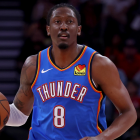
There was something poetic about the way Jalen Williams opened the 2026-27 season. His numbers only jumped off the page if you were looking for symbolism. He scored 12 points, the same margin by which the Oklahoma City Thunder defeated the San Antonio Spurs. The message, if you believe in such things, was pretty clear: after losing to the Spurs in the Western Conference Finals largely without him a year ago, Jalen Williams is the player that pushes the Thunder over the top against their nemesis. He is the difference between another parade and another defeat.
And now, his season is in jeopardy. On Sunday, in a game against the very Los Angeles Clippers whose 2022 first-round pick brought Williams to Oklahoma City in the first place, the Thunder star suffered what appeared to be a devastating ankle injury on an attempted dunk. We are still waiting on a diagnosis, but even the best outcomes would portend a lengthy absence. If he's done for the year, there goes the margin against the Spurs.
For most teams, a loss like this could be season-ending. The Thunder are not most teams. They made it to Game 7 of the Western Conference Finals without Williams a year ago. They will press forward without him this season as well. So where would a Williams-less version of the Thunder stand in a crowded championship picture? What can they do to improve in his absence? And what does all of this mean for the future of one of the more promising young players in basketball? Let's attempt to answer these questions as the Thunder prepare to move forward without one of their best players.
What does this mean for the Western Conference pecking order?
The Thunder went 39-10 without Williams a year ago. That's a 65-win pace. Their +10.9 net rating in the minutes spent without him would tie for the 16th-best full season figure in NBA history. They used only four Williams-free lineups for at least 50 minutes a season ago, but all four of them outscored opponents by at least 18.6 points per 100 possessions. Even without him, Oklahoma City still has a contender, a regular-season wins machine that will earn a top seed so long as Shai Gilgeous-Alexander stays relatively healthy. They may even be a favorite against anyone outside of San Antonio.
The Spurs are another beast. Victor Wembanyama disarms Gilgeous-Alexander in ways no other defender can by taking away the basket completely. He made a league-best 6.6 field goals per games off of drives last season. That figure was nearly cut in half in the Western Conference Finals. Gilgeous-Alexander isn't much of a pull-up 3-point shooter. Without anyone to take pressure off of him, he was reduced mostly to contested, mid-range jumpers by the end of that series. He nearly made enough of them to win it in Game 7. That still isn't a viable recipe against a Spurs team that figures to be even more imposing with a full playoff run under its belt.
Ajay Mitchell missed most of that series too. If he's healthy this time around, if Jared McCain takes the step that his early performance suggests that he could, if Chet Holmgren doesn't turn into a pumpkin again next May, then maybe the Thunder can still climb Mount Victor. The odds will be against them on that front, and the road to that matchup is more treacherous than ever.
The Los Angeles Lakers, Houston Rockets and Minnesota Timberwolves are all undefeated thus far. The Denver Nuggets have only lost to the Thunder (though maybe don't look too closely at their only other outing). All four of those teams were badly banged up last spring. Inevitably, one or two of them will be again this year. Someone in that group will be healthy enough to pose a threat. The Thunder know from experience how terrifying Luka Dončić and Nikola Jokić can be in a seven-game setting. Williams is their best defender by far for the former and a necessary athletic counter for the latter. With him the Thunder have a talent advantage over everyone. Without him they are distressingly mortal.
The field knows that. The Rockets, given their deep pool of assets, are uniquely qualified to go for it. We came into the season expecting a two-team race out West. Now, we're one Spurs injury away from a wide-open field. One or two of those second-tier contenders will make a win-now push. The Thunder are vulnerable this year. They may not be next year. The time to get them is here and now.
That window extends to the regular season. The Spurs aren't exactly optimizing for regular-season wins right now, instead choosing to settle their starting lineup debate now so it's not a concern in June. The De'Aaron Fox-Stephon Castle-Dylan Harper trio is struggling offensively thus far. The Spurs will course-correct eventually and win a bunch of games. But suddenly, home-court advantage in the West seems gettable. This iteration of the Thunder has never started a playoff series on the road.
Oklahoma City's margin for error has mostly evaporated. Remember, the Thunder traded Lu Dort, Isaiah Joe and Aaron Wiggins to duck the second apron. They came into the season as the NBA's deepest team, but that depth is no longer a superpower. It's only October. Other players will inevitably get hurt. Losing Williams may not end Oklahoma City's season, but every subsequent injury hurts that much more without him to cover their gaps. Reinforcements of some sort are probably a necessity.
Can Oklahoma City replace Williams on the trade market?
A minor moment from the offseason looms large right now. While the Denver Nuggets were locked in a restricted free agent standoff with Peyton Watson, the Thunder attempted to swoop in and steal Spencer Jones on an offer sheet that pushed the Nuggets into the second apron. Denver matched. The Thunder retained their $7 million or so in second apron room... but couldn't swipe the defensive forward they had hoped would replace Dort. As good as Oklahoma City's perimeter defenders are, they're mostly small. Size was already a priority.
That sort of archetype may be a target again. Ideally, it would be someone in that price range, $7-10 million, so the Thunder can remain below the second apron for at least this season. Derrick Jones Jr. is a sensible name on this front, and so is Herb Jones now that the New Orleans Pelicans have bizarrely cut his playing time. Others will come up closer to the deadline.
The Thunder can get a bit more ambitious if they want. They have a $17.7 million trade exception, offering them a bit of room to bring in a decent-sized salary. If they want to replace some of Williams' offense, Rui Hachimura or Max Strus would fit into that exception, though the Thunder would have to offload salary elsewhere to get back below the second apron.
A year ago, the Thunder stole McCain through pure opportunism. There was a player on another team they liked with several years of cheap team control remaining and a roster that no longer fit him. They swooped in with a first-round pick they could afford to trade. Most contenders don't have those lying around. The Thunder still do, if there's a similarly affordable young forward out there they like. Those are harder to find than guards. Here's a name: Jaime Jaquez. The Milwaukee Bucks didn't sign him to a rookie extension, and the Thunder couldn't afford to keep him in restricted free agency. But he'd give Oklahoma City badly needed ball-handling depth and size, and he's the sort of high-IQ player they tend to prize.
There are going to be calls for something more substantial. The Thunder have all of the draft picks in the world! Why can't they just trade a handful of them for another star to go replace Williams? That's easier said than done for a few reasons.
- Oklahoma City's draft surplus is smaller than you think and mostly evaporates after its three first-round picks in the weak 2027 class. After 2027, their only external first-round picks are a 2028 swap with the Dallas Mavericks and a top-5 protected pick from Denver in 2029. They still have their own picks, and they still have more than almost everyone else. But it's not 2021 anymore. They don't control Clipper picks from here until eternity.
- The Thunder have way less matching salary than they used to. If this had happened a year ago, the Thunder could've used the Dort, Joe and Wiggins contracts to pivot into a bigger name. They didn't at least in part because they expected Williams to be ready by the postseason. Well, they may not this time around, but they don't have those contracts lying around anymore either. They have three max players (Gilgeous-Alexander, Williams and Holmgren), two essential, veteran role players (Isaiah Hartenstein and Alex Caruso), and then everyone else makes less than $8 million. Now, some of the players in that bottom tier are pretty straightforward contract fodder (Nikola Topić, Thomas Sorber and Kenrich Williams get you to $15 million in flotsam quickly and harmlessly), but that's not close to a star's salary.
- The Thunder can aggregate salaries, but only if they stay below the second apron in doing so. If they take back more money than they receive in a trade, they create a first-apron hard cap they cannot abide.
Imagine a player like Trey Murphy. He's on a contract widely believed to be team-friendly. He plays the same position as Williams, and while he's nowhere near his equal defensively, he could adequately replace him on offense. He's been in trade rumors for years. Nobody has met New Orleans' asking price, but the Pelicans haven't negotiated with a team as asset-rich as the Thunder. If the cost is three first-round picks, the Thunder could do that.
But Murphy makes $27 million, and the Thunder couldn't functionally match that figure without including Alex Caruso. Depriving this defense of Caruso, with Dort gone and Williams hurt, weakens it in ways the Thunder would surely deem unacceptable. In the 2023 CBA, making the money work for a trade like this is often harder than stacking the assets.
All of this essentially means that if the Thunder want to add a star-level player, he would have to be making a preposterously low salary. Such players technically exist, but they're typically not available for trade. Could the Thunder go to, say, the Portland Trail Blazers and offer them five first-round picks for Deni Avdija? Sure. Avdija is making less than $14 million this season, and he's roughly on Williams' tier as a player. But unless Portland's season goes sideways in a way that it hasn't thus far, the Blazers likely aren't interested in giving up Avdija. Ditto the similarly underpaid Nickeil Alexander-Walker in Atlanta. Contracts like this are rarely traded.
If the Thunder identify a gettable player of that ilk? By all means, go for it. Their draft pick surplus represents helpful liquidity on that front. The Thunder could theoretically make a substantial draft pick investment in the right player without fear of long-term repercussions because they could simply flip that player elsewhere in the offseason to get most of those picks back once Williams comes back. They're so loaded long-term that they could effectively rent someone for this year's title push if they wanted to. Most teams couldn't afford the inherent risk of doing so because they only have their own picks -- and the access to rebuilding those picks offer -- to trade. The Thunder obviously don't have such concerns. That's the benefit of managing an external surplus.
Still, the reality of a star-level acquisition is that the Thunder would probably have to send a star-level salary out in order to make one. Gilgeous-Alexander is untouchable, and if the Thunder were going to trade Holmgren it probably would have happened last summer after his meltdown against the Spurs. So... is Williams himself fully off of the table?
What will this mean for Williams in the long term?
A Williams trade this season, for a multitude of reasons, seems enormously unlikely. Since when do the Thunder ever trade someone from a position of weakness? Considering his recent history of injuries, his trade value is just almost certainly too low to justify giving up a former All-Star in his mid-20s. You're not trading Williams for a bloated contract and one or two picks just to maximize this year's push.
Even if that was the proper basketball decision, it would just be so out of character for the Thunder organizationally. This is a team that prizes its culture and developmental infrastructure more than just about any team in the league. Giving up on one of its great success stories after a terrible injury is just callous in a way that the Thunder have never been. This is a notoriously player-friendly organization. These things matter to the Thunder.
And yet, the following facts loom large over the Thunder both now and later:
- With each passing season, the young Spurs get closer to their primes and the Thunder lose depth to the aprons. You could therefore argue that Oklahoma City's optimal play is to frontload its championship equity, essentially making long-term sacrifices to maximize its chances this year and in the next few. The Thunder tend not to think this way, and the parity era inserts a degree of randomness into these conversations that didn't previously exist in the same way, but if you think the Spurs are headed for a dynastic run, real thought should be given to trying to sneak your championships in now before they peak.
- Williams played hurt throughout the 2025 playoffs. He barely played in the 2026 playoffs. He may now miss the entire 2027 postseason. These were unrelated injuries to different body parts, and the latest looked more like a fluke than anything. The Thunder know far better than we do how injury-prone Williams will be moving forward. But given how expensive this roster is about to get, the prospect of paying max money to someone you can't rely on to stay healthy is terrifying. Is the hope of keeping Williams healthy worth sacrificing lesser yet healthier players? Again, it's a real conversation. But players like Mitchell and McCain won't be cheap forever. Cason Wallace starts his rookie extension next season.
- It's easy to forget this considering how accomplished the Thunder are... but this is still a relatively young team. It's still growing. What happens if players grow in ways that make Williams more expendable? What if players thrive without Williams but might be forced into lesser roles upon his return? These are first-world problems, but problems nonetheless. If he's done for the year, Williams will have played just 41 regular-season and playoff games combined last season and this year. The team he returns to next season will be very different from the one he was largely healthy on two years ago. He's a very adaptable player, but integrating someone this significant into a team that has grown used to playing without him poses real questions.
Again, the notion of an immediate trade is enormously unlikely. It's exceedingly rare for a team to trade a 25-year-old All-Star who wants to play for them, especially when he already has a championship ring. But Oklahoma City was facing difficult long-term questions already, and this injury only makes things harder. For now, we'll see how the next few months play out. The Thunder won't rush anything. They'll want to know for certain what they have in this roster and what's available to them externally before making any big decisions. But those decisions are coming, and with this season's championship push suddenly weakened, they may be coming sooner than we previously imagined.