Predicting Team USA's 2028 Olympic men's basketball roster: KD wants a fifth gold ... so who will join him?
The 2028 Summer Games in L.A. are still two-plus years away ... but it's not too early to dream up a roster

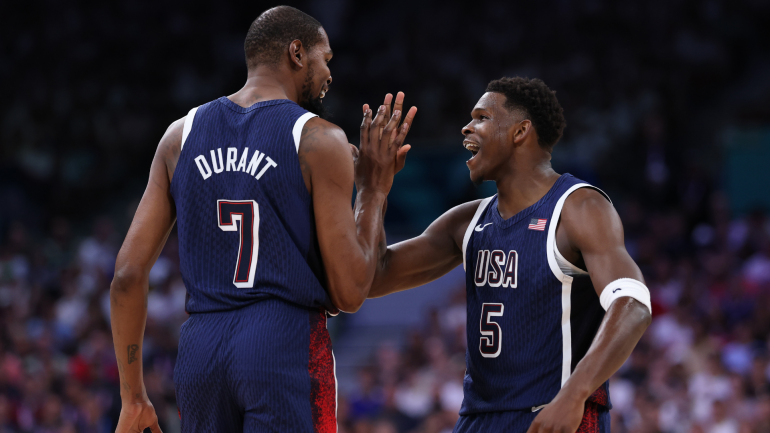
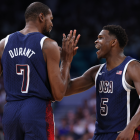
The 2026 Winter Olympics concluded on Sunday, and the NBA is already looking ahead to the 2028 games. Recently, four-time Olympian Kevin Durant said that he wants to play for a historic fifth gold medal in Los Angeles. "Hell yeah, I want to play," Durant said. "I would love to, but I've got to stay on top of my game. I'm not expecting, I want to produce on the floor and make Grant (Hill) and whoever is making the decisions, want to put me on the team. I don't want -- not just for seniority. I want to still prove I can help the team win."
Durant may ultimately deserve a spot on merit -- 2028 is still a ways away for a 37-year-old, but he is still an All-Star-caliber NBA player -- but if he wants a spot, it's his on seniority. He is the greatest Olympic basketball player of all time, and his skillset should age well enough and fits so smoothly next to other elite players that, short of significant injury- or age-related decline, it's hard to envision a scenario in which he wouldn't be able to help Team USA.
But that exacerbates a first-world problem for Team USA: after years of fear about the American developmental pipeline, we're in the middle of a talent boom. The last handful of drafts have been very kind to American prospects, and when you consider all of the great existing American players who have already worn the red, white and blue, it suddenly gets very difficult to trim the roster down to 12 players. With Durant in place, there are really only 11 spots.
So ... who do we think is filling those other slots? We're going to take a shot at filling in the rest of the team. Keep in mind that we're still more than two years away here, so aging will be a factor. So will the stylistic differences between the NBA and FIBA game. Remember, FIBA has no defensive three-second rule, no goaltending and a shorter 3-point line, so shooting is at an absolute premium. Officials tend to call fewer fouls as well, allowing for more physicality defensively. We still have a ways to go before 2028, but for now, these are the players who make the most sense four Team USA's next Olympic roster.
The stars
Yes, yes, I know, almost everyone who plays for Team USA is going to qualify as a "star." But every Olympic cycle reminds us this process is a bit more complex than slapping the 12 biggest names together. We just watched Jayson Tatum ride the bench in the 2024 run to gold while his less-accomplished NBA teammate, Derrick White, played a vital rotation role. The idea here is to grab a handful of the best players in the NBA and then use the rest of the roster to round out the team with specialists.
Now, Durant will be on the team, but he will be 39 when the Olympics arrive. He's probably coming off of the bench. We'll address the bigs separately. Fortunately, the four other starters appear to be relatively straightforward at this point.
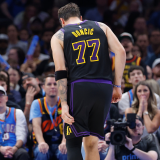
- Cade Cunningham is, at worst, the fourth-best point guard in the NBA. Shai Gilgeous-Alexander is Canadian, Luka Dončić is Slovenian and Stephen Curry likely won't be back as a 40-year-old in 2028. That leaves Cunningham as the obvious choice as our starting point guard. His playmaking should fit in quite well on an Olympic roster with far more offensive firepower than his Pistons, and his size and defensive versatility ensure he won't get picked on. This one's a no-brainer.
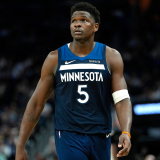
- Anthony Edwards won gold in 2024, has improved markedly as a shooter and post player since then and will turn 27 soon after the 2028 Olympics. He should be at the peak of his powers at this point and could easily be the best American player in the NBA. Once again, this one is obvious.
- Jayson Tatum really should have been one of the core members of the 2024 team. American Olympians usually only play once or twice before handing the baton to the next generation. Durant and LeBron James didn't do that last time, so that forced Tatum to the bench, where Steve Kerr seemingly determined that despite being a jack of all trades, he was not enough of a master at any single one to justify consistent specialist minutes off the bench. Well, with James presumably done competing for gold and Durant headed for the bench, Tatum's versatility alongside other stars suddenly looks a lot more valuable. Assuming he doesn't significantly decline as a result of his torn Achilles, he should still be a deserving starter. He was the best American forward in the NBA before he got hurt, and arguably the best overall American player.
- Cooper Flagg rounds out our core. We're admittedly doing some projecting here, but it feels relatively safe to do so. He's just the fourth rookie in NBA history to average 20 points, six rebounds and four assists. The first three were Michael Jordan, Larry Bird and Luka Dončić. Odds are, he'll be a special player by his third season. His defensive versatility and competitiveness should fit in quite well here.
So let's take stock here. In Cunningham, Edwards, Tatum and Flagg, we have an enormous set of starters in which our smallest player, Edwards, is 6-foot-4. Defensively, this foursome should be stellar and capable of pretty much any scheme Erik Spoelstra wants to run. There's plenty of playmaking here too. Cunningham currently trails only Nikola Jokić for the NBA lead in assists, and Tatum and Edwards have both averaged at least five assists per game in a season despite not playing point guard. Throw in Flagg's passing and you have a really balanced group that can all set one another up.
If it's lacking anywhere, it's probably shooting, and that's only a minor blemish. Cunningham is roughly a 34% shooter from deep, Flagg is at around 30%, and while Tatum is typically a reliable shooter, his jumper seemingly abandoned him during his last run with Team USA. Fortunately, we have a wide pool of American players to choose from to fill in that "gap" and round out the rest of the team. Let's start with the big men, who deserve their own category. Fortunately, there isn't really a shortage of American bigs who can shoot.
The bigs
Our first center choice is easy. We want a big who can shoot? Chet Holmgren is roughly a 37% 3-point shooter. Problem solved. That he's also a perpetual Defensive Player of the Year candidate is a nice bonus. He's not a great rebounder, but having Tatum and Flagg at forward should help offset that minor deficiency, and besides, we have two more big slots at our disposal here. We can stylistically cherrypick from this point on.
Rebounding largely fits into the broader need for physicality. Serbia gave Team USA its biggest test in 2024, so winning in 2028 means having an answer for Nikola Jokić. Alperen Sengun, Domantas Sabonis and Giannis Antetokounmpo loom as possible opponents here as well, and though he plays differently, Team USA needs as many stylistic options as it can find to throw at Victor Wembanyama. So for our second big slot, we're looking for a bit of heft.
This isn't something the American hoops pipeline tends to deliver much anymore, but we fortunately have a pretty straightforward choice here. It's Jalen Duren. He comes with baked in chemistry with Cunningham, he rebounds, and although the sample in the modern NBA is always going to be fairly small, his numbers defending the post have by and large been excellent. Over the past three seasons, he has been in the 75th percentile or better at post up points allowed per possession. Again, tiny sample, but it checks out. When you're as strong as Duren, you're probably going to be tough to score on near the basket.
The third spot comes down to two names, and they're pretty similar players. Both Bam Adebayo and Evan Mobley are enormously versatile defensive big men who have improved meaningfully as shooters in recent years and can create some of their own looks. The standard aging curve would suggest that Mobley, who will be 27 when the Olympics roll around, is likely to be better at that point than Adebayo, who will be 31. He might even be better now. But Erik Spoelstra is coaching this team, and he's probably going to lean toward the player he's more comfortable with, which would surely be the one he's coached in Miami for almost a decade now. It wouldn't hurt to have a bit more Olympic experience on this roster, so Adebayo's 2024 run is a plus as well. If it's a tie or close to it, he's probably going to win. If he's declined at all by then, though, Mobley is ready to go.
The supporting cast
So right now, we have eight spots locked up: Durant, Cunningham, Edwards, Tatum, Flagg, Holmgren, Duren and Adebayo. There are three pretty straightforward roles we need to fill with our four remaining slots: backup point guard, designated shooter and designated defender.
- Tyrese Maxey is our backup point guard. His speed and shooting contrasts nicely with the bigger Cunningham, giving Team USA a curveball to throw at opposing bench lineups. The name of the game here is versatility, and Cunningham and Maxey just complement each other perfectly.
- Kon Knueppel is the clear designated shooter choice. He's leading the NBA in made 3-pointers as a rookie. He's averaging eight 3-point attempts per game, and the only players to shoot a higher percentage from deep on that volume in a season are Stephen Curry and Duncan Robinson. He's on track to succeed Curry as the best shooter in the NBA, so if we're looking for one, pure shooter for the roster, he's our guy.
- Amen Thompson is our defensive specialist. This was the trickiest choice. He just checked the most boxes. He's perhaps the NBA's best athlete, he's 6-foot-7 with a seven-foot wingspan so he's positionally versatile, and FIBA's whistle should be very kind to him given how physically he likes to play.
We'll get into some of the other players I considered for those slots in the snub section, but for now, we have one last slot to fill. It's a tricky one. There's no specific need we're looking to address here. We've checked every positional box, and because of how big some of our guards are, there's not really an impetus to seek out size here either. It's just a matter of picking the best available American player.
Now, this could change in the next two years, but I believe at this point the best available American player is Donovan Mitchell. He'll be closing in on his 32nd birthday by then, so decline is a real possibility, but he still hasn't played and 2028 will probably be his last realistic chance. He's a seven-time NBA All-Star. Every other active player to be chosen to that many All-Star teams has at least been chosen by Team USA, though Kawhi Leonard dropped out due to injury. He finished fifth in MVP voting last year and just ranked seventh in ESPN's latest MVP straw poll for this season. Only two Americans finished above him, Cunningham and someone we'll get to in a moment. Purely as an individual, he is the most accomplished American player without a gold medal.
So Mitchell is the pick to round out the roster. That leaves us with the following 12-man team ...
The final roster
Point guard | Cade Cunningham |
Shooting guard | Anthony Edwards |
Small forward | Jayson Tatum |
Power forward | Cooper Flagg |
Center | Chet Holmgren |
Guard | Tyrese Maxey |
Guard | Donovan Mitchell |
Guard | Kon Knueppel |
Forward | Amen Thompson |
Forward | Kevin Durant |
Center | Bam Adebayo |
Center | Jalen Duren |
The snubs
So, we mentioned one other American player who just outranked Mitchell in the MVP straw poll. That would be Jaylen Brown. In pure basketball terms, he would be a reasonable choice. He's having the best season of his career, he played for Team USA in the FIBA World Cup, and our roster does lean a bit more toward guards than forwards.
Ultimately, the prediction was informed by two factors. The first is that I simply think Mitchell is slightly better. In the best year of Brown's career, he and Mitchell are still basically even in terms of scoring volume. Brown is the better defender given his size, but Mitchell is a better playmaker, is more efficient and beats Brown in most of the all-in-one metrics pretty meaningfully. They're close enough that if there was a specific need for something Brown did, he'd be a fair choice. But if that were the case, we would have carved out a specialist slot for him and we didn't.
The other factor was politics. Brown criticized Team USA in 2024 for his belief that it allows Nike influence over roster decisions. Whether that's true or not, it's a headache Team USA would probably prefer to avoid. If we were talking about a foundational part of USA Basketball, that would be one thing, but for one of the last slots on the roster, the tie is probably going to go to someone else.
The other candidate for the final, "best available American player" slot was Jalen Williams. He's not the individual creator Brown is, but he's a better defender and on the right side of the aging curve. He's having a down year as he recovers from a wrist injury, but it's reasonable to assume that he'll at least bounce back to the level he played at last season, when he was an All-NBA choice. If USA Basketball wants a forward for this last slot, he's the easy pick. But in a tie, I'm giving the edge to the older player. Williams will have more chances.
Backup point guard was a nightmare. Tyrese Haliburton was on the 2024 team, though he barely played. Jalen Brunson missed the cut, and he reportedly wants another shot in 2028. Either would have been worthy choices. But the guard pool is so deep that, with two years out, I'm inclined not to gamble on what Haliburton looks like post-Achilles tear. I'm a bit more comfortable with Tatum, a forward, looking mostly like himself after that injury compared to Haliburton, a guard. Brunson is the oldest of the three, right in the same range as Mitchell, but his playing style is a bit more tailored to the NBA given his mid-range mastery and defensive vulnerability at his size. Both were agonizing cuts, especially given how well Haliburton's passing fits into the FIBA game, but we only have 12 spots.
Devin Booker didn't really fit into a neat box, but he was another brutal cut considering how well he played in 2024. But Mitchell has outplayed him for several years now, and we've now had two full seasons of subpar 3-point shooting out of Booker, so he wasn't going to get any consideration in the designated shooter slot. He's not beating players off of the dribble quite as easily anymore either, so I'd be a bit concerned with how he'll look in two-and-a-half years.
I could have gone in so many different directions for the designated defender slot. Jalen Suggs isn't durable enough. Herb Jones doesn't do enough offensively. Alex Caruso is too old. Cason Wallace is too small. The two players that most seriously challenged Amen Thompson were his brother Ausar and Stephon Castle. In the end, Amen's offensive advantage over his brother and his slight size advantage over Castle were the tiebreakers. Castle is certainly better on offense than Thompson, though, and if either of them can just get to passable as a 3-point shooter, that would make picking a winner easier. Speaking of shooting, that was what kept Scottie Barnes off the team. He could qualify as a defensive specialist, though he's obviously more well-rounded than that overall. This team just already has enough of what he does offensively, and Thompson is an easier fit in the on-ball defensive role we're looking to fill.
The only other big man I gave any consideration to was Walker Kessler. He hasn't played much this season due to injury, but he played for Team USA in the 2023 World Cup and he checks the same size and physicality boxes that Duren does. Duren's growth into an All-Star this season made him the clear choice for this role on the team, but I'm keeping an eye on Kessler just on the faint hope that his experiments with 3-point shooting ever bear fruit. If he ever learns to shoot at his size, he'd be a great FIBA player, so watch out over the next two years.
And then there are the youngsters. I don't think Reed Sheppard is going to catch Knueppel, but he was a similarly gifted college shooter. The 2025 draft class is promising enough that some of these players, like Cedric Coward or Derik Queen, may be heard from in the years to come. And of course, we have three enormously promising American youngsters coming in June in Darryn Peterson, AJ Dybantsa and Cam Boozer. Making the team after only two years as a professional is rare, but not unheard of. Keldon Johnson made the cut after his rookie season in 2020, and Anthony Davis played for Team USA before he even played in the NBA. Neither played major roles in the Olympics, but both won gold medals, so we can't rule the upcoming rookies out.