Fantasy Baseball Draft Prep: The toughest players to rank for 2026 include Rafael Devers, Ozzie Albies
What roster shakeups mean for player value heading into draft season

The Cardinals finally found a taker for Nolan Arenado. And unfortunately, that taker happened to be the Diamondbacks, which raises some real questions about Jordan Lawlar's role in Arizona, which is the biggest impact from this move, since Arenado almost certainly doesn't matter for Fantasy anymore.
Lawlar has almost exclusively played on the infield in his career, but with the Diamondbacks now set at second, short, and third base, his only seeming path to playing time will come in the outfield. Where he has played three games as a professional, all in a stint in the Dominican Winter League this offseason. He'll surely get more reps there this spring, but it puts even more pressure on him to perform right away to have a chance to play regularly. Lawlar is still only 23, but it seems like a lot of folks have lost faith in him, and I wonder if that doesn't also include the Diamondbacks, who have seemingly had a need for him over the years and have seemingly found every excuse not to actually use him.
That, despite Lawlar remaining very productive at Triple-A. He has above-average raw power by the metrics, with a swing tuned to getting the most out of it to the pull side, and good enough plate discipline. But he has struggled to stay healthy and has gotten eaten up by breaking balls, an issue that was there in Triple-A, too. The Diamondbacks know Lawlar better than anyone, and the fact that they don't seem fully bought in on him as an everyday player three years after his MLB debut seems to say a lot.
I still like Lawlar as a sleeper, but whereas I might have pounded the table for him as a late-round pick in all drafts before this, I'm definitely going to have to cool on that moving forward. He could still end up a viable contributor in Fantasy, but the Diamondbacks' seeming lack of faith in him should spill over to how we view him.
That makes him a tough player to rank – and that is what we call an "expert transition" in the biz. That's what the rest of today's newsletter is all about -- the Marlins also sent Ryan Weathers to the Yankees, a move with less Fantasy fallout, but which does open a pretty clear runway for Robby Snelling and Thomas White to join the Marlins rotation, perhaps as soon as Opening Day. With our rankings live on the site, I wanted to give some insight into the process by highlighting 10 players who gave me headaches while going through the rankings process – and are still giving me headaches now that they are out there for everyone to judge.
Toughest players to rank
Adley Rutschman, C, Orioles
My ranking: C14
Catching is hard. Catchers tend to peak later than other positions while also tending to have shorter peaks, and we might be seeing the latter in action with Rutschman, who has just been beaten up over the past couple of seasons. His 2024 was seemingly derailed by a hand injury he played through for much of the second half of the season, while his 2025 was hampered by injuries to his hand, his head, and then by two oblique injuries that required trips to the IL and limited him to just 89 plate appearances from late June on. But now here's the question: Were his struggles the past two seasons a result of him playing through injuries, or have injuries permanently lowered his baseline skill level? With a 27-year-old who was a legitimate MVP candidate as recently as June of 2024, I'm inclined to give the benefit of the doubt. But with his xwOBA dropping from .374 in 2023 to just .320 and .325 over the past two seasons, I can't be as confident in that as I'd like. Ranking him as a high-end No. 2 catcher is the best balance of risk and reward I can come up with at this suddenly pretty loaded position.
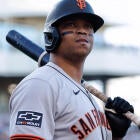
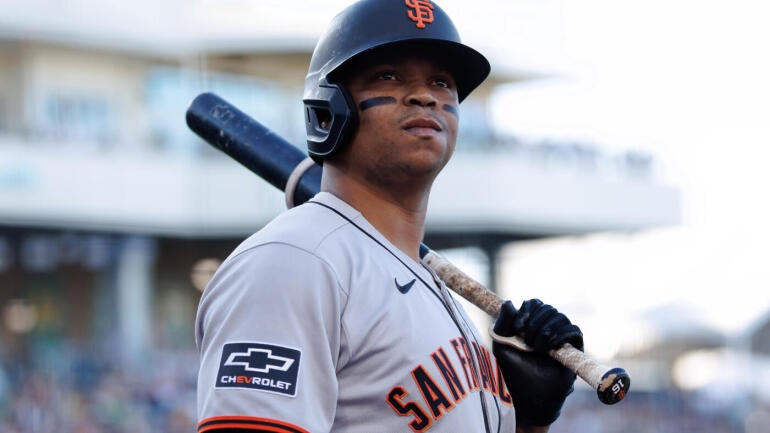
Rafael Devers, 1B, Giants
My ranking: 1B5
I actually don't have too many concerns about Devers. What makes him so hard to rank is that I am kind of out on a limb relative to the consensus, and that always makes me a bit uncomfortable – Devers is the No. 7 1B in ADP right now, but I have him ranked nearly 25 spots higherin my overall rankings than the consensus. I think the general skepticism around him comes from his home ballpark in San Francisco, which is maybe the toughest place for left-handed hitters in the majors, and we saw that in his post-trade production – his .825 OPS in Oracle Park was significantly worse than his .977 mark at Fenway Park.
Of course, an .825 OPS isn't bad at all, and Devers' 162-game pace in just his 48 games at Oracle would be more than worth his current price:
Devers' 162-game pace in Oracle: .234 average, 37 HR, 91 R, 84 RBI
The .234 batting average is ugly, but everything else is pretty great! In fact, it's right in line with what Pete Alonso did in 2024, when his ADP was about a round ahead of where Devers' is right now.
And, notably, Devers won't be playing every game in San Francisco next season. He'll play roughly half of them, in fact! So, while yes, Oracle Park is an obstacle that might hold Devers back from being the borderline first-round hitter he has been in the past. But now that his ADP has slipped to the fifth or sixth round range, you don't need him to be a first-rounder. There are some concerns about contact rate dropping into the scary range, but that's also the range he's been at for two years now, and it hasn't really impacted him that much.
I'm uncomfortable being on a relative island with Devers, but I have faith in the skill set.
Ozzie Albies, 2B, Braves
My ranking: 2B8
There's no good time for an injury, but the hand injury that ended Albies' 2025 season came at an especially bad time. Stuck in one of the deepest slumps of his career – a carry-over effect from the fractured wrist he suffered in 2024 – Albies started to figure things out in the second half of the season, tapping back into his right-handed pull power to club nine homers in 62 games after the All-Star break, after hitting just seven in 95 games in the first half. Albies is expected to be back from the fractured hamate bone in his left hand that ended his season in September, but "back" isn't necessarily the same as "fully recovered," as we learned last season. I'm inclined to give him the benefit of the doubt, but one thing we've learned about Albies in recent years is that he does not have a particularly wide margin for error. Because he relies so heavily on generating power in his relatively rare at-bats against left-handed power, any small dip in his skill set tends to have especially large repercussions for his production. I have him ranked a bit ahead of his ADP, but I recognize that could be a big mistake.
Noelvi Marte, 3B, Reds
My ranking: 3B11
A former top prospect, Marte seemingly made good last season, hitting .263/.300/.448 with a 25-homer, 20-steal pace in 2025. Given the age and pedigree, it makes sense that a lot of Fantasy players are buying in … but it might be a trap. The underlying numbers very much don't back up what Marte did in 2025 – his .245 xBA was nearly 20 points worse than his actual mark, and he overperformed his xwOBA by 17 points, too. I might be willing to overlook that and give Marte the benefit of the doubt (playing in Cincinnati helps), except that he absolutely collapsed down the stretch to cap off the apparent breakout. He hit just .191/.214/.287 in September with a monumental 33% strikeout rate. That isn't enough to bury Marte, but it's enough to raise real questions about him as a top-10 option at the position. I won't be buying him at that price.
George Springer, OF, Blue Jays
My ranking: OF18
A 36-year-old had a career year? Well, that's an easy fade. What's so hard about ranking that? While "Fade players in their mid-30s coming off career years" is generally good advice, it doesn't always work out that way. Nelson Cruz's first .900 OPS season didn't come until he was 34, and he followed it up with two more seasons of similar quality and hit 40-plus homers as late as his age-38 season, to name just one notable recent example. In Springer's case, while the change in production came out of nowhere, it wasn't necessarily a fluke. His .404 xwOBA was actually right in line with his actual .408 mark, and was actually the fourth-best mark among qualifying hitters last season, tucked between Shohei Ohtani and Kyle Schwarber. I'm inclined to bake in a lot of regression from what Springer did last season, but this is another situation where the market is simply baking in a whole lot more – his ADP is about 30 spots later than my rankings for him, overall. And that makes me nervous.
Jakob Marsee, OF, Marlins
My ranking: OF29
Marsee wasn't really a prospect of much note, especially coming off a 2024 season where he hit just .200 with a .315 slugging percentage across Double-A and Triple-A. But he was a productive hitter long before that, and then bounced back to hit .246/.379/.438 in Triple-A … which is still a long shot from his .292/.363/.478 line in the majors. The patience is real, and so is the athleticism, so I think he'll put up pretty good on-base numbers and contribute decent value once he is on the bases … but doesn't the whole skill set feel kind of Cavan Biggio-esque?
Marsee straddles the "passive vs. patient" line with his swing decisions, though he does at least generally avoid swinging at the wrong pitches and generally makes a lot of contact. But, at least as a rookie, the contact he made was pretty weak, with an 88.9 mph average exit velocity and 14.8% pulled-air rate that will likely hold him back as a power hitter. If pitchers respond to that lack of power by challenging him in the zone more, can he adjust his approach to take advantage? If not, the strikeout rate might start to balloon, which will put even more pressure on him to maintain an outlier BABIP, something he didn't consistently do in the minors. I'm mostly inclined to believe in Marsee, since he provides a rare opportunity for a stolen base specialist who will hit leadoff consistently and won't be a zero as a hitter.
But if you're looking for this year's Lawrence Butler (an exercise I'll be doing at a later date), Marsee seems like the most obvious candidate.
George Kirby, SP, Mariners
My ranking: SP19
I keep pointing to one thing with Kirby when I write about him this offseason: The loss of his splitter/changeup in 2025. Those were never especially important pitches on their own for Kirby, but I think their absence in 2025 was a sign that Kirby was never quite right after coming back from his shoulder injury. Kirby experimented with both the splitter and changeup, which he had largely ditched in 2024, which says that he was searching for that offspeed pitch and just couldn't find it. Which helps explain why he was just a bit less effective across the board in 2025, putting up a 4.21 ERA and 3.88 xERA, the latter of which was nearly a half-run worse than his 2024 mark.
I'll be watching Kirby this spring to see if his arm slot rises and the splitter is back, a sign that my theory is correct. If that's the case, I'll be more inclined to buy in on his chances of getting back to being a difference maker, even if the splitter itself probably won't play much of a role in that either way. Think of it like a canary in a coal mine – if he's throwing the splitter around 10% of the time this spring, it's probably a sign that he's fully past the shoulder injury from last season. Until then, I just don't really know where to slot him.
Spencer Strider, SP, Braves
My ranking: SP35
Can Strider get his fastball back? I'm ranking him low enough, relative to ADP, that I don't think I'll wind up with him on any of my teams to find out. He was terrible last season, and there really isn't much positive to point to – even during a six-start run to close out the season, where he put up a 2.50 ERA, he had just a 19.6% strikeout rate. Strider has never had the kind of command to get away with anything but an elite strikeout rate, and with his fastball losing nearly 2 mph and dropping in whiff rate by nearly half since the last time he was healthy in 2023, I just don't have a lot of confidence he's going to get back to being a difference maker.
But he was so good at his absolute peak that I certainly don't feel comfortable writing him off entirely. Even if I think there might be only, say, a 10% chance Strider gets back to that 2023 level, the potential that he might be the only pitcher to flirt with 300 strikeouts again makes it awfully tough to bury him entirely. If we're ranking solely based on what I think the most-likely outcome is for every pitcher, I'm not sure Strider would even be in my top-50. When you look at it that way, I'm being pretty generous with his ranking, aren't I?
Brandon Woodruff, SP, Brewers
My ranking: SP29
Every time I look at it, it seems too high. Woodruff will be 33 shortly before pitchers and catchers report, and he hasn't thrown even 100 innings in a season since 2022. He returned from shoulder surgery and was excellent last season, putting up a 3.20 ERA and a career-best 32% strikeout rate, so there's clearly upside here to go along with the risk. But that also came with a 3 mph dip in fastball velocity relative to 2022, and while that didn't really impact his effectiveness, he did deal with a lat injury that ended his season in mid-September.
That's an awful lot of red flags before we even get to the fact that, heading into his age-33 season, Woodruff opted to accept the qualifying offer rather than seek a long-term contract in free agency. I'm sure part of the thought process there is that he has a chance to pitch a full, healthy season and build his free agency value even more (while still pocketing north of $20 million for 2026). But one can't help but wonder if there also wasn't some concern on Woodruff's part that concerns about his health might have cratered his market, especially as teams started looking more closely into his health.
This is, to be fair, just speculation. But when you stack up all of the red flags that are already present … yeah, maybe I have Woodruff too high. He's ranked right around ADP for now, but I'm not sure I actually have much interest in drafting him at this price. It might be time to push him down my rankings already.
Jacob Misiorowski, SP, Brewers
My ranking: SP37
It's just FOMO, pure and simple. Misiorowski has the kind of arm talent you can only dream about, sitting at 99.3 mph with his four-seamer and 94.1 mph with his slider as a rookie. The four-seamer was a tremendous bat-misser, sporting a 32.5% whiff rate, but everything else in the arsenal was … surprisingly pedestrian when it came to missing bats. Among 479 pitchers who threw at least 500 pitches in 2025, Misiorowski's non-fastball whiff rate of 26.2% ranked 383rd. Just ahead of Frankie Montas and Simeon Woods Richardson.
Maybe that doesn't matter. Misiorowski's non-fastball pitches did a good (though hardly elite) job of limiting damage on contact, and the fastball might be so good that the whole arsenal plays up. It did all lead to an elite 32% strikeout rate, and while his 4.36 ERA wasn't great, his 3.41 xERA suggests there was some bad luck there. The upside here is clear, and with just a few tweaks, we could be talking about one of the most dominant pitchers in baseball.
I just wish we saw more of that in his rookie season. Misiorowski struggled with command, walking 11% of opposing hitters, and that wasn't something that got better as the season progressed. That led to an awful lot of very short outings from Misiorowski, who is also coming off a season where he threw just 129.1 innings, his first time ever topping 100. There will likely be some limitations and some hand-holding throughout the season for Misiorowski, so if I'm going to draft him as a top-36 starter, I really wish I could feel more confident he was going to be an absolute difference maker on a per-inning basis. That's no guarantee.
So … I'm ranking him one spot outside of the top-36. Dilemma solved!