Ranking 16 players who would have been free agents this offseason: Vlad Guerrero Jr., Fernando Tatis Jr., more
Plus, let's predict which players would have made more on the market now than when they signed their extensions

In terms of pace of the action and transactions, this has been a really slow offseason, even as it's heated up in the last 10 days or so. Two of the top 10 free agents remain unsigned and there's a strong list of trade candidates who could still be moved. Spring training is only a few weeks away now, yet it feels like there's plenty of offseason still to happen.
At least part of the slow winter has to do with what is, frankly, an underwhelming free-agent class. It is what it is. Some free-agent classes are great, some aren't, and this one isn't. The class would be even weaker if several of the top free agents hadn't taken short-term deals in the past and used their opt outs this winter. Think Pete Alonso, Alex Bregman, and Cody Bellinger.
Long-term extensions have also taken a bite out of the free-agent class. Teams frequently lock up their best young players early in their careers, trading financial security for extended control and cost certainty. I don't blame any player who jumps on an early career extension. I'd do the exact same thing. Being set for life in your early-to-mid 20s seems pretty great, doesn't it?
These early career long-term extensions are smart business for the team and player, but they do weaken future free-agent classes. Players become a free agent when they reach six full years of service time and, during the 2025 season, 16 players hit that benchmark but did not become a free agent this offseason because they had already signed an extension.
Among those 16 players are some of the very best players in the sport, players who would have livened up the free-agent class and created massive bidding wars. Because ranking things is what we do, we're going to rank those 16 would-have-been free agents based on the contract we think they would have received this winter had they, you know, hit the market.
Here now are 16 players who would have qualified for free agency this offseason if not for the long-term extension they signed earlier in their careers. Come with me, won't you?
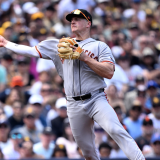
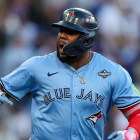
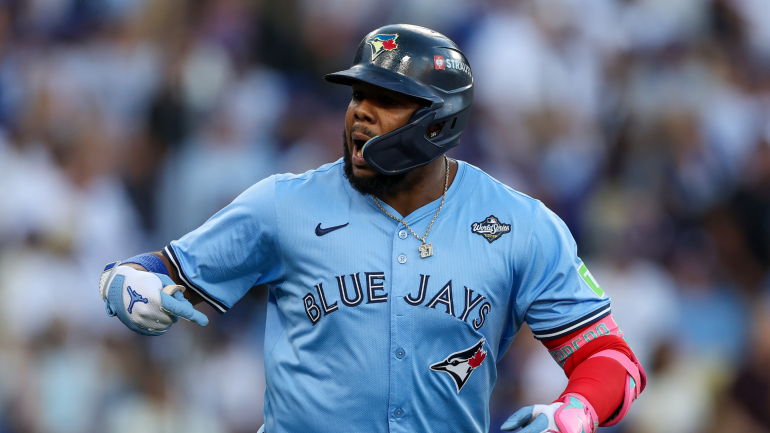
1. Vladimir Guerrero Jr., Blue Jays


Contract: 14 years, $500 million (signed April 2025)
Remember all that ruckus about Guerrero's Opening Day negotiation deadline? Half a billion dollars has a way of making deadlines flexible. Guerrero agreed to his landmark deal -- $500 million is the third-largest guarantee ever behind Juan Soto ($765 million) and Shohei Ohtani ($700 million) -- about a week after Opening Day, making it a near certainty he will finish his career with the Blue Jays.
Guerrero will turn only 27 in March and he's coming off one of the greatest postseason performances ever. Teams these days know better than to overvalue small sample postseason performance, but gosh, but hitting .397/.494/.795 in October wouldn't hurt Vlad Jr.'s earning potential, you know? If nothing else, it would have ratcheted up the pressure on Toronto to keep him forever.
The regular-season performance has been a bit up and down over the years, though never worse than solidly above average. The underlying markers are outstanding: elite plate discipline, elite contact skills, elite exit velocities. Guerrero has turned himself into a nimble defender too. Had he passed on his extension, he would've been the offseason's No. 1 free agent, hands down.
What would he have gotten this winter? Guerrero is a year older right now than Soto was last offseason, plus his regular-season performance isn't as consistently excellent, so I don't think he would have signed for SotoBucks. I also don't think he would've been far off either. The 14 years are a lock. Stars sign until age 40 these days and 14 years takes Guerrero right there.
Soto's $51 million is the average annual value record for a position player. Aaron Judge is second at $40 million. Given his age, I think Guerrero would have beaten Judge. Call it $42 million a year for 14 years, and that's $588 million. When you're in that deep and that close to the big round number, you might as well go ahead and give him the extra $12 million to get to $600 million.
Think about the bidding war. The Blue Jays obviously would have tried to retain him. The Yankees could've gotten involved after losing Soto. The Mets might've tried to pair Vlad Jr. with Soto. The Red Sox may have given it a go. All the right teams would have been after him, pushing the price up. Guerrero's extension begins in 2026. He has all 14 years and $500 million ahead of him.
2. Fernando Tatis Jr., Padres


Contract: 14 years, $340 million (signed February 2021)
His style may not be for everyone, but Tatis is a terrific all-around player and an electrifying presence. You can't take your eyes off this guy. He's a well-above-average hitter even with his power not fully returning following his 2022 shoulder surgery (and his 2022 performance-enhancing drug suspension) and he's a sensational defender in right and a standout baserunner. Tatis does it all.
Age is also key. Like Guerrero, Tatis will play the entire 2026 season at age 27. He has just about his entire peak ahead of him and teams have shown they'll pay handsomely for those late-20s peak years. PED suspensions do not cost players. Nelson Cruz, Starling Marte, Jorge Polanco, and others cashed in nicely after serving PED suspensions. It wouldn't have mattered with Tatis.
What would he have gotten this winter? The injury history, particularly some serious shoulder issues, would have been a larger concern than the PED suspension. Let's put Tatis down for 12 years at $33 million per year, or $396 million total. Round it up to $400 million even. He has nine years and $286 million remaining on his contract, or $31.8 million per year.
3. Logan Webb, Giants


Contract: 5 years, $90 million (signed April 2023)
A workhorse in an era of five-and-dive starters, Webb has led baseball in innings pitched each of the last three years, and last year he boosted his strikeout rate without sacrificing much ground ball ability. Webb has finished in the top six of the NL Cy Young voting each of the last three years and is the safest bet in the sport to take the ball every five days and be very good to great. The No. 1 starter on the free-agent market, he would have been.
What would he have gotten this winter? Webb turned 29 in November. Dylan Cease turned 30 in December and he never misses a start either, though his performance is volatile in a way Webb's isn't. Cease just signed for seven years and $210 million. I'm putting Webb down for eight years and $248 million, or $31 million per year. Three years and $70 million remain on his deal.
4. Yordan Alvarez, Astros


Contract: 6 years, $115 million (signed June 2022)
I'm not sure there's a more imposing hitter in the sport. Alvarez is a massive human, first and foremost, plus he's a tremendous hitter with thunderous power who is not neutralized by the left-on-left matchup. Here are his career numbers:
| AVG/OBP/SLG | PA per HR | BB% | K% | |
|---|---|---|---|---|
vs. RHP | .286/.388/.569 | 15.9 | 13.2% | 19.3% |
vs. LHP | .316/.391/.580 | 19.2 | 9.9% | 20.4% |
Alvarez, 29 in June, has a lengthy injury history, including knee surgery and a hand injury that limited him to 48 games in 2025. That plus poor enough defense that all but guarantees he'll spend the majority of the rest of his career at DH would have kept Alvarez from really breaking the bank this winter, but make no mistake, he would've been one of the offseason's most coveted free agents.
What would he have gotten this winter? If Pete Alonso and Kyle Schwarber can get five years at $30 million to $31 million per year in their early 30s, Alvarez would have cleared that in his late 20s, even with the injuries. I think he would've gotten seven years and come in around $34 million per year, or $238 million total. Alvarez has three years and $78 million to go on his extension.
5. Will Smith, Dodgers


Contract: 10 years, $140 million (signed March 2024)
Smith hit the game-winning home run in the 11th inning of Game 7 of the World Series and I think his free agency would have been fascinating. He clearly would have been the No. 1 catcher on the free-agent market, but he turns 31 in March, so age-related decline may not be too far away, plus he rates poorly as a pitch-framer and pitch-blocker. The bat is far above average for a catcher though, and offense always pays. Great catchers rarely hit free agency, and when they do, position scarcity equals big bucks.
What would he have gotten this winter? Smith's contract is frontloaded, so he has eight years and $83.45 million remaining. I'm not sure he would get eight years as a free agent. The $83.45 million though? Smith would clear that. I'm thinking six years and $25 million per year, or $150 million total. The bidding war might've been won by whichever team put a seventh year on the table.
6. Nico Hoerner, Cubs


Contract: 3 years, $35 million (signed March 2023)
Hoerner, 29 in May, is a secondary skills superstar. He lacks the power and exit velocity that gets guys paid top-of-the-market dollars, but he's an excellent contact hitter, an excellent baserunner, and an excellent defensive second baseman who would play shortstop for the Cubs if they didn't have Dansby Swanson. My sense is Hoerner is underappreciated by casual fans. He definitely isn't within baseball. He's the kind of player front offices love because he posts every day and helps his team in so many ways.
What would he have gotten this winter? This free-agent class is light on legitimate shortstops and I think a team (cough Tigers cough) or three would have pursued Hoerner at that position. I'm not sure Hoerner would've gotten Willy Adames money (seven years and $182 million) given his lack of power, but six years at $20 million a pop? Sure. That's $120 million total. His short-term extension has one year and $12 million to go.
7. Austin Riley, Braves


Contract: 10 years, $212 million (signed August 2022)
Riley's $212 million contract is the largest in Braves' history. He was a perennial MVP candidate who averaged 159 games and 36 home runs per year from 2021-23. There have been injuries the last two years though, including nagging oblique issues that limited Riley to 102 games in 2025, and the offense has slipped from All-Star caliber to merely pretty good. His third-base defense is not bad, though you would have to understand a long-term free-agent deal likely includes a lot of first base down the road.
What would he have gotten this winter? Riley, 29 in April, has seven years and $22 million annually left on his contract, plus a $20 million club option (no buyout) for an eighth year. That's $154 million total without the option. I think Riley is the first player in our rankings who would have fared worse as a free agent than with his remaining contract. Not much worse, but worse. Maybe five years and $20 million per year? Riley might've been a candidate for a one-year plus player option(s) prove-it deal a la Pete Alonso, Alex Bregman, Cody Bellinger, et al.
8. Andrés Muñoz, Mariners


Contract: 4 years, $7.5 million (signed November 2021)
Locking up Muñoz when they did (soon after he completed Tommy John surgery rehab) was a tidy bit of business for the Mariners. He's already completed the four guaranteed seasons on his contract and is now into the club option years. Seattle picked up their $6 million option for 2026, and Muñoz's deal has an $8 million club option for 2027 and a $10 million club option for 2028. Barring injury, those are no-brainers. Muñoz does everything you want from a late-inning reliever: strikeouts, grounders, weak contact.
What would he have gotten this winter? Muñoz will play the entire 2026 season at age 27, and if 34-year-old Robert Suarez can get three years at $15 million apiece this offseason, Muñoz would have cleared that with room to spare. Five years at $17 million annually sounds about right, or $85 million total. Not quite Josh Hader money (five years and $90 million), but close.
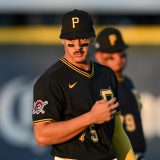
9. Mitch Keller, Pirates


Contract: 5 years, $77 million (signed February 2024)
There was heavy interest in Keller at last July's trade deadline because a) he's a rock solid innings guy as is, and b) there is some belief he has untapped upside. I'm not 100% sold on that last part -- the Pirates are pretty darn good at developing pitchers -- but who really knows with pitchers these days? Keller will turn 30 in April and pitchers who never miss a start while giving teams at least some reason to believe there's another level to their game are always hot commodities, whether in free agency or by trade.
What would he have gotten this winter? I don't think Keller would have been a nine-figure free agent this offseason. I have him more in the four years and $80 million range, which is Eduardo Rodriguez money. A good starter but not someone I want at the top of my rotation, to put it another way. Keller's backloaded extension has another three years and $54.5 million remaining.
10. Sean Murphy, Braves

Contract: 6 years, $73 million (signed December 2022)
It has been tough sledding for Murphy since the 2023 All-Star break. He hit .306/.400/.599 in the first half that year and has hit .189/.296/.361 in close to 800 plate appearances since. Murphy's had injuries too, including right hip surgery this past September. Still, he's expected to be ready for Opening Day and he continues to rate as a standout defender. Good catchers rarely hit the open market and, having just turned 31, Murphy should still have a few productive years ahead of him.
What would he have gotten this winter? The hip injury is the X-factor. Murphy admitted his hip had bothered him for several years; if he'd been playing for a contract, would he have gotten it fixed ASAP? As in, a year or two ago? The player Murphy is right now probably gets three years and $18 million to $20 million annually as a free agent because a) good catchers are hard to acquire, and b) teams would talk themselves into believing his performance will rebound with a healthy hip, which isn't unreasonable. Murphy has three years at $15 million apiece remaining on his contract, with a $15 million club option (no buyout).
11. Jake Cronenworth, Padres

Contract: 7 years, $80 million (signed April 2023)
Cronenworth shook off what looked like a worrisome offensive decline in 2023 and is back to being a pesky, all-around contributor who slots in comfortably toward the bottom of the contender's lineup. Would I want him as a centerpiece of my roster? No. Would I feel good about having him on my team when I put my head down on the pillow at night? Yes. Cronenworth is rock solid in all phases of the game is the kind of winning player contenders love to fill out their roster with.
What would he have gotten this winter? Age would have worked against Cronenworth, who will play the entire 2026 season at age 32. He has another five years at $12 million annually to go on his extension, or $60 million total. The $12 million per year is more than fair. A bit of a bargain, really. The five years would have been the hang up. Four years at $14 million might've been the play here, or even three years at $16 million or so. Not quite what's left on his deal, but pretty close.
12. Tommy Edman, Dodgers

Contract: 5 years, $74 million (signed November 2024)
The Dodgers locked up Edman soon after their 2024 World Series win and his NLCS MVP performance. He's never returned to the offensive heights of his rookie season in 2019, instead settling in as a league average or slightly worse hitter who can play all over. Wrist and ankle trouble have taken a bite out of Edman's game the last two years. He doesn't run quite as well as he used to and he can't bounce around to different positions quite as easily. But clearly, Edman can still be a good role player on a contending team.
What would he have gotten this winter? The Dodgers print money and just won another World Series, so what does it matter, but I do wonder if there's a little buyer's remorse. Edman turns 31 in May and has four years and $52 million remaining on his contract, which includes the $3 million buyout of a $13 million club option. The injuries and just OK bat lead me to believe that would have been Edman's ceiling as a free agent this winter, four years and $52 million or so.
13. Bryan Reynolds, Pirates

Contract: 8 years, $106.75 million (signed April 2023)
The Pirates gave Reynolds the largest contract in franchise history three years ago and he's since leveled off as a hitter, one who had a 99 OPS+ in 2025. He's also gone from center field to left field defensively, and he's nothing special in left either. Chances are Reynolds will spend most of the rest of his extension as a DH. It's definitely not great for the Pirates, a team that rarely spends as it is, that they've gotten only 5.4 WAR out of the first three years of the richest contract in their history.
What would he have gotten this winter? Nothing close to the five years and $79 million remaining on his contract, I can tell you that much. (That $79 million includes the $2 million buyout of a $20 million club option). Reynolds will play the entire 2026 season at age 31. He was pretty good in 2024. Not great, but pretty good. That might've gotten him something like Tyler O'Neill's three-year, $49.5 million contract, which included an opt out after the first year.
14. Cristian Javier, Astros

Contract: 5 years, $64 million (signed February 2023)
Not too long ago, Javier started a combined no-hitter in the World Series and was one of the best young pitchers in the game. He labored through 2023 though, then Tommy John surgery wiped out most of his 2024 and 2025. When he returned last August, Javier showed the usual post-elbow reconstruction rust. We saw flashes of the old Javier at times (six no-hit innings against the Angels on Aug. 29), but also too many games in which nothing came easily. Every out was a grind.
What would he have gotten this winter? Javier strikes me as a player who would've taken the $22.025 million qualifying offer, looked to rebuild value as he got further away from Tommy John surgery in 2026, then gone into free agency at age 29 and without draft pick compensation attached next winter. Without the qualifying offer, I think teams would have rushed to offer Javier a short-term prove-it contract, say one year and $20 million with a player option(s). He has two years at $21 million apiece left on his deal.
15. Luis Robert Jr., White Sox


Contract: 6 years, $50 million (signed January 2020)
You may remember Robert signed his extension before he even made his MLB debut. There were very clearly unspoken service time concerns there -- "Sign this contract or we're going to manipulate your service time" -- but hey, who can complain about locking in $50 million before your debut? Robert's had very high highs (38 homers and 4.9 WAR in 2023) and very low lows (85 OPS+ from 2024-25) in his career. Good luck figuring out how he would have been valued as a free agent.
What would he have gotten this winter? Now 28, Robert just wrapped up the guaranteed portion of his contract and the White Sox picked up his $20 million club option for 2026. He has another $20 million club option ($2 million buyout) for 2027. It was a surprise when Chicago didn't trade Robert at last year's deadline and instead picked up the option. Clearly, he would have been looking at a short-term prove-it contract as a free agent. One year and $15 million with a bunch of incentives, maybe?
16. Jose Trevino, Reds


Contract: 3 years, $14.925 million (signed March 2025)
A perfectly cromulent defense-first backup catcher and excellent clubhouse vibes guy, Trevino is a strong pitch-framer and he puts the ball in play at a high enough rate that he'll have a few two- or three-week hot streaks each year. You know the kind. The kind that make you wonder if the backup catcher should play more, then he plays more, then the offense dries up, then he goes back to being the backup, and we do it again a month or two later.
What would he have gotten this winter? Trevino just turned 33 and good backup catcher money is two years and $10 million or so these days. He has two years at $5.25 million a pop remaining on his contract, plus a $6 million club option ($1 million buyout) for a third year. So reasonably priced it's boring.