Giannis Antetokounmpo mock trades: What potential offers from Knicks, Lakers, Warriors could look like
What could an eventual Giannis Antetokounmpo trade look like? Let's assess the landscape

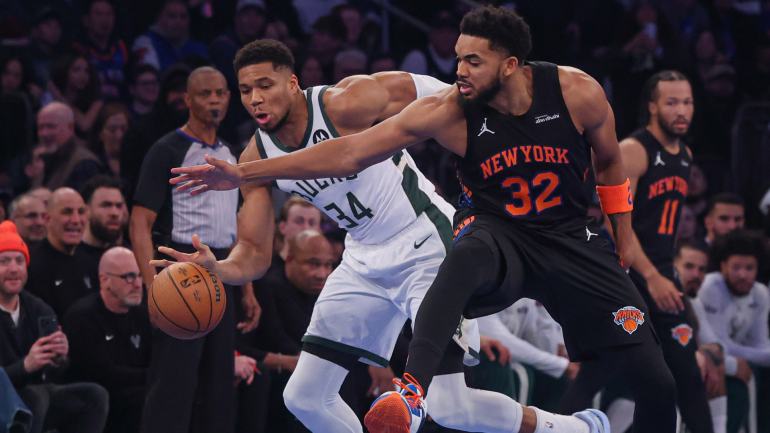
What could an eventual Giannis Antetokounmpo trade look like? That's hard to say. The NBA isn't the stock market. Players don't have set trade values. It's not as though the Bucks can set a price, say, five first-round picks, and any team with that pool of available assets can go get him. Some picks are more valuable than others. Some teams have more desirable salaries to swap.
And of course, some teams will appeal more to Antetokounmpo than others. It's reasonable to believe that Antetokounmpo might stick his thumb on the scale for a big-market contender like the Knicks or Lakers. That's less likely for smaller cities or less proven teams. He has a 2027 player option. He can use that to scare off teams he'd prefer not to join. Nobody's paying a premium for a rental.
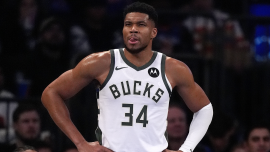
So we're going to go through some of the most common, predicted Antetokounmpo destinations and try to mock out what a Giannis trade would look like for that, specific team. We'll cover what the Bucks would look for out of such a deal, what obstacles stand in the way of a trade, and ultimately, whether or not the team getting Giannis in these mock deals should actually pull the trigger. We'll begin, of course, with the team Antetokounmpo was reportedly interested in joining over the summer: the New York Knicks.

Trade 1: Giannis to the Knicks
- Knicks get: Giannis Antetokounmpo, Kyle Kuzma, Cole Anthony
- Warriors get: Mikal Bridges, Gary Trent Jr.
- Bucks get: Karl-Anthony Towns, Jonathan Kuminga, Buddy Hield, Deuce McBride, Golden State's unprotected first-round picks in 2026 and 2032, Washington's top-eight protected first-round pick in 2026 (reverts to two second-round picks if not conveyed), unprotected first-round swap rights with New York in 2030 and 2032, swap rights with the lesser of New York's and Brooklyn's first-round pick in 2028
There are a number of serious road blocks here. Most notably? The Knicks don't really have assets that the Bucks would or should want. When you give away a star, you tend to want to rebuild around youth and draft picks. The Knicks don't have youth or draft picks. They're going to have to trade a veteran or two away to find them. It's hard to imagine anyone paying a substantial amount for Karl-Anthony Towns on a supermax deal. Realistically, we're looking for a third team that would pay up for OG Anunoby or Mikal Bridges. Anunoby is the better of the two players. Bridges is a bit easier to trade because, even though he extended in the offseason, his 2025-26 cap figure is far lower.
Plenty of win-now teams would probably love Bridges, but Golden State makes sense for a few reasons. For starters, they have a young player in Jonathan Kuminga whose upside would potentially be pretty valuable for Milwaukee, but who has struggled to fit into Golden State's existing structure. That wouldn't be an issue for Bridges. He'd check just about every box for the Warriors. He wouldn't compromise their spacing as Kuminga does, and he's a far better defender. He could give them some badly needed secondary creation as well. Golden State's offense dies whenever Stephen Curry rests.
In addition to Bridges, Golden State would send Milwaukee two first-round picks to seal the deal. The 2026 pick would probably be in the middle of the first-round, as Golden State is off to an 11-10 start in a loaded Western Conference. The 2032 pick? That's far more appealing. Curry, Draymond Green and Jimmy Butler will be retired by then. That pick could potentially be enormously valuable.
Towns would at least give the Bucks a reasonable short-term floor. They wouldn't need to be bottom-dwellers with him, and the concept of having two big men that shoot as well as he and Myles Turner do would open up a lot of interesting lineup concepts. If nothing else, that's the ideal setup for Kuminga. They could sell some tickets and buy time as they wait to regain control of their own future draft capital in the years to come. Getting first-round swaps from the Knicks is nice as well. By 2032, Antetokounmpo will be 37 and Jalen Brunson will be 35. New York's window could very well be closed.
This is a best-case scenario for the Knicks. They'd be able to keep OG Anunoby, their superior wing. Losing McBride would sting, but the Bucks would want his cheap contract. Kyle Kuzma and Cole Anthony are at least playable depth for them. The real question here would be what New York could do next, if anything. Josh Hart and Mitchell Robinson are iffy fits on an Antetokounmpo team. He needs shooting around him. They're poor positional shooters. Could New York turn them into shooters somehow? Or could the Knicks make it work with suboptimal spacing? Those are real problems, but ones the Knicks would probably be willing to take on if it meant getting a top-five player in the NBA.
In an honest bidding war, the Knicks lose. This is one of the worst packages we'll cover in this space. But if Antetokounmpo is willing to make things uncomfortable for the Bucks, they might not have a choice. This is what the Knicks can offer. Maybe there's a different iteration of the deal in which someone pays more for Anunoby instead of Bridges. Maybe Milwaukee would want Hart or Robinson. But the core concept of Towns and one of the wings is what a Knicks deal would look like, and if Giannis wants to play at Madison Square Garden badly enough, he could probably make it happen.
Trade 2: Giannis to the Lakers
- Lakers get: Giannis Antetokounmpo
- Bucks get: Austin Reaves, Rui Hachimura, Maxi Kleber, Gabe Vincent, Dalton Knecht, Los Angeles' unprotected first-round pick in 2031, unprotected first-round swap rights with Los Angeles in 2026, 2028, 2030 and 2032
Oh, you don't think the Lakers have enough to trade for Giannis? That's cute. I bet you didn't think they could get Luka Dončić either. The normal rules just don't apply to this team. If Antetokounmpo gives the Bucks a list, there's a good chance the Lakers are on it. And frankly, given his ascension to All-Star status, Austin Reaves is not an unreasonable centerpiece in a deal like this.
Of course, the question is timing. If the Lakers were to move right now, they'd only have one first-round pick to trade. They could supplement that pick with four first-round swaps, but the Bucks would surely prefer the three first-round picks the Lakers will be able to deal over the summer. But by then, Reaves will be an unrestricted free agent with no incentive to cooperate in a sign-and-trade with the Bucks. He'll have max offers from more desirable cap space teams. Brooklyn and Utah come to mind. If it gets to the summer, the Lakers probably wouldn't want to broach the subject of a sign-and-trade with Reaves anyway. The last thing they'd want would be for him to doubt the team's commitment to him and walk for nothing. If this is going to happen, it probably needs to happen during the season, and if it's going to, the Bucks would need some indication from Reaves' camp that he would be willing to re-sign over the summer.
We're going to pretend for the moment that those conditions are met. We'll also pretend that Antetokounmpo has taken some step to get to Los Angeles specifically, likely by giving the Bucks a list that includes only teams like the Lakers and Knicks with limited assets to offer. In that scenario, this is what an Antetokounmpo trade to the purple and gold would look like.
Reaves makes around $40 million less than Antetokounmpo does. That means the Lakers would have to supplement him with most of their expiring salaries: Hachimura, Kleber and Vincent. Throw in Knecht as a recent first-round pick that is hopefully salvageable and the Lakers would be left with a roster with 10 players. They'd have to fill out the rest of it with minimum salaries and then figure out the supporting cast later.
Could the Lakers win the 2026 championship with Antetokounmpo, Dončić, LeBron James, Deandre Ayton, Marcus Smart and Jake LaRavia as the core? They'd certainly be at a depth disadvantage compared to other top contenders, but holy cow would that team have star power. Given the injury and age-related risks at play, though, this wouldn't exactly be an automatic champion. It's fair to question the fit between Dončić and Antetokounmpo as well. We saw a version of this play out with Damian Lillard. We thought they'd be the best pick-and-roll tandem in the NBA. It turns out, Antetokounmpo doesn't want to set 40 screens a game. That's what a Dončić big requires.
This would be a pretty underwhelming return for the Bucks, yet it represents pretty much the last bullets the Lakers could fire. They'd have a few first-round picks to work with over the summer, but they'd have no matching salary to attach it to. Historically speaking, this is the sort of trade the Lakers would absolutely make. They love nothing more than their stars. But after their experience with Russell Westbrook, it's possible this team has learned to appreciate depth. The Mavericks gave the Lakers a formula for building around Dončić: one more offensive star (which could be Reaves) along with a bunch of size and athleticism for defense. It might have made sense to eschew that approach a few years ago, but as the NBA increasingly trends away from top-heavy teams and toward deeper ones, the Lakers would have to have an idea of how they'd fill out the rest of the team before even considering a move like this.
Trade 3: Giannis to the Warriors
- Warriors get: Giannis Antetokounmpo, Gary Trent Jr.
- Bulls get: Draymond Green
- Bucks get: Jonathan Kuminga, Zach Collins, Buddy Hield, Tre Jones, Jevon Carter, Golden State's unprotected first-round picks in 2026, 2028 and 2032, Golden State's first-round pick in 2030 protected 21-30 (currently owed to Washington in that range), unprotected first-round swap rights with Golden State in 2027, 2029 and 2031, Chicago's top-four protected 2026 first-round pick
We've covered the Warriors as a facilitator. Now we'll cover them as the actual acquiring team. Everything we covered above applies. Future Warriors picks are immensely valuable because of how old the roster is. Kuminga should appeal to the Bucks. So this is mostly a straightforward deal from Milwaukee's end. They get Kuminga and full control over Golden State's next seven drafts, aside from the not especially valuable portion of their 2030 first-round pick that goes to Washington. In this scenario, the Bucks would get it if it fell between No. 1 and No. 20, which is where most pick value is derived. They'd also get one more pretty interesting pick from the Bulls.
Why Chicago? Well, Golden State has to match money on Antetokounmpo somehow. There are two ways to do it. The first would involve Jimmy Butler, who is conveniently a dollar-for-dollar match for Giannis. The trouble here is that the Bucks wouldn't want Butler, and neither would many other teams. Everyone saw what a headache he was for the Heat last year. He can really only play for teams he actually wants to join, and there aren't that many of them. Most contenders lack the money or need for Butler. It just doesn't seem feasible that he gets moved again.
So that leaves Door No. 2: Kuminga, a mid-sized salary (in this case, Hield) and Draymond Green. Parting ways with a team icon would sting, but they already split from Klay Thompson. If the Warriors are committed to getting Stephen Curry his fifth championship, it's a sacrifice they'll be willing to make. Finding a Green suitor would be easier than a Butler taker because of his smaller salary. There are plenty of teams that could use frontcourt help defensively. Would Boston consider swapping Anfernee Simons' expiring contract and a pick for Green? Probably not considering their devotion to shooting, but that's an option here.
What about the Bulls, who are reportedly in search of their version of Pascal Siakam in their quest to copy the Pacers. Green isn't the scorer Siakam is, but he could have a similar impact on Chicago's underwhelming defense. He'd also be a valuable mentor to a young roster, and with Nikola Vučević at center, the Bulls could probably get away with a weaker shooter at power forward. They'd be placing a big burden on Vučević and Coby White to create late-game shots, but this would be a very fun, up-tempo, pass-happy team. If nothing else, it would suggest that the Bulls are serious about trying to win something. Considering the cost would only be this year's first-round pick, with a top-four protection no less, Chicago's perpetually depressed fanbase could probably get behind that idea.
The Warriors have more to work with here than the Lakers or Knicks. We haven't even mentioned Brandin Podziemski, who the Warriors once refused to trade for Lauri Markkanen. His star has dimmed since his promising rookie year, but he's a solid player who could further entice the Bucks. If this turns into a true bidding war, one in which smaller markets have a real chance, the Warriors are outgunned. But if Antetokounmpo keeps the circle small, the Warriors have a real shot.

Trade 4: Giannis to the Spurs
- Spurs get: Giannis Antetokounmpo
- Bucks get: Stephon Castle, Devin Vassell, Keldon Johnson, Atlanta's unprotected 2027 first-round pick, San Antonio's unprotected 2029 first-round pick, the better of San Antonio or Sacramento's unprotected 2031 first-round picks.
Here's where we start to get into the teams Milwaukee would actually want to trade with. The Spurs have youth, good contracts and picks to dangle. The question is how much they could extract. In all likelihood, Dylan Harper is off-limits. The No. 2 overall pick in last June's draft has already flashed future stardom, and unlike Stephon Castle, doesn't come with a potentially crippling shooting weakness. That weakness would mean far less on a rebuilding Bucks team that could give him the ball plenty than it would on this loaded Spurs team. For the Bucks, Castle could be a future star. For the Spurs, there's a chance he was going to eventually grow into an offensive liability they needed to move anyway. So why not cash in at something close to the peak of his value rather than waiting and seeing how things develop?
Castle would be the core of the deal, but the Spurs have plenty more to add. Matching salary is the first question. San Antonio would likely prefer to trade the older Harrison Barnes and Kelly Olynyk, but if the Bucks aren't getting Harper, they should at least have their pick of role players. So they manage to swipe Vassell and Johnson, two solid supporting pieces on slightly inflated but ultimately harmless contracts.
And then there are the picks. The first two aren't all that interesting, as the Hawks will probably be good in 2027 and the Spurs almost certainly will be in 2029. But the last pick? That's the crown jewel of San Antonio's collection, as it includes the right to swap with the hapless Kings. That's a premium asset, one so valuable that the Kings couldn't even get it back when they gave San Antonio De'Aaron Fox last season.
This isn't close to San Antonio's best offer, but who's going to force the Spurs to make it? They're trading from a position of strength here. The Bucks need an asset-rich trading partner more than the Spurs need Giannis. San Antonio can continue to slow play its roster build. The Bucks can't dismiss the Spurs if their alternatives are the Knicks and Lakers.
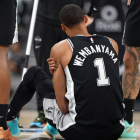
There are a number of younger teams for whom an Antetokounmpo trade would represent too much risk in spite of the possible reward. Houston, for instance. The Rockets would have to remake their team and style on the fly to suit Antetokounmpo, and they're probably too good to justify that. But the Spurs could fit Giannis more comfortably, especially with a shooting big man like Victor Wembanyama next to him. The two would create arguably the greatest rim-protecting duo in NBA history, and they'd be similarly imposing offensively. Wembanyama presents enough an injury risk for the Spurs to want to speed things up a bit under the right circumstances. They have a chance here and now. It might last 15 years. It might last 15 months. Yet Wembanyama's long-term upside is so enormous that the Spurs would probably be able to stay in contention even after Antetokounmpo's decline provided good health. They have asset redundancy at point guard anyway, so the cost means less to them than it would to most teams. If they keep Harper and Wembanyama, they'll be fine for the foreseeable future. If they add Giannis? Their present is suddenly just as exciting.

Trade 5: Giannis to the Pistons
- Pistons get: Giannis Antetokounmpo
- Bucks get: Ausar Thompson, Jaden Ivey, Tobias Harris, Detroit's unprotected first-round picks in 2026, 2028, 2030 and 2032
The Pistons seem to show up in fake trades for just about every available power forward. They're a Lauri Markkanen staple, and the Jaren Jackson Jr. noise is getting louder. What about Antetokounmpo? The immediate obstacle here is that Detroit's draft picks just aren't very valuable. Cade Cunningham will be only 30 on draft night in 2032. As long as he's there, the Pistons probably won't be picking very high. So they'll still send the Bucks a pile of picks, but they'll have to supplement it with a fair bit of player value.
That probably means one of Detroit's two prized youngsters, Ausar Thompson or Jalen Duren, are heading out. With Myles Turner in place and the generally robust supply of centers leaguewide, the Bucks would probably prefer Thompson. Ivey would probably benefit a fair bit from a deal like this. He needs to play on a team that will give him a high-usage role. That just isn't available with Cunningham in Detroit. Even two-way rookie Daniss Jenkins is seemingly supplanting him in the rotation. Ivey still has considerable talent and upside. He's not going to realize it in Detroit. He could in Milwaukee. Harris is simply salary fodder.
So we can assume that Detroit has the assets to do this. That leaves two major questions. The first is whether or not Antetokounmpo would want to be a Piston. We've never seen a player proactively force his way to Detroit before. The last time the Pistons traded for a star was Blake Griffin, and the league-wide reaction was essentially that the Clippers did their star dirty (some history that has repeated itself this week). Detroit is more appealing with Cunningham now, but he's yet another high-usage ball-handler. Antetokounmpo would probably benefit from playing with one as he ages. He probably should start to steer more toward his big-man tendencies in order to preserve his body. But if he wants to be the primary ball-handler, this is a tricky fit. Not an impossible one. The Pistons aren't loaded with ball-handling beyond Cunningham. But the point Giannis days would probably be over.
We don't know if Giannis would want the Pistons. Would the Pistons want him? The idea of employing Giannis Antetokounmpo is to dominate near the basket. The Pistons already do that. Detroit outscores opponents by 13.3 points per game in the paint. They don't need help in transition either, ranking eighth in fast-break points per game while allowing the fifth-fewest in basketball, and they have the third-best free-throw attempt rate in the NBA, so they don't need another star to get to the line. Their players, in the aggregate, already provide most of what Antetokounmpo does. A partnership between him and Cunningham could still be spectacular, but it just isn't what this team really needs. They already rank 28th in 3-point attempt rate. They need more shooting. That doesn't necessarily mean they won't want Antetokounmpo, but there's a reason players like Markkanen, Jackson and Trey Murphy are so often speculated as trade targets for them. They aren't just talent upgrades, they're seamless fits.
The Pistons are a 17-5 No. 1 seed right now. There's no compelling reason to rock the boat beyond the idea that Antetokounmpo is worth rocking any boat over. If the Pistons believe that, they'd probably be the Eastern Conference favorites with him. But they'll be in the mix for far longer without him. As common as these fake trades have become, the Pistons should probably pass.