Agent's Take: Super Bowl LX financial of the tape for Patriots vs. Seahawks
A look at how both teams spent their money to get to the Super Bowl
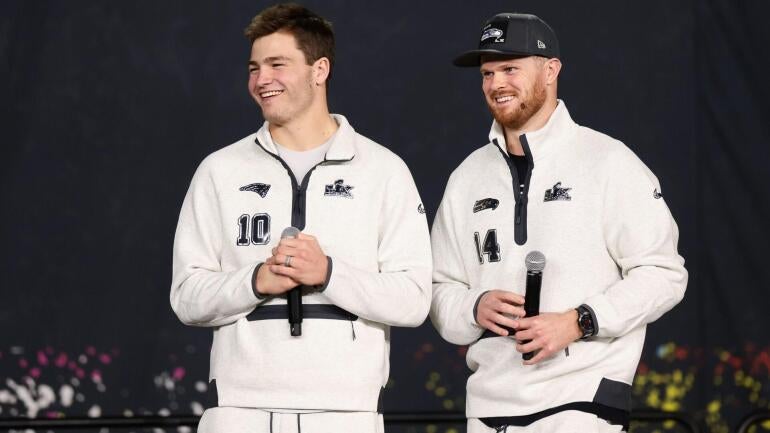
A specific blueprint for getting to the Super Bowl doesn't exist. Championship-caliber rosters can be built under the salary cap in a variety of ways.
The New England Patriots and the Seattle Seahawks were two of the NFL's most aggressive teams in free agency. A big spending spree that pays instant dividends with a Super Bowl trip is rare.
The following chart outlines the cap charges for the Patriots' and Seahawks' key contributors throughout the season at each position and on special teams. That's 30 players for the Patriots and 31 for the Seahawks. Both teams have 15 players on offense. The Seahawks have one more defensive player than the Patriots, who utilize 15.
Dead money -- a salary cap charge for a player no longer on a team's roster -- is also tracked. The NFL Collective Bargaining Agreement's $315 daily amount for participating in a team's voluntary offseason workout program is included in the cap numbers.
| Position | Patriots | Seahawks |
|---|---|---|
| QB | $8,336,984 | $13,400,000 |
| RB | $8,544,975 | $5,404,810 |
| WR | $16,721,019 | $16,317,554 |
| TE | $16,518,585 | $2,764,375 |
| OL | $39,399,856 | $16,948,402 |
| Edge | $17,803,602 | $25,872,976 |
| Interior DL | $30,149,215 | $23,761,940 |
| LB | $15,270,050 | $6,330,658 |
| CB | $21,303,206 | $16,122,714 |
| S | $2,921,846 | $12,889,390 |
| ST | $2,864,537 | $12,668,398 |
| Dead Money | $51,962,585 | $79,838,929 |
The NFL salary cap is $279.2 million for the 2025 league year. Each team's actual salary cap (known as the adjusted salary cap) typically differs from the league's set amount because unused cap room can be carried over from one year to the next, and other adjustments can further increase or decrease cap space.
The leaguewide average is $293.485 million, according to NFLPA data. Only two teams, the San Francisco 49ers and Cleveland Browns, have a larger adjusted salary cap than the Patriots. Carrying over $34.855 million of unused cap space from the 2024 league year is the primary reason New England's adjusted salary cap sits at $322.5 million.
Despite New England holding a little more than a $46 million advantage over Seattle's $286.39 million adjusted salary cap, the salary cap expenditures are fairly close. Seattle's are $271.362 million, while New England's are $275.234 million. The Patriots are carrying over the NFL's most cap space to the 2026 league year at $47.27 million.
Seattle's key contributor cap spending skews heavily toward the defensive side of the ball. That isn't surprising considering the Seahawks arguably have the NFL's best defense. It's $54.835 million on offense and just under $85 million on defense. The Patriots have a more even distribution, with $85.521 million devoted to offense and $87.4 million to defense.
Dead Money
Dead money exists because of how salary cap accounting rules operate. Signing bonuses, option bonuses and certain roster bonuses are prorated -- or spread evenly -- over the life of a contract for a maximum of five years. When a player is released, traded or retires, the remaining proration of these salary components immediately accelerates onto his team's current salary cap.
There are two major exceptions to this general rule. Only the current year's proration counts toward the salary cap if a transaction occurs after June 1. The bonus proration in future contract years is delayed until the next league year beginning the following March. A team can also release two players each league year prior to June 2 (known as a post-June 1 designation) who will be treated under the salary cap as if they were released after June 1. With a post-June 1 designation, a team must carry the player's full cap number until June 2 even though he is no longer on the roster. The player's salary comes off the books at that time unless it is guaranteed.
This means dead money is typically a sunk cost where money isn't owed to a player. Only when salary guarantees remain at release will there be a payment associated with dead money.
Both teams have significant dead money. New England's sits at $51.96 million. Safety Kyle Dugger, who was traded to the Pittsburgh Steelers in late October, carries the biggest charge at $11,094,067.
The Seahawks are essentially operating with one hand tied behind their back because of a below-average adjusted salary cap and $79.8 million of dead money. Wide receiver DK Metcalf's $21 million is tied for 2025's seventh-largest dead money charge after he was traded to the Steelers in March. Seattle has three other dead money charges larger than Dugger's: defensive lineman Dre'Mont Jones, wide receiver Tyler Lockett and quarterback Geno Smith at $14,072,918, $13.895 million and $13.5 million, respectively.
OFFENSE
Quarterback
Neither team has a high-priced quarterback. The Seahawks signed Sam Darnold to a three-year, $100.5 million contract averaging $33.5 million per year (worth a maximum of $115.5 million through incentives) with $55 million in guarantees, including $37.5 million fully guaranteed at signing, during free agency. He's a good value considering the average salary for 2025 starting quarterbacks -- excluding those on rookie contracts -- is $44,067,508 per year, according to NFLPA data. Darnold's $13.4 million cap number ranks 20th among quarterbacks. It's $100,000 less than Smith's dead money.
A high-caliber quarterback on a rookie contract, like 2024 third overall pick Drake Maye, is the most valuable commodity in the NFL because of the roster flexibility it provides. Maye's cap number is $8,336,984. The Patriots will have at least one more year of a cost-effective cap number before he becomes eligible for a contract extension after the 2026 regular season.
Running back
The Patriots have a bigger investment at running back because Rhamondre Stevenson ($5,543,696 cap number) is the only ball carrier of consequence on a veteran deal. Stevenson signed a four-year, $36 million extension (worth up to $48 million through incentives) averaging $9 million per year with $17.116 million fully guaranteed in 2024. TreVeyon Henderson led the Patriots in rushing with 960 yards. The 2025 second-round pick has a $2,031,199 cap number.
Kenneth Walker III ($2,693,517) and Zach Charbonnet ($1,884,114) split carries for the Seahawks. Charbonnet is missing the Super Bowl after tearing the ACL in his left knee during a divisional playoff game against the 49ers.
Wide receiver
New England's big-ticket item at wide receiver is Stefon Diggs ($10,501,260). The Patriots signed him to a three-year, $63.5 million contract (worth a maximum of $69 million through incentives) with an extremely team-friendly structure in March, a couple of weeks into free agency, despite the right ACL tear he suffered midway through the 2024 season. Mack Hollins ($4,059,765), another free-agent pickup, took the most offensive snaps for a Patriots wide receiver during the regular season with 656.
Seattle's combined dead money for Metcalf and Lockett ($34.895 million) is more than double its actual wide receiver cap charges. Jaxon Smith-Njigba ($3,939,238) was just named the NFL's Offensive Player of the Year. The Seahawks didn't hesitate to sign Cooper Kupp ($9,478,820) to a three-year, $45 million contract in March after the Los Angeles Rams released him. There was a glaring need at wide receiver because of Metcalf's and Lockett's departures. Acquiring Rashid Shaheed from the New Orleans Saints for 2026 fourth- and fifth-round picks was a great trade-deadline addition. His cost for half the season was $2.1 million.
Tight end
It's experience versus youth at tight end. Hunter Henry has New England's fifth-largest cap number at $11,509,765. Austin Hooper's $5,008,820 cap number is just over 80% more than the collective cap hits of 2024 fourth-round pick A.J. Barner ($1,157,597) and 2025 second-round pick Elijah Arroyo ($1,606,778), who are both on rookie deals.
Offensive line
Seattle's entire starting offensive line -- besides Abraham Lucas ($4,663,474) -- is on rookie contracts. Left tackle Charles Cross ($6,812,701) signed a four-year, $104.4 million extension averaging $26.1 million per year with $75 million in guarantees in January. Because the deal was completed after the regular season, proration of his $25 million signing bonus couldn't begin in the 2025 league year and will instead run from 2026 through 2030. The Seahawks used the 18th overall pick in the 2025 NFL Draft on left guard Grey Zabel, who has a $3,362,794 cap number.
Right guard Michael Onwenu is the only holdover from New England's 2024 offensive line and carries the team's largest cap number at $21,008,820. He signed a three-year, $57 million deal averaging $19 million per year with $36.5 million fully guaranteed in 2024. Right tackle Morgan Moses ($4,704,725) and center Garrett Bradbury ($4,608,820) were free-agent additions. Left tackle Will Campbell ($7,943,715) was selected with the fourth overall pick in the 2025 NFL Draft.
DEFENSE
Edge rusher
Seattle's edge rotation is headlined by DeMarcus Lawrence ($8,286,483) and Uchenna Nwosu. Lawrence left the Dallas Cowboys after 11 seasons believing he couldn't win a Super Bowl there, signing a three-year, $32.5 million contract with $18 million in guarantees in free agency. Incentives and escalators can push the deal to $41.5 million. Nwosu's cap number dropped from $21,283,333 to $12,450,853 after he took a $7.05 million pay cut to remain in Seattle. His reworked deal also includes $3 million in not-likely-to-be-earned incentives.
New England's most productive pass rushers came via free agency. Harold Landry ($8,509,450) signed a three-year, $43.5 million deal (worth up to $48 million through incentives) with $26 million fully guaranteed. K'Lavon Chaisson ($3,979,135) received a one-year, $3 million deal worth up to $5 million through incentives. Chaisson and Landry led the Patriots with 7.5 and 8.5 sacks, respectively. Landry has been slowed by a knee injury that kept him out of the AFC Championship Game.
Defensive interior
The Patriots are the only NFL team that has signed two interior defensive linemen to contracts averaging at least $20 million per year. Christian Barmore signed a four-year, $84 million extension (worth up to $92 million through incentives) with $41,822,128 in guarantees in 2024. Milton Williams' four-year, $104 million free-agent deal with $63 million in guarantees ($51 million fully guaranteed at signing) made him the NFL's third-highest-paid interior defensive lineman at $26 million annually. Barmore and Williams carry New England's second- and third-largest cap numbers at $15,109,450 and $14,009,750.
Leonard Williams is Seattle's highest-paid defensive player. He signed a three-year, $64.5 million deal averaging $21.5 million per year with $43.85 million in guarantees in 2024. Williams has Seattle's largest cap number among players under contract at $15,094,715. 2024 first-round pick Byron Murphy II carries a $3,664,075 cap figure.
Linebacker
The Patriots allocate more resources to off-ball linebackers. Robert Spillane ($9,010,080) signed a three-year, $33 million contract averaging $11 million per year with $20.6 million fully guaranteed as an unrestricted free agent. Incentives can push the deal to $37.5 million. New England also matched the Las Vegas Raiders' two-year, $13.508 million restricted free-agent offer sheet to retain Christian Elliss, whose cap hit is $4,850,505.
Ernest Jones was a key Seahawks re-signing, receiving a three-year, $28.5 million contract worth up to $33 million through incentives and escalators. He earned second-team All-Pro honors this season.
Cornerback
New England turned to free agency to pair a veteran with Christian Gonzalez ($4,127,784), a 2024 second-team All-Pro. Carlton Davis signed a three-year, $54 million contract averaging $18 million per year with $34.5 million fully guaranteed. Incentives can push the deal to $60 million. Davis has New England's fourth-largest cap number at $12,001,890.
The Patriots also rewarded Marcus Jones with a three-year, $36 million extension averaging $12 million annually (worth up to $40.5 million through incentives) in October. His 2025 cap number rose from $1,656,032 to $4,213,532.
The bulk of Seattle's cornerback cap charges come from Devon Witherspoon and Riq Woolen. Witherspoon, a Pro Bowler in each of his first three seasons, leads the group with an $8,697,910 cap hit. Woolen's $5,437,244 cap charge stems from his fourth-year salary escalating to the $5.346 million second-round restricted free-agent tender after his original-ballot Pro Bowl selection as a rookie in 2022.
Safety
The Patriots have a minimal investment at safety after trading Dugger and releasing Jabrill Peppers during roster cutdowns. Free-agent pickup Jaylinn Hawkins ($1,810,080) has been a tremendous value.
Seattle's safety cap charges are nearly 4.5 times higher than New England's. Julian Love ($6,120,131) is the highest-paid safety on either roster after signing a three-year, $33 million extension with $18.6 million in guarantees in 2024. Nick Emmanwori ($2,113,667) has drawn comparisons to Ravens All-Pro Kyle Hamilton because of his versatility. The 2025 second-round pick finished as the Defensive Rookie of the Year runner-up.
Special teams
The special teams cap charges are night and day. The Patriots have punter Bryce Baringer ($1,084,694) and kicker Andy Borregales ($909,273) on rookie contracts.
The Seahawks have the NFL's highest-paid punter in Michael Dickson at $4.05 million per year. Dickson's $4,801,260 cap hit is the second-largest for a punter in 2025. Jason Myers carries the biggest kicker cap number at $6,826,465 and is the only kicker above $5.75 million.