| ||||||||||||
2026 Fantasy Baseball Draft Prep: Breakouts 1.0 for Scott White, featuring Ben Rice and Chase Burns
These 12 are about to blow up in a big way

By
Scott White
•
19 min read
If sleepers and busts are the bread and butter of Fantasy prognostication, breakouts are the Vegemite. Any attempts to explain what they are will only lead to more questions.
But I'll try for the umpteenth time anyway. Breakouts are good, like sleepers, but they're not sleepers because the emphasis is on the novelty rather than the value. A breakout may also be a sleeper, if the value is there, but he may not be a value at all. The neater distinction is that he's about to do something new.
And it should be really good.
- Sleepers 1.0: Scott | Chris | Frank
- Breakouts 1.0: Scott | Chris | Frank
- Busts 1.0: Scott | Chris | Frank
Ben Rice, C/1B, Yankees


NFBC ADP: 60.8
I may have been the first aboard the Ben Rice breakout train, but I'm not riding solo. In fact, recent NFBC drafts have him going inside the top 50, which is verging on prohibitive. If, however, I'm your only source of Fantasy Baseball inspiration or you play in a league that doesn't get swept away in the latest trends, the case deserves to be made. So I'll make it a la Andrew Lincoln with his cue cards: standing out in the cold, with little hope of being let in.
To me, Rice is perfect. You may wonder why I'd call him a breakout when he already put himself on the map with an unexpected 26-homer season, but for as promising as his .255 batting average and .499 slugging percentage in 2025 were, the Statcast readings say he deserved better. How much better? Try a .283 batting average and .557 slugging percentage, the latter of which was topped by only five qualifying batters: Aaron Judge, Shohei Ohtani, Cal Raleigh, Kyle Schwarber and George Springer. Rice's 93.3 mph average exit velocity was 95th percentile, akin to Fernando Tatis. His strikeout rate was under 20 percent, giving him better bat-to-ball skills than the typical slugger. And while many a high-impact hitter has been dragged down by the angle the ball takes off his bat, Rice's pull-air rate was over 25 percent, putting him in the top 10 percent of the league.
He bats left-handed, by the way, which means that when he's at home, all of those balls that he's pulling in the air are hurtling toward the famous short porch in baseball. And did I mention he's a catcher for Fantasy Baseball purposes? He's the best type of catcher, too: one who's not expected to catch much, if at all. This gives him a playing time advantage over the true catchers, particularly with manager Aaron Boone having already confirmed Rice will play "a lot" vs. lefties.
Sure, no one much cared about him prior to last year, which is not a typical trajectory for a player who's about to turn 27, but if you look back on the minor league history, Rice was rocking it there as well. The deeper you dig, the better it gets, so I can understand why you may have to forfeit a top-50 pick to get him. I'm just too risk-averse to take him ahead of longstanding studs like Matt Olson and Rafael Devers.
Agustin Ramirez, C, Marlins
| ||||||||||||

NFBC ADP: 76.5
While Rice averaged 2.79 Head-to-Head points per game last year, Ramirez averaged 2.78. The comparison is a misleading one because Rice made 18 appearances off the bench, sometimes without getting even an at-bat, while Ramirez made only four, but even if you compare Ramirez to Hunter Goodman (2.82) and William Contreras (2.84), he still comes out looking better than you might expect. And that's with him hitting just .231 and slugging just .413. Statcast suggests he should have hit .259 and slugged .457.
Yet again, we have a catcher-eligible player whose expected production far exceeded his actual production, and in a way that's not easily disregarded. Ramirez's pull-air rate wasn't as high as Rice's, but it was still in the upper half of the league. Maybe he wasted some of his hardest contact by hitting it to the wrong part of the field, but judging by his overall batted-ball trends, it shouldn't be a chronic problem. His 19.3 percent swinging-strike rate was especially impressive for a rookie who hit a ball as hard as 116.9 mph, a mark topped by only 12 players last year, and even though he didn't arrive until about a month into the season, his 16 stolen bases led all catchers.
That position has seen a massive influx of talent in recent years, to the point that it feels like you can do no wrong in a one-catcher league, but Ramirez brings a couple of additional elements, from the stolen bases to the additional DH at-bats, which are all the more attractive when you factor in that he left some meat on the bone as a hitter. If any of the recent breakthrough catchers is going to take that next step into studliness, it's him.
Kyle Bradish, SP, Orioles
| ||||||||||||


NFBC ADP: 87.2
Never has there been a quieter top-five Cy Young finish than Bradish in 2023. That's what I've deduced by the way even the most seasoned baseball writers, Fantasy or otherwise, talk about him. So I guess I'll play along and act like it'll be some great surprise when he competes for a Cy Young (again), which he absolutely will if he stays healthy.
Health is of course the reason why he's something of a forgotten man, to the degree that he is. He missed most of the 2024 and 2025 seasons due to Tommy John surgery. But consider that over his past 44 starts, beginning with that down-ballot Cy Young season, he has a 2.78 ERA, 1.05 WHIP and 10.1 K/9. That K/9 rate jumped to 13.2 in the six starts after returning from Tommy John in 2025, which would have ranked first by nearly 1.5 strikeouts among pitchers with at least 100 innings. Even with the long layoff and difficult recovery, Bradish has continued to get better.
The difference between his swinging-strike rate post-surgery was even starker. His walk rate was the best it's ever been, and his fastball had more carry than ever. He even managed to go six-plus innings in three of his six starts back from the injury. By virtually every indicator, Bradish is an ace, and seeing as the Orioles didn't make a play for another one this offseason, they would seem to view him the same way.
Chase Burns, SP, Reds
| ||||||||||||


NFBC ADP: 123.4
Calling a once prized prospect a breakout in what should be his first full big league season may seem like bad form to some, but I don't think early drafters are accounting for how good Burns is.
And to a certain degree, I get it. At the time of his promotion last June, he had emerged as the top pitching prospect in baseball just a year after being the highest drafted, so expectations were through the roof. But then he pitched to a 5.24 ERA, missed a month with a flexor strain, and returned to work 1-2 innings at a time out of the bullpen. Hard to characterize that particular stint as anything more than a flop.
Or was it? The final ERA, though an uninspiring 4.57, was belied by a 3.44 xERA and 2.65 FIP. The stuff was knock-your-socks-off good. Among pitchers with at least 100 innings, no one had higher than an 11.9 K/9 rate. Burns' was 13.9. Among that same selection of pitchers, only one, Tarik Skubal, had a higher swinging-strike rate than Burns' 15.8 percent. Those are some of the plainest indicators of pitching dominance, and he measured up to, or even exceeded, the giants. Perhaps the clearest example of this is that over the eight starts he made in his first big league stint, Burns recorded double-digit strikeouts four times. That's more than Paul Skenes has done it in his entire career, spanning 55 starts in all.
Yeah, he's going to be a good one.
Noelvi Marte, 3B/OF, Reds
| ||||||||||||

NFBC ADP: 134.8
What a ride it's been for Marte, who became a top prospect in the Mariners system at the ripe old age of 17, then was moved in the Luis Castillo deal a couple years later, then had a scintillating debut in 2023 followed by a tumultuous rookie season that was derailed by a PED suspension. And then came 2025, which was a roller coaster ride all its own. If you had asked me on Aug. 24, when he was hitting .300 with an .856 OPS, whether he'd be a breakout candidate for me, I would have said "no, he's already broken out." What I couldn't have known then, though, was that he'd go on to hit .193 with a .549 OPS over his final 29 games, striking out 33 percent of the time while walking just six times.
Still, his up-and-down 2025 showed that the strong first impression he made in 2023 wasn't entirely PED-fueled, which some outside observers had speculated after what happened in 2024. He still hit a ball as hard as 116.7 mph in 2025, a mark topped by only 13 hitters, and if not for his miserable finish, his strikeout rate for the year would have been only 18.8 percent. The highs, particularly given where he plays his home games, are high indeed, and now that we've seen him sustain them for a longer period of time, we can hold out hope for a more stable performance.
What does that look like? I think five-category excellence. He's clearly strong enough to put the ball in the bleachers upward of 25 times, fast enough to continue stealing bases, and could sustain a batting average in the .275 range if he resumes his usual strikeout rate. A key will be avoiding the sort of slump that takes him out of the lineup, particularly now that he's shown himself to be a defensive liability, having made the move from third base to right field. Fortunately, we'll get to enjoy one more year of him at third base for Fantasy purposes.
Emmet Sheehan, SP, Dodgers
| ||||||||||||


NFBC ADP: 138.7
I'm running this one back again two years later, having waited for Sheehan to recover from Tommy John surgery and seen him return no worse for wear.
What do I mean by "no worse for wear?" Not just the 2.82 ERA, 0.97 WHIP and 10.9 K/9, which are themselves pretty exciting. What was most impressive about his first go back in 2023 was his outlier swing-and-miss ability. He began that season with a 20 percent swinging-strike rate in two months at Double-A. He ended it with a 23 percent swinging-strike rate in three major league starts. To put those numbers into context, the highest swinging-strike rate for any starting pitcher on record (minimum 100 innings) was 18.9 percent for Spencer Strider in 2023. Only one other pitcher (Blake Snell in 2019) has even broken 17 percent.
So how did the returning Emmet Sheehan fare in that regard last year? Well, his overall swinging-strike rate of 15.6 percent was still nothing short of spectacular, and that's with him not being up to form early on. Over his final six appearances, three of which lasted seven innings, he had a 1.11 ERA, 0.62 WHIP, 12.5 K/9 and, most tellingly, a 19 percent swinging-strike rate that was right in line with Strider's record-setting season.
Sure, it's always small stretches, but there's now a pattern of Sheehan doing it over several small stretches. I'm anxious to see what he'll do over a longer one. I'd still be concerned that the Dodgers will handle him with kid gloves, like they do all of their pitchers, and that's why I'd prioritize Nolan McLean and Trey Yesavage over Sheehan. But seeing him go seven innings multiple times down the stretch gives me hope.
Gavin Williams, SP, Guardians
| ||||||||||||


NFBC ADP: 150.1
The difficulty in putting together a breakout list in 2026 is the element of surprise. Since the advent and widespread acceptance of Statcast, anyone who fancies himself an analyst is working off the same basic data set, leaving little to the imagination.
But not everyone is onto Williams, at least at this stage of his development. More likely, you'll see him touted as a bust, given that he had a 3.06 ERA compared to a 4.28 xERA and 4.08 xFIP. Why the departure for me? Having watched him intently last year, waiting, like every other analytically minded person, for the other shoe to drop, I instead saw him launched into the stratosphere, not just with a 2.18 ERA, 1.05 WHIP and 10.0 K/9 in the second half but, more convincingly, with a 1.74 ERA, 1.06 WHIP and 11.0 K/9 in his final five starts. The 61 percent strike rate and 11 percent swinging-strike rate that were so ordinary prior to then jumped to 66 percent and 14 percent in those five starts, which are the kind of numbers that should have everyone salivating.
The key to the turnaround was an increased reliance on his two-seamer, the same adjustment that's gotten so much attention for Edward Cabrera and seems to have worked the same wonders, just over a shorter stretch, for Williams, consistently putting him ahead in the count to allow his nastier pitches to wreak havoc.
Now 26, Williams was one of the most celebrated pitching prospects throughout his time in the minors, renowned above all for his electric arsenal. For him to lose footing in Fantasy right when he's showing his clearest signs of progress seems backward to me.
Bubba Chandler, SP, Pirates
| ||||||||||||


NFBC ADP: 161.9
I know I said that calling a prized prospect in his first full season a "breakout" was bad form, but as with Chase Burns, I think the misfortunes of the previous season have unfairly served to suppress Chandler's stock. He should have arrived in May and made upward of 20 starts. Instead, he arrived in August and made only seven (three of which were technically relief appearances, but they were long enough to count).
The reason for the delay initially was the Pirates' frugality, but it was perpetuated by a dreadful decline in production at Triple-A. What started as a 1.42 ERA and 0.67 WHIP in six starts there became a 4.94 ERA and 1.75 WHIP in his next 18, his walk rate jumping from 7.7 percent to 13.1 percent. When the Pirates did finally call him up, I think it was because they didn't know how else to fix him.
But it worked. He blew away major league hitters with a fastball that peaked at 100 mph and generated whiffs at a rate (31 percent) that you almost never see for that particular pitch. His changeup was a world-beater as well, his entire arsenal combining for a 13.4 percent swinging-strike rate that ranked up there with Paul Skenes. Even more notable, though, is that Chandler issued just four walks for his entire big league stay, making for a 3.2 percent rate that few pitchers in history could match. And there's no way Chandler will sustain it either, but the turnaround was so stark that I can't help but believe his struggles were largely mental, the frustration of being passed over when he felt like he had earned his shot. He more or less admitted as much both at the start of his struggles in May and the end of them in August.
Because the major league sample was small and the ERA a slightly inflated 4.02, some drafters may not find it convincing enough to erase the memory of his miserable minor league season. But I think Chandler's talent is greater than that of Jacob Misiorowski, who's going nearly 40 picks later.
Jonathan Aranda, 1B, Rays
| ||||||||||||

NFBC ADP: 177.9
Goonies never say die, and neither do I when it comes to Aranda, awarding him a spot on my breakouts list for an unprecedented third consecutive year. But haven't I made my point already? After all, Aranda just hit .316 with an .883 OPS, even earning a trip to the All-Star game. Yeah ... about that All-Star game. I was online during the tiebreaker swing-off and heard the snickers when Aranda was chosen as one of the AL's three representatives. And though he was the only one of the five participants not to hit a home run, merely banging one off the wall, I nonetheless took it personally.
Quite simply, you underestimate his power.
My prediction then was a second-half surge that would propel Aranda to 25 home runs, but because he wound up missing most of the second half with a fractured wrist, his breakout earns an incomplete grade. He kind of made my point, though, when he homered twice in his three games back from the injury in late September. Fourteen home runs over two-thirds of a season seems more promising than 12, even if just psychologically. And I still think it sells short the power potential of a guy who hit the ball 93.0 mph on average, putting him in the 94th percentile.
Wait, those numbers sound familiar. How about a little side-by-side comparison, courtesy of everyone's favorite Baseball Savant graphic?
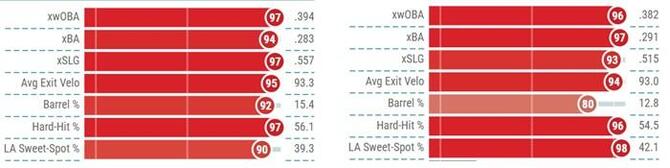
The player on the left is Ben Rice, whose breakout potential is so apparent to all that he's being pushed into the top 50. The player on the right is Aranda, who's barely cracking the top 200. Catcher eligibility isn't worth that much!
They're both 27. They both have mild platoon concerns. They both had the sort of minor league numbers that should have made them much bigger prospects than they were. (Aranda slashed .315/.413/.546 in 231 career games at Triple-A, for goodness' sake.) Aranda struck out more in 2025, but he also had the superior line drive rate. I think he's the better batting average bet of the two, actually. Look, Rice deserves to be drafted ahead of Aranda -- and I love him, too -- but Aranda is being ignored in a way that doesn't really add up for me.
Ivan Herrera, DH, Cardinals
| ||||||||||||


NFBC ADP: 185.9
The lack of enthusiasm over Herrera, who's being drafted in the same range as 2025 disappointments Christian Walker and Matt Shaw, doesn't add up to me. At a time when player evaluation rarely needs to be more complicated than denoting the amount of red on a player's Baseball Savant page, the 25-year-old rates out well in that regard:
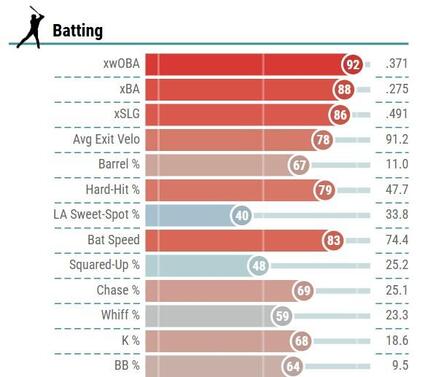
Even if you're guided more by the top-line numbers, he slashed .284/.373/.464 with a 162-game pace of 29 home runs. His 3.08 Head-to-Head points per game were akin to Manny Machado (3.06), Vinnie Pasquantino (3.03) and Jarren Duran (3.02), all of whom are being drafted more than 100 picks earlier. Herrera even showed a dash of speed with eight stolen bases in 107 games. What's not to love?
If I could attempt to put myself in the minds of the doubters for a moment, I think my biggest hesitations would be these:
- He played in just 107 games. What good is a 162-game pace for a part-time player? OK, but the shortfall was more because of health (separate IL stints for knee and hamstring issues) than role. In fact, after returning from the second of those IL stints, Herrera started 65 of the Cardinals' final 66 games, mostly at DH.
- You said it yourself: He's a DH. I'd much rather invest in someone who I can use at an actual position. OK, but every Fantasy Baseball format can accommodate a DH, and in the end, it's production we're after, not versatility. Secondly, he was confined to DH because a bone spur in his elbow prevented him from making the necessary throws behind the plate. Now that it's been removed, he's expected to resume catching in a part-time capacity this year, still getting the majority of his at-bats at DH, which could make for some of the most favorable eligibility of all.
- Oh, but you said he had surgery? Stop it already. If he played all that time with a bone spur, its removal shouldn't impact him at the plate, and he's expected to be ready for spring training as well. That injury tag next to his name is one you can safely ignore.
So what am I expecting over a full season? Honestly, I think Herrera could do a pretty good Rafael Devers impression. Leaving the DH spot vacant for him on Draft Day seems like a wise idea, and it may not even be necessary with his impending return to catching duties.
Daulton Varsho, OF, Blue Jays
| ||||||||||||


NFBC ADP: 205.3
I encourage those who let Varsho slip beyond Pick 200 to take a closer look at the numbers. Because at a glance, they look like a typical Varsho season -- 20 homers, a suboptimal batting average, etc. -- and because he's an already established asset, it's easy to label it business as usual and move on to the next guy.
But that drive-by analysis misses a crucial detail: He played in only 71 games, having missed the first month while recovering from shoulder surgery and another two because of a strained hamstring. Project his numbers over 162 games, and he's up to 46 homers, which is a horse of a different color.
Doesn't the track record count for more? Well, yeah, normally I'd say that a 29-year-old in the middle of his career is a finished product, and any departure from his career norms should be taken with a grain of salt. But normally, such players don't see their exit velocities jump 2-3 mph. Varsho was impacting the ball more like Kyle Tucker than Nolan Schanuel, and seeing as he was already a capable home run hitter at the lower velocities, a massive increase could make one of the game's premier sluggers. It seems like we just saw the earliest signs of that.
The breakthrough is tied to a mechanical adjustment, with Varsho having learned that he's more direct to the ball when he holds his bat vertically to begin his swing. You can read more about it here if you happen to find hitting mechanics more interesting than I do, but the one quote from that Sportsnet article that stands out most to me is this one:
"I'm not comparing him to Jose Bautista, but I think that's the one that jumps out as you figure something out mechanically, and it just gives you a better shot every single time," manager John Schneider said. "So, I think that Varsh is still like an untapped resource offensively. He's got all the traits that lead you to think that he's going to be [great], and I think he's starting to get there."
The playing time hasn't always been consistent for Varsho, which is my biggest hesitation when drafting him, but he's a defensive asset and has respectable numbers against left-handers. He started every game of the Blue Jays' lengthy postseason run, so if he's impacting the ball just as well to begin 2026, he should quickly settle into everyday duty.
Edwin Uceta, RP, Rays
| ||||||||||||
NFBC ADP: 279.4
Though he didn't crack my breakouts list last year, I repeatedly touted Uceta as the heir apparent for Pete Fairbanks in Tampa Bay, possibly taking over before the year was done. The Rays had lowered his arm slot in 2024 and seen him take off with a 1.51 ERA, 0.82 WHIP and 12.3 K/9 -- numbers that I think anyone would recognize as closer-caliber.
Unfortunately, Uceta took himself out of the discussion almost immediately, his strikeout rate cratering as his ERA hovered around 5.00. But you see where the numbers ended up. There must have been a turnaround of some kind. Boy, was there. Over 29 appearances after the All-Star break, Uceta put together a 1.78 ERA, 0.91 WHIP and 12.7 K/9, looking just as much like a closer as he did in 2024. I haven't found a clear explanation for the turnaround -- more like a series of smaller adjustments -- but because it was in line with a version of Uceta we had already seen, I'm inclined to believe it.
Perhaps even more telling, though, is that the Rays declined Fairbanks' option for 2026 -- a reasonable one, seeing as the Marlins ultimately signed him for more -- and immediately announced that they'd be going closer-by-committee. Maybe they will. In Griffin Jax and Garrett Cleavinger, they do have a couple other relievers who've flashed closer potential, and manager Kevin Cash has long shown an affinity for bullpen flexibility. But generally when a team goes into a season with this intention, it doesn't take long for scars to develop and patterns to emerge. Uceta strikes me as the most natural fit for the closer role and the one I would invest in on Draft Day.