Ranking the 15 best contracts in the NBA: Jalen Brunson, Deni Avdija, Alperen Sengun and more
Contract negotiation is just as vital as scouting for front offices these days

The 2023 CBA imposed all sorts of draconian spending restrictions on NBA teams. The luxury tax, at least at the repeater level, is more punitive than ever. The new trade rules can be pretty oppressive to expensive teams. The aprons loom over every roster decision teams make.
Meanwhile, playing style changes that have developed organically over the past few years have made depth more important than ever. The average pace of an NBA game this season is 99.4 possessions per team, which, aside from a two-year blip right before COVID, is the highest it's been since the late '80s. Players have to cover more space defensively than they ever have because of all of the shooting teams put on the floor. Defenses are using more full-court pressure than ever, tiring out ball-handlers. Players can't play as many minutes as they used to. The best teams go at least nine- or 10-deep.
All of this together has made contract negotiation one of the most important elements of modern team-building. Every dollar counts now. There aren't automatic max deals anymore. All-Stars like Trae Young and Anthony Davis can get traded for a pittance because their salaries are too prohibitive for most teams to acquire. The best teams are by and large the ones that have done the best job of managing expenses by negotiating and acquiring good contracts. By now, you've read the headline and know where we're going with this. It shouldn't surprise you to learn that most of the NBA's best contracts belong to winning teams.
So... what exactly makes a good contract? Seven factors stand out:
- Average annual value: This is obvious. How much are you paying a player per year? There's no exact formula other than to say you'd like to pay your players less than similarly valuable players around the league are making. If most teams are paying their All-Stars the max and you're paying yours less, that's probably an indication that it's a good contract. Sporting News writer Stephen Noh developed a handy tool that measures a player's actual salary against what he should be earning based on his DARKO score, a well-known all-in-one metric. We'll be referring to it from time to time.
- Length: If you sign someone for less than they're worth, you want them locked up for longer. This is especially important considering how friendly the past few CBAs have been to contract extensions. The amount of money a player is eligible to extend for usually depends on how much he was making on his last contract, so one cheap contract can beget another.
- Age: While no two players follow identical aging curves, you'd generally expect contracts given to younger players to age better than those given to older ones. Sign a 23 year old to a long-term deal and you'd reasonably expect him to get better over the course of the contract. Sign a 33 year old to that same contract and you'd likely expect him to get worse.
- Guarantees: If a player is only partially guaranteed for any length of his contract, that's an added layer of security for the team that signed it. If a player has a team option, not only is that security present, but the team in question has a bit of leverage to secure a favorable extension. Meanwhile, if a contract has a player option, it's a bit less valuable since you'd assume any underpaid player is likely to just decline that option and get properly paid sooner.
- Durability: Availability becomes a bigger factor in contract negotiations with each passing year. Some good contracts are the result of injury problems that fade after signing. This was the case for arguably the greatest contract in NBA history, Stephen Curry's rookie extension. He re-signed when he was ravaged by ankle issues, proceeded to win two MVPs and two championships, and then got paid properly afterward.
- Portability: This one is a bit harder to define. Essentially, a contract is more valuable if more teams both want the player and can afford the deal. Versatile wings and shooting bigs can fit on any roster, especially when they're making less than the max. Ball-handling guards? Not as much. Sometimes it makes sense for a team to overpay a player for specific reasons that wouldn't apply to the rest of the league. Take De'Aaron Fox in San Antonio. He probably isn't worth a four-year max in a vacuum, especially given how dependent he is on speed that is already starting to fade. But to the Spurs, specifically, given how many of their best players are on cheap rookie deals and what a difference Fox makes to their immediate championship prospects? He likely is worth that deal. But a contract being good for one team doesn't necessarily mean that it is good for every team, and we're looking for the latter here.
- Structure: Most contracts start low and rise by the maximum 8% annually. Though it's obviously circumstantial, contracts that are flat annually are more valuable trade chips than contracts that ascend, and contracts that descend are more valuable than flat ones.
So, with all of this in mind, we're going to rank the 15 best contracts in the NBA. Why 15? Because there are 15 spots on an NBA roster, so if we're going to draw an arbitrary line, that seemed like the appropriate place to put it. Contracts that were artificially limited by the maximum salary or the rookie scale are off-limits, but anything else is fair game. We're also only looking forward, since roster-building for the 2025-26 season is now more or less complete. That means we won't consider contracts that don't extend beyond this season (sorry Austin Reaves), and the length of the contract will only be measured in years beyond this one. So with all of that in mind, let's rank some deals.
15. Aaron Nesmith
Total owed: $51,389,440
Years remaining: Three


Aaron Nesmith is a great example of how one below-market contract can lead to another one. The Pacers traded for him after his second NBA season. The Celtics had barely used him in those two years, and Indiana was in the lottery in his third, making it hard for him to stand out. So when he became eligible to extend after that third season, he re-upped for $33 million over three years. Immediately after doing so, he morphed into a reliable 40% 3-point shooter and one of the most important defenders on a team that made the Eastern Conference Finals and then Game 7 of the NBA Finals. Spectacular value. As a reliable 3-and-D wing in a market starved for them, he's probably closer to a $25 million-per-year player than the $11 million he was making.
However, with two cheap years left on his contract, Nesmith chose security and inked the biggest extension he legally could: two years, $40.4 million. Now, in total, he's owed around $17 million per year through 2029. That's less than 3-and-no-D players like Grayson Allen and Rui Hachimura, who lack his stellar playoff track record. Most players on Indiana's books are on team-friendly contracts, so don't be surprised to see another Pacer come up later on.
14. Derrick White
Total owed: $97,780,000
Years remaining: Three (player option for 2028-29)


The White contract breaks a lot of our rules. He's in his 30s, and this deal will take him through his age-34 season. He has a player option, so if he's not aging well, the contract looks bad at the end, but if he is, he'll opt out and leverage his value into a new deal. He's not even an All-Star, so paying him 18-19% of the cap is no small expenditure.
So why is White here? Portability. Think of the trade packages Mikal Bridges and Desmond Bane netted as non-All-Stars. Everyone wants a Derrick White. It's very easy to overpay players like this. Take the OG Anunoby contract for the Knicks; he's making 25-26% of the cap during this same window because New York knew if they hadn't given him that contract, Philadelphia would have. If White were a free agent this offseason, he'd make more than this because of how easily he slides onto any roster. Case in point: Noh's tool has White generating more than $7 million in surplus value this season and a projected $9 million more over the next two seasons. Guards who can scale up or down as ball-handlers, guard at an All-Defense level, rebound above their weight class and generally make their 3s (White's having a down year, but he was above 38% in the three seasons prior) are worth their weight in gold. On this contract, it's more like the Celtics are paying for silver or bronze.
13. Scotty Pippen Jr.
Total owed: $5,250,677
Years remaining: Two (team option for 2027-28)


It's a family tradition. After the original Scottie Pippen was enormously underpaid for years in Chicago, his son gave the Grizzlies four years of team contract at effectively a minimum salary after already having proven himself as a real NBA player. Now Memphis has one of the NBA's better backup point guards locked up for pennies on the dollar for two more years and, thanks to that 2027-28 team option, he'll likely be retained on yet another team-friendly contract. He's missed most of this season due to injury, but offensively viable backup point guards who can effectively defend the point of attack are exceedingly rare, and the Grizzlies have one on a very valuable deal. On a per-minute basis, Noh's tool has Pippen as a $21.8 million player, meaning he's generating a ridiculous $19.5 million in surplus value. That obviously doesn't account for the time he's missed, but it shows just what a steal the Grizzlies are getting when he's available.
12. Isaiah Stewart
Total owed: $30 million
Years remaining: Two


Arguably the best per-minute defender on the second-best defense in the NBA is basically making mid-level exception money. Detroit owes much of its defense- and physicality-centered identity to Stewart, who, even as a reserve, is an absolutely vital part of this Pistons renaissance. His 3-point shot hasn't come along quite as much as the Pistons likely hoped when he made 38.3% of 175 attempts two years ago, and they'd likely prefer to avoid any more suspensions, but considering how much more demand there is than supply in the front court right now, there would be no shortage of teams willing to pay Stewart starter money if they could. He's among the handful of best rim-protectors in basketball.
11. Neemias Queta
Total owed: $2,667,944
Years remaining: One (non-guaranteed team option)

This is the only one-year deal we're covering here, and it speaks to just how valuable Queta has become. The Noh model treats him as a $33.2 million player, meaning he is generating more than $30 million in surplus value for the Celtics on his minimum deal this season. This obviously means that keeping him long-term is of the utmost importance to Boston, and that's where this team option comes in. The Celtics could just pick it up, keep him at the minimum and re-sign him as a free agent in 2027. However, since Queta has never made more than the minimum, he'd likely be incentivized to take long-term security now if Boston offers it, so there's a world in which the Celtics decline the team option and re-sign him on a very team-friendly long-term deal going into his age-27 season. So either Boston keeps perhaps the NBA's best bargain for almost nothing next season or they get him on a long-term discount. Either way, it's a steal.
10. Onyeka Okongwu
Total owed: $32,980,000
Years remaining: Two


Okongwu and Stewart are in the same tax bracket with their slightly-above mid-level deals, and they're similarly undersized at center. Both had shown faint promise as shooters when they re-signed, but Stewart stagnated while Okongwu is now shooting over 38% from 3 on more than five attempts per game. He's not the rim-protector Stewart is, but he's more comfortable on the perimeter and he plays far more minutes. There are teams that would prefer Stewart, but Okongwu is a bit more reliable and a bit more portable thanks to the shooting, so he gets the slight edge.
9. Nickeil Alexander-Walker
Total owed: $29,565.510
Years remaining: Two

The basic concept that landed Derrick White on this list also applies to Nickeil Alexander-Walker. The difference is that he's making less than half as much per year and he's four years younger. Alexander-Walker has always been able to defend. He shored up his shooting during his three years in Minnesota. Now that he's in Atlanta, he's proven that he's capable of playing a real on-ball role offensively as well. He's not quite the playmaker, defender or rebounder that White is, but he's closer than anyone likely thought possible on a far cheaper contract. Every team in the NBA wishes it had a guard like Alexander-Walker, so the Hawks get major points for locking up this one.
8. Ajay Mitchell
Total owed: $5,700,000
Years remaining: Two


This one admittedly feels a tad unfair. The Thunder signed Mitchell to a two-way contract after drafting him No. 38 overall in 2024, but eventually converted him to a standard contract. They declined his team option to make him a restricted free agent, a common practice the Thunder have used to re-sign Lu Dort, Aaron Wiggins, Isaiah Joe and Jaylin Williams to team-friendly deals, and sure enough, they did the same with Mitchell last summer. If he'd been drafted 10 spots higher, he would've been subjected to the rookie scale and ineligible for this list.
Instead, he was picked in the second round, and the Thunder clearly saw something in him before any of us did, so they deserve credit for locking him up to a long-term deal worth basically nothing. If he hadn't gotten hurt in January, he easily could have won Sixth Man of the Year, and Noh's model has him as a $22.3 million player this year. That's tantalizing enough, but the big numbers he put up early in the season, before Jalen Williams returned and affected his role, suggest there's even more here. Could he be the next Jalen Brunson, a future star hiding in plain sight because he was a second-round pick drafted onto a roster that already had enough ball-handling? That will play out in the years to come, and the Thunder paid bleacher prices for a front row seat to that story.
7. Payton Pritchard
Total owed: $16,071,428
Years remaining: Two

Mitchell might've won Sixth Man of the Year if he'd stayed healthy. Pritchard has already won it and graduated from that race after spending most of this season as a starter. The going rate for high-level bench buckets over the past few years has hovered just below $20 million annually. That's what players like Malik Monk and Collin Sexton made to be less valuable than Pritchard. That market is going to correct itself in the years to come, but, unlike most of the small guards losing value lately, Pritchard is having a career year. His shooting is an enormously powerful offensive weapon, and like White, he's a strong playmaker who never turns the ball over. He has defensive vulnerabilities given his size, but he's the rare supplementary offensive player who's actually probably worth the $20 million or so per year so many of his peers actually earn.
6. Ivica Zubac
Total owed: $42,132,440
Years remaining: Two

He may have signed his contracts with the Clippers, but Zubac is yet another Pacer whose first below-market contract led to a second, and then a third. Zubac came in 18th in All-NBA voting last season, yet he's the NBA's 16th-highest-paid center this season. His defense hasn't been quite as valuable this season as it was last, but look at the roster full of geezers he was playing on with the Clippers. We'll have a much better idea next year if he's still an All-Defense-caliber force. Even if he's not, and even without the 3-point shooting, he's a far better value for Indiana than Myles Turner would have been on the four-year, $109 million pact he signed with Milwaukee. Aside from shooting, he's better at just about everything else while making meaningfully less.
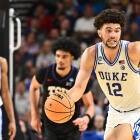
5. Alperen Sengun
Total owed: $112,018,349
Years remaining: Three


Wanna know why I just ranked the Rockets as the NBA's third-best front office? Well, Alperen Sengun and Franz Wagner were in the same draft class. Sengun, by most measures, was the superior player through three seasons. At the very least, it was a toss-up. The Magic gave Wagner a no-questions-asked max as soon as they could in July 2024. The Rockets actually negotiated with Sengun, took it down to the wire, and managed to get real concessions. Wagner started his deal at 25% of the cap. Sengun's started just below 22%. Sengun got roughly 5% annual raises. Wagner got the full 8%. Sengun got a concession back in the form of a 2029-30 player option, but Houston, unlike many teams with younger stars, actually held the line and managed to generate real savings through negotiation.
More teams should take that approach, and more likely will in the years to come. Now Sengun is an All-Star making less than his max. Would the Rockets prefer if he were a bit more mobile defensively or if he was a slightly better finisher? Absolutely. But they can abide his imperfections in ways that it will be harder for teams like Orlando to do with players like Wagner because they have the financial wiggle room to properly support him with role players. Like we said at the beginning, every dollar counts.
4. Jaden McDaniels
Total owed: $84,020,688
Years remaining: Three


As a percentage of the cap, McDaniels got only a bit more on his rookie extension than De'Andre Hunter did. That's how it often goes with wings. Teams are far more willing to extend them on potential than they are other positions because of their scarcity. It didn't work out with Hunter, but the McDaniels deal has been a home run. He made an All-Defensive team in his first season after re-signing, and while his offense took a bit longer to develop, he's having a breakout season on that end of the court by averaging more than 15 points per game on 44.3% 3-point shooting.
McDaniels is never going to be a star, but he's remarkably portable. Wings are the single most prized commodity in basketball, and now that McDaniels is at least a good offensive player, his incredibly valuable defense can shine unimpeded. The Timberwolves prioritized keeping McDaniels in the Rudy Gobert trade, and that decision has paid off several times over by now. Again, think of the Anunoby contract we discussed earlier. McDaniels is several years younger and making slightly more than half as much to do the same job, and it's not as though the Anunoby deal is explicitly bad. That's just how valuable McDaniels has become.
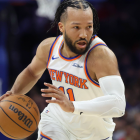
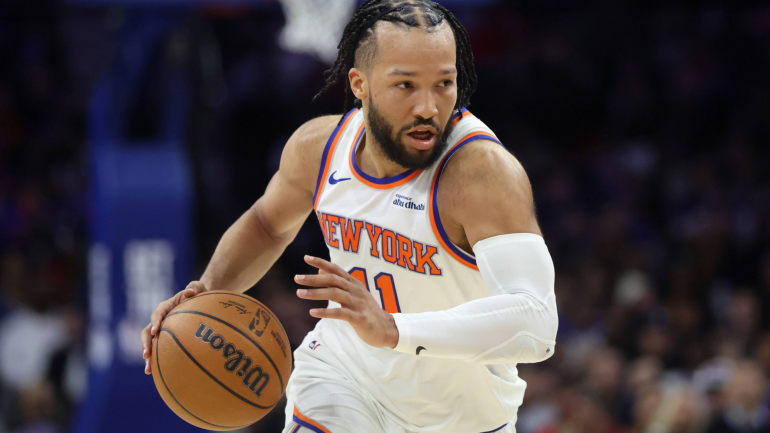
3. Jalen Brunson
Total owed: $78,274.562
Years remaining: Two


This is probably the contract you were thinking of when you clicked on the story. Brunson easily could have waited until 2025 free agency and gotten a max contract. Instead, he extended early to give the Knicks a bit of extra space to build out the rest of their contending roster. Brunson is the single best player on this list. He's the only true franchise player in the NBA today making less than the max besides the ones who are still on rookie deals. He only misses out on the top two spots because of the absurd value two other All-Stars offer in different ways.
2. Jalen Johnson
Total owed: $120,000,000
Years remaining: Four

Is Johnson as good as Brunson? No. In fact, the Noh model even argues that he's worth less than he's actually making this season, though I'd obviously firmly disagree on that front. But Johnson has to come in relatively high on a list like this for three reasons:
- He's only 24 and he's already an All-Star. Odds are, he's still a few years away from his peak, whereas Brunson is probably right around his own.
- He has four years of team control left. He's the only four-year contract we're covering in this space. The Hawks will have him for the rest of the decade.
- His contract is flat. It's $30 million per year with no raises. Based on Spotrac's cap projections, he's expected to cost around 15.6% of the cap in the deal's final season. That's around what DeMar DeRozan is getting this season.
You'd probably rather have Brunson than Johnson today, but the Johnson contract is probably going to generate more surplus value over its remaining life than Brunson's. Young All-Stars on flat, sub-max, four-year deals are practically unheard of. This is an absolute steal for Atlanta, but given the injuries Johnson has dealt with in his career, it made sense for him to take the sure thing rather than holding out for more upside.
1. Deni Avdija
Total owed: $25,000,000
Years remaining: Two


Deni Avdija is making $14.4 million this season. The non-taxpayer mid-level exception pays around $14.1 million. So Portland is essentially paying mid-level money for a 25-year-old All-Star. Sounds pretty crazy, right? Well, what if I told you Avdija's contract descends by $1.25 million in each of the next two years? He's going to make less than 7% of the salary cap in the 2027-28 season, which, based on his aging curve, may be right around his peak. This isn't just the best contract in the NBA. It's an all-time NBA contract if he keeps playing at this level. Remember that incredible Curry contract we mentioned above? Well, in the last year of that deal, he made $12.1 million. Avdija will make $11.9 million on his... more than a decade later.
This is the rare NBA contract that might actually be too good. It's basically unextendable. At his maximum 40% raise in the first year of a new deal, he'd still be making something like mid-level money because of that descending structure. Portland would have to get below the salary cap entirely and carve out meaningful space to renegotiate and extend him in 2027 to offer him more than that, but the Blazers have loaded up on bloated contracts for older players like Jerami Grant and Jrue Holiday that will still be going by then, rendering a lot of the value this contract should be adding moot. Still, we're judging these contracts in a vacuum. The Blazers may have mismanaged their books in other ways, but the Avdija trade was a home run. Not only did it get them a cornerstone young player, but it did so at a historically low price.