2026 Fantasy Baseball Draft Prep: Busts 2.0 for Scott White adds James Wood, Spencer Strider to the mix
Velocity decreases and strikeout concerns inform this latest batch of busts

My first round of busts came way back in January. Now that we're in the thick of Draft Prep season, it's time for an update.
Below, you'll find some new additions followed by my original list, which has been refreshed with the latest information. To put it simply, these players have clear warning signs that make them not so worth drafting at their going rate. Some even show the potential for outright collapse.
- Sleepers 2.0: Scott | Chris | Frank
- Breakouts 2.0: Scott | Chris | Frank
- Busts 2.0: Scott | Chris | Frank
I'm not so confident in my prognostication skills that I'd avoid any of these players outright, but at cost, I'd prefer to go another direction.
Note that ADP comes from FantasyPros, which averages data from multiple platforms. ESPN was excluded because its data is the most out of step (possibly due to different scoring rules).
THE NEWCOMERS
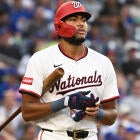
James Wood, OF, Nationals
| ||||||||||||


FantasyPros ADP: 31.6
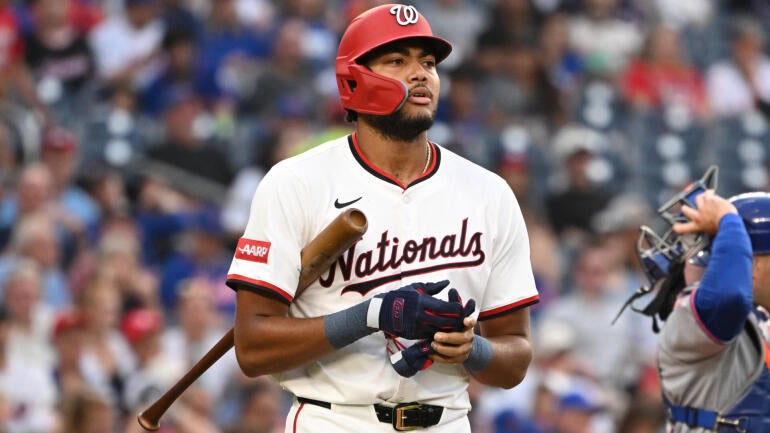
Wood's and Pete Crow-Armstrong's fates seem inextricably tied. Both were recent top prospects who seemed on the path to becoming Fantasy first-rounders early last year, in spite of their flaws, but both collapsed down the stretch, raising serious doubts about their 2026 outlook. So why am I disentangling them here? Well, I gave Crow-Armstrong a hard enough time last year and can't even take credit for the bust call because his first half was so good. Besides, his collapse seemed like it was tied to a preexisting flaw, the poor plate discipline that made me skeptical of him in the first place.
Wood's collapse, by contrast, was the result of something entirely new. He wasn't just struggling to pull the ball in the air, which had always been the case. No, the problem was that his strikeout rate ballooned, going from 27.6 percent in the first half to 39.0 percent in the second half. Nobody, no matter how good their contact quality (and Woods' is among the best) could survive with a strikeout rate so high, and sure enough, Wood hit .223 with a .690 OPS during that time.
Explanations for this downturn have ranged from his launch angle becoming too steep to him simply tiring out in the second half. But the launch angle excuse is thinly sourced, and the "he was tired" claim is just plain weak. It could still prove to be valid, but it's not convincing enough for me to want to sink a third-round pick in him. I may still do it in the name of upside, but the downside risk is higher than I'd prefer for that kind of draft capital. My preference would be for someone else to take the plunge on Wood, allowing me to direct my attention to one of the stud first baseman who go in that range instead.
Riley Greene, OF, Tigers
| ||||||||||||


FantasyPros ADP: 61.0
The 2025 season marked Greene's second straight with must-start production, so you may not have given even a second thought to its legitimacy. But he came about that must-start production in a different way -- one that seems less sustainable to me. In short, it was all home runs. His launch angle became steeper, his approach became more aggressive, and he just let 'er rip, hitting a dozen more home runs than the year before.
The tradeoff was a reduced average exit velocity, from 84th percentile to 48th percentile, and much more swing and miss, his 30.7 percent strikeout rate ranking fifth among qualifying batters. He went from being a fairly well-rounded hitter -- one who struck out a little too much but could contribute in different ways -- to one whose outlook is entirely tied to the long ball. He may not be enough of a pure power hitter to measure up in that regard. The cracks were already beginning to show toward the end of last season. Really, "toward the end" is a generous way of putting it. Over his final 73 games, or nearly half the season, he hit .212 with a .691 OPS.
My fear is that if he gives back just a little something in the way of home runs, the batting average collapses. His hitting profile now seems as volatile as Brenton Doyle's, only without the soft landing of Coors Field. It's possible Greene tweaks his swing and approach to recapture the form he showed in 2024, but the bottom line is that the price doesn't factor in enough of the downside risk. There's no way to justify taking him over Cody Bellinger and Randy Arozarena, as AP shows.
Spencer Strider, SP, Braves
| ||||||||||||


FantasyPros ADP: 102.4
I was trying to reserve judgment on Strider, hoping that an offseason spent regaining his fastball shape or developing a new pitch to go with still-killer slider would help him regain the dominance he apparently forfeited with an internal bracing procedure in 2024. His comments suggested that he knew what the issue was and simply needed the time to address it, and his history as a self-made pitcher earned him credibility on that front. But then came his first start of the spring Saturday, an actual data point instead of happy talk, and let's just say there was nothing happy about it.
OK, one little thing: His fastball shape was sort of, kind of back. The pitch had 18 inches of induced vertical break, which was more than an inch more than last year and about where it was at his most dominant. Unfortunately, it was also down another 2.5 mph. I've been contending that regaining his fastball shape was more important than regaining his fastball velocity, an idea that Strider himself has echoed, but I wasn't counting on another drop in velocity. I'm not sure any shape could save him at 93 mph. His fastball registered just one whiff Saturday.
I may be jumping the gun by including him here. The official line, according to Mark Bowman of MLB.com, is that Strider is "pacing himself" and that "there's no reason to overly concern yourself with any pitcher's velocity during the first few weeks of spring training," but that, frankly, seems like too convenient of an excuse for a pitcher who was already on shaky ground.
I reserve the right to change my mind if Strider's velocity ticks up over the rest of spring training. For as disappointing as he was last year, he still had an incredible 48 percent whiff rate on his slider, and his overall 13.9 percent swinging-strike rate would have ranked seventh among qualifiers. But his fastball was too susceptible to loud contact at its going velocity, which itself may be out of reach. I initially ranked Strider similarly to the consensus, which was about 30th at starting pitcher, but now I think he'd have to drop outside of the top 45 for the reward to be worth the risk to me.
Carlos Estevez, RP, Royals
| ||||||||||||


FantasyPros ADP: 122.6
Estevez is such an obvious regression candidate that part of me wants to take a contrarian stance just because saves are saves and don't always come in the prettiest packages. But he hasn't actually slipped enough in drafts to make that approach a rewarding one. In fact, he's being drafted ahead of not just Emilio Pagan and Daniel Palencia, who have the kind of swing-and-miss stuff better suited for the role, but also Raisel Iglesias, who is one of the most accomplished closers in the game today.
Sure, you could raise concerns about those three relievers. Pagan is a homer-prone pitcher who managed to navigate his first year in homer-friendly Great American Ball Park well enough but doesn't have the sort of track record to suggest he always will. Palencia came out of nowhere to be the Cubs closer last year and certainly wouldn't be the first pop-up reliever to give it all back the following year. Iglesias struggled for the first couple months of 2025 and now has Robert Suarez waiting in the wings should he fall into a similar rut.
But none of those concerns is more glaring than the 8.2 percent swinging-strike rate and 7.4 K/9 that Estevez put together in 2025, all while losing about a mile per hour off his fastball and two off his slider. Those are the kinds of numbers that you'd see from back-end rotation filler like Nick Martinez or Kyle Hendricks, not a pitcher tasked with freezing the offense in its tracks during the most critical inning of every game he enters.
If that's not bad enough, his fastball is down another 6-7 mph through two appearances this spring. You read that correctly. Anne Rogers of MLB.com notes that he endured something similar last spring and went on to have the season he had, leading the majors in saves with a stellar ERA and WHIP, which may be why his stock hasn't tanked yet. But the spring velocity dip, enormous though it may be, is far from his biggest concern.
Andy Pages, OF, Dodgers
| ||||||||||||


FantasyPros ADP: 134.4
If you take Pages' numbers last year at face value, he's a perfectly reasonable choice to be your third outfielder in Fantasy, which is about the range where he's going in drafts. But I'm here to tell you that you shouldn't take his numbers at face value. I'll make the case in three ways.
- A traditional statistical analysis. Pages's success last year was front-loaded. He slashed only .251/.295/.418 from July 1 on, a span of 75 games.
- An advanced statistical analysis. Pages was an overachiever by the Statcast readings, which pegged himf or a .258 batting average and .428 slugging percentage as compared to his actual .272 and .461 marks. His average exit velocity placed in only the 28th percentile and his max in only the 40th percentile, which aren't readings befitting of a power hitter. He also had significant enough chase issues that his walk rate ended up being the seventh-lowest among qualifiers. You can see why the data didn't love him.
- A usage concern. Pages was so bad in the postseason, going 4 for 51, that the Dodgers ended up benching him for the final two games of the World Series, with everything on the line. They may not have a great alternative in center field at the moment, which buys him some time, but that will change once Tommy Edman is back from ankle surgery in May. Plus, they're the Dodgers. They have the resources to go fetch whatever they need.
Of course, it's distinctly possible that, at 24, Pages uses his postseason failure as a learning experience and grows into something more in 2026, but I don't see a loud of enough tool set for me to bet on it. For the price, I'd rather play it safe with an Ian Happ or Jurickson Profar type.
Munetaka Murakami, 1B, White Sox
| ||||||||||||


FantasyPros ADP: 181.0
In a way, the league has already made the case against Murakami for me. How does a 25-year-old with prodigious exit velocities, two MVPs and a Triple Crown already under his belt, and the single-season record for most home runs ever by a Japanese-born player (set during a dead ball era for the league, no less) only get two years and $34 million from the lowly White Sox? The most logical answer is that better contracts weren't available, and the better teams all passed.
The reason why is that for all of Murakami's power, he has major contact issues, the sort that may actually contend for the worst in MLB history. His zone-contact rate last year was only 72.6 percent. No qualifying major league hitter had a mark that low last year, and if we reduce "qualifying" to just 300 plate appearances, only one does: Gabriel Arias, author of a .220 batting average. Others in the bottom 12 include Christopher Morel (.219), Matt Wallner (.202), Michael Toglia (.190), Michael Taylor (.200), Oneil Cruz (.200), Ryan McMahon (.214) and Colton Cowser (.196). There were successes in there as well -- like Rafael Devers, Nick Kurtz and Ronald Acuna -- but clearly, missing hittable pitches is the kind of flaw that can sink an otherwise talented hitter.
And remember, Murakami's 72.6 percent mark came against pitchers in Japan. The pitchers are a little bit better here, at least on the whole, and the main way they excel over their Japanese counterparts is in pure velocity. According to FanGraphs, Murakami's contact rate on fastballs 93 mph and over is just 63 percent since 2022. Pitchers who throw only 93 mph here are lucky to have a job.
I'd love to see Murakami put on a power display in the majors, but I don't see how he makes enough contact to factor in a meaningful way. Clearly, a bunch of teams with far better methods of analysis than I have feel the same way. You may argue that you're not giving up much by gambling on him at Pick 181, but among the players going later are Daulton Varsho, who saw a big exit velocity jump last year and had a 162-game pace of 46 home runs, and Jac Caglianone, who hits the ball about as hard as Murakami and has been lighting up spring training.
THE HOLDOVERS
Jackson Merrill, OF, Padres
| ||||||||||||


FantasyPros ADP: 62.4
If you're questioning the sense of declaring a player a bust a year after he already busted, I would say, well, we clearly didn't learn the lesson the first time. Merrill is still being drafted like a stud outfielder -- ahead of the likes of Cody Bellinger, Ben Rice and Geraldo Perdomo -- when he was easily one of the most disappointing Fantasy assets last year. His 16 home runs in 115 games (a 23-homer pace over 162 games) shouldn't inspire much confidence on its face and, even worse, was only made possible by a seven-homer September. He also stole precisely one base, one, which means we can't count on him being even a viable contributor to that category.
The prevailing sentiment right now seems to be "oh, well, he suffered a concussion early on, so clearly that impeded him all year, preventing him from stealing bases and undermining his power potential until that final hot stretch." Maybe! It wouldn't be the first time a concussion had far-ranging effects. But without a track record to back it up, it's kind of just optimism. Merrill was a prospect in high standing when he arrived in 2024, but his production in the minors to that point was lacking. His 2024 rookie season is his only high-performing season on record.
Going back to my earliest days of Fantasy Baseball analysis, one of the clearest warning signs for a young hitter was a lack of patience. Major league pitchers are simply too good not to take advantage of that, and Merrill's walk rate for his career is only 5.8 percent. So that undermines his hit tool, which is purportedly his best, and then his power tool, which is more middle-of-the-pack (70th percentile average exit velocity in 2024 and 46th percentile in 2025), is undermined both by a ballpark that's long been known to suppress left-handed power and a pull-air rate that ranks firmly in the lower half of the league.
I don't think Merrill will lose his job or end up back in the minors or anything, but I do think, particularly if he doesn't turn out to be the base-stealer we once thought he would, he might end up ranking closer to the Brandon Nimmo side of the ledger than the Jackson Chourio side. I'm obviously giving him more credit than that by ranking him 23rd among outfielders.
Nick Pivetta, SP, Padres
| ||||||||||||

FantasyPros ADP: 87.2
Pivetta a bust? Didn't I just have him as a sleeper a year ago? And didn't it play out exactly as I suggested then, with his move to a pitcher's park finally allowing his sparkling peripherals to shine through?
Well, yes and no. He did have a fantastic season, his ERA dropping more than a run as he placed sixth in NL Cy Young voting. But what the accolades hid is that his sparkling peripherals lost much of their luster. He had consistently delivered on, and at times even exceeded, 10 K/9, but h dropped to 9.4 K/9 last year, including 8.5 in the second half. His swinging-strike rate, meanwhile, dropped nearly a full point from 2024, landing at 10.5 percent, which is about as middling as it gets.
And there were no improvements in other areas to account for these losses. He didn't allow lower exit velocities. He didn't induce more ground balls. His weaknesses remained the same, but his strengths weakened. So with that, he went from being a guy who consistently underperformed his ERA estimators to one who greatly overperformed them last year, with the gap between his 2.87 ERA and 3.95 xERA representing the ninth-biggest among qualifying pitchers and the gap between his 2.87 ERA and 3.49 FIP also representing the ninth-biggest.
Maybe the drop in strikeout rate was just a blip and he returns to career norms next year, but seeing as he's already 32, decline isn't an unreasonable explanation. Yet his going rate -- 23rd among starting pitchers by the latest FantasyPros ADP -- seems to take his 2025 production at face value, placing him alongside the more bankable Framber Valdez and ahead of the more interesting Eury Perez.
Alex Bregman, 3B, Cubs
| ||||||||||||


FantasyPros ADP: 93.6
Bregman's decision to sign with the Cubs comes at a cost. For the first time in his career, he won't be playing in a venue that favors right-handed pull-side power.
And he's always depended on that for his home run output. For as frequent as those home runs have been, he doesn't actually impact the ball well, his exit velocities typically ranking in the lower half of the league. But by angling the ball just right, he has been able to take aim at some of the shallowest points in the yard, namely the Crawford Boxes at Daikin Park and the Green Monster at Fenway Park.
Wrigley Field is on the other end of the spectrum as far as that goes, its unusual outline giving it the deepest outfield corners in all of baseball. It's 355 down the left field line while Daikin Park is 315 and Fenway Park is 310.
We already have an interesting comp in Isaac Paredes, who went from Tropicana Field, which is also 315 down the left field line, to Wrigley and then to Daikin. He wore out the left field foul pole at Tropicana and Dakin, emerging as a viable power threat, but he hit only .223 with three homers and a .633 OPS in his 52 games for the Cubs. Bregman's pull tendencies aren't as extreme as Paredes' and his exit velocities aren't as slight, so I wouldn't expect the dip to be as extreme. But there will be one. Forty extra feet is no joke for a player whose raw power is on the fringier side.
Some will point to Statcast's xHR stat, which suggests Bregman would have actually had one more home run playing every game at Wrigley last year, as reason for optimism. But Wrigley Field is particularly difficult to model, both because of its unconventional fence shape and its vulnerability to wind, and home run estimates there often come back high. No venue is impacted more by wind, and in recent years, that wind has blown in much more than out (51 times vs. 19 times this past year, according to Jesse Rogers of ESPN).
Between the wind and the dimensions, you couldn't have asked for a worse landing spot for Bregman's swing. I'd be surprised to see him hit 20 home runs for the Cubs, even with a full season of health, and if the home runs he's forfeiting turn into flyouts, his batting average may well dip below .250.
Trevor Story, SS, Red Sox
| ||||||||||||

FantasyPros ADP: 108.8
So is Story injury-prone or isn't he? Given that he hardly played for a three-year stretch, averaging just 54 games from 2022 through 2024, the consensus view seemed to be that he was. Turns out he only needed to stay healthy for one year, playing 157 games in 2025, for it all to be forgotten.
Sure, he was good, hitting 25 homers and stealing 31 bases, but plenty of shortstops are good. Bo Bichette is good, but without the same injury baggage. Corey Seager has injury baggage, but he's more reliably good than Story, who has performance questions on top of the health questions. Story is among the least disciplined hitters in the league, his 26.9 percent strikeout rate ranking in the 12th percentile and his 5.0 walk rate in the 10th percentile, which led to him having a lower xBA (.249) than his actual .263 mark. His strikeout rate was above 30 percent for each of the three years he was banged up, giving him an xBA right around the Mendoza Line.
There are so many ways Story could turn out wrong that it's hard to understand why he's going just a couple rounds behind Bichette and Singer. Even Dansby Swanson, who wasn't a 20-30 guy last year but is more reliably 20-20, might represent better bang for the buck, and he's available four rounds later.
Bottom line is that there are near-equivalent options at shortstop, so enthusiasm for Story isn't driven by scarcity the way it sometimes is for notable trouble cases coming off everything-goes-right seasons. Unbridled optimism is more the order of the day, which is an unlikely turnaround for a player who was discarded to the ash heap just a year ago.
Jacob Misiorowski, SP, Brewers
| ||||||||||||


FantasyPros ADP: 127.4
The story of Misiorowski's rookie season was already written five starts into it, when his eye-popping radar gun readings earned him a ticket to the All-Star game while legitimate Cy Young contenders (Cristopher Sanchez, anyone?) stayed home.
His fastball is indeed impressive, averaging 99 mph and peaking at 103 for a 33 percent whiff rate, but what else is there? He throws a slider and curveball, but neither has an impressive whiff rate on its own, making them more like change-of-pace offerings. And while a wave of uncharacteristically good control propelled Misiorowski to the majors, the control backed up after a few turns with the big club. He was so inefficient over his final nine outings, issuing 4.7 walks per nine innings, that he went five innings, the minimum required for a win, in just three of them while compiling a 5.89 ERA and 1.50 WHIP.
Not what you remember, is it? Yes, many tuned out for the Mr. Hyde side of Misiorowski, which was confined mostly to the months when football overlaps with baseball, and his hot start effectively served to mask it, making his final stat line seem not so bad. My own prediction for Misiorowski this year is that he struggles to stay in the majors amid the Brewers' surplus of viable arms, made less effective by a too-limited arsenal and thwarted by longstanding control issues that cut his outings short.
He made a name for himself last year -- and that name has stuck with many -- but he's still too much of a project for you to make him an integral part of your Fantasy rotation. A mid-round upside play? Sure. A top-36 starting pitcher, as he's currently being drafted? I don't see it.
Jakob Marsee, OF, Marlins
| ||||||||||||


FantasyPros ADP: 127.4
The bust case for Marsee is an easy one -- so easy that I'm surprised early drafters have left it on a tee for me. It would be more complicated, perhaps, if you took his stat line from his two months in the majors at face value. A .292 batting average, .842 OPS and what amounts to a 40-steal pace is indeed impressive and would be enough to make you reconsider your priors about the player if it were to continue uninterrupted.
But unfortunately, it was interrupted. You'll see what I mean when you split the stat line into the two different months Marsee spent in the majors:
August: .352 BA, 3 HR, 9 SB, .988 OPS in 30 games
September: .231 BA, 1 HR, 5 SB, .619 OPS in 25 games
Anything good that Marsee did came in August, and it was so good that not even a bad September could ruin the overall stat line. But the bad September happened, creating such a sharp contrast that it's worth examining who Marsee was prior to his August debut, and you aren't going to like the answer.
Between 2024 and 2025, Marsee hit .219 in the minors. He reached base at a nice clip and stole an ample number of bases, but he had poor contact quality and wasn't trending toward being more than a reserve outfielder in the majors. He was in nobody's top 100. Few would have even described him as a prospect except by way of technicality.
Given that background, which of Marsee's two months in the majors seems more legitimate? I think he had a Shane Spencer moment, arriving on such a heater that he took the league by storm, but then quickly returned to status quo, possibly never to be heard from again. OK, so the Marlins will need someone to man center field, which grants Marsee a longer leash, and with that sort of job security, his stolen bases alone might make him worthwhile in Fantasy. But as a hitter, I think he rates closer to Jose Caballero than to the Brandon Nimmo and Lawrence Butler types that he's often drafted alongside.
Taylor Ward, OF, Orioles
| ||||||||||||


FantasyPros ADP: 129.0
There are some who view Ward as the epitome of safety and stability, and I'll admit that the bottom-out potential here is low. But I think anyone who anticipates him repeating last year's career-high home run total is sorely mistaken, and without that, I'm not sure how useful he is in most Fantasy contexts.
That second point is a longstanding dispute I've had with Ward truthers who insist that a .250 batting average, 25 home runs and 75 RBI is actually quite valuable in Fantasy, usually by pointing to where Ward finished according to whatever scoring format they were using. But the truth is that any viable hitter who manages to stay healthy for a full season, as Ward typically has, will finish ahead of superior ones who don't stay healthy.
You still want the superior ones. Just because they missed time last year doesn't mean they will this year, and if they don't miss time, they'll obviously be much better than Ward. You'll also get the stats of whatever fill-in you use to replace them, should it come to that, so it's not an apples-to-apples comparison with Ward. The 32-year-old offers more assurances, but it's assured mediocrity and not the kind of production that will set your team apart. Your mileage may vary based on league size. In 15-team Roto leagues with sparse waiver wires, his dependability counts for more, but in anything shallower, which is what most people play, he's decidedly blah.
But he wasn't last year, which is the reason why we're discussing him here. His 36 home runs represented a near 50 percent increase over his previous high, but there was no underlying skill change. He didn't make more contact or harder contact or contact at angles more conducive to home runs. The increase is owed mostly to variance in a sport that tends to be high variance. Perhaps the most compelling evidence for this is xHR. With those 36 home runs, Statcast suggests Ward exceeded his expected home run total by seven. Only four players exceeded it by more.
Ceddanne Rafaela, 2B/OF, Red Sox
| ||||||||||||

FantasyPros ADP: 149.2
Apparently, we haven't learned our lesson with Rafaela yet. He's on this list for a second straight year. I'll admit the numbers he put up in June and July -- a .285 batting average, 11 homers and .861 OPS -- gave me pause, but his August and September were more true to form, seeing him hit .224 with two homers and a .622 OPS.
My case against him isn't as simple as "he was cold to end the year," but I wouldn't say it's complicated either. All the blue on his Baseball Savant page goes most of the way to telling the story. The guy has few redeeming qualities as a hitter.
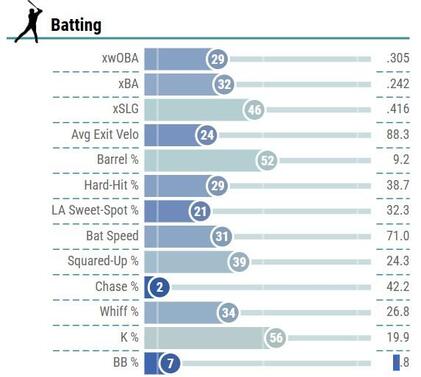
About the only one is an above-average contact rate, but even that ends up working against him because he swings at too many bad pitches, his 45 chase rate ranking fifth among qualifying batters, according to FanGraphs. Even if he did make better swing decisions -- an attribute that's unlikely to change -- he wouldn't impact the ball well enough for it to matter.
Could he eke out 20 homers by taking aim for the Green Monster in left field? Maybe. He's already come pretty close. But it's a hollow total because of his minimal on-base ability and the poor run and RBI production that comes from batting at the bottom of the Red Sox lineup. I don't see what makes him 80 spots better than Otto Lopez and Heliot Ramos, as ADP currently shows.
Robbie Ray, SP, Giants
| ||||||||||||


FantasyPros ADP: 160.0
By his full 2025 stat line, Ray is being drafted appropriately, and the most analytically pure among us will be quick to remind me that full-season numbers are more predictive than partial-season numbers. But good players do eventually get worse, especially injury-prone 34-year-olds, and it can sometimes happen in-season.
The second half of last season saw Ray get worse in most every measurable way. First, the surface level. He had a 5.54 ERA and 1.45 WHIP in his final 12 starts. His K/9 rate went from 9.7 to 8.2 and his swinging-strike rate from 13.1 percent to 11.6 percent. He struggled so mightily with his command that he failed to go the minimum for a win in five of those 12 starts. He was, in a word, terrible.
You particularly hate to see it from a pitcher in his first full year back from Tommy John surgery. The first half offered a sigh of relief, even earning Ray a nod in the All-Star game, but the second half should have us all wondering how much he really has left. He was walking a tightrope to begin with. Though a former Cy Young winner, he's always given up some of the loudest exit velocities of any pitcher, and his control has tended to come and go. If he's not a premier bat-misser, he's not much of anything, and that's what we saw play out in the second half last year.
Jackson Holliday, 2B, Orioles
| ||||||||||||

FantasyPros ADP: 165.8
Note: Holliday's fractured hamate bone, which could sideline him for the first couple weeks of the season, hasn't lowered his ADP enough for me to discard him as a sleeper.
We so badly want this to work, don't we? Yes, a former No. 1 overall pick with ties to Fantasy royalty (his father, Matt Holliday) and who happens to play the position most lacking in high-end talent right now really has the makings of something special.
But how has that line of thinking gone for us so far? For two years, we've given Holliday the benefit of the doubt, and for two years, he's let us down. Granted, the second year was better than the first. He was at least usable in leagues that require a third middle infielder. But he didn't live up to his 184 ADP and offered no real hints of latent potential. His Baseball Savant page is splashed with blue, showing exit velocities in the lower 30 percent of the league, and he lacks the lift-and-pull tendencies to overcome that. Even his plate discipline isn't what it was promised to be.
You might say it's unfair to assess a 22-year-old at face value, and I agree with that. But potential doesn't come with a timetable. To presume a breakthrough without evidence for it is foolhardy.
And I don't want to hear that a position like second base requires you to take bigger chances in the name of upside. It may be lacking in bankable talent, but there are upside plays apart from Holliday. Marcus Semien was showing signs of coming around prior to breaking his foot last August and will now be playing at a venue much better suited for his swing. Matt McLain had a miserable first year back from shoulder surgery, but he was on a 29-homer, 25-steal pace as a rookie in 2023, batting .290. Jorge Polanco will be batting behind Francisco Lindor, Juan Soto and Bo Bichette only a year after hitting 26 home runs. All three are being drafted at least 30 spots behind Holliday. Those are your lottery tickets, if that's all you're asking Holliday to be.
Edward Cabrera, SP, Cubs
| ||||||||||||
FantasyPros ADP: 214.2
The enthusiasm for Cabrera in Fantasy is fairly restrained relative to the headlines, some of which touted him as an ace when the Cubs acquired him from the Marlins.
Is this the same Edward Cabrera who's been an eternal headache for Fantasy Baseballers, such that I've branded him a Charizard for his tendency to inflict just as much damage on yourself as your opponent? We're calling him an ace now? Really?
I'll admit he was less of a Charizard last year, finally finding consistency from mid-May through mid-August especially, but the ERA was still in the mid-threes with a WHIP approaching 1.25. Is that an ace? Certainly not by Fantasy Baseball standards. And how likely is he to sustain those numbers, even?
The improvement wasn't just natural variance but the product of a substantive change. He finally began fading his four-seamer, a pitch he could never control, for a two-seamer, which put him ahead in the count more and allowed his secondary offerings, long the reason for optimism, to shine. So it's a legitimate fix.
But how durable is the fix? Old habits die hard for a player as established as Cabrera, and even if he follows through on the strategy again, the league may catch up to it. It reminds me of Sean Manaea dropping his arm slot to Chris Sale levels two years ago. He thoroughly dominated with that change, beyond even anything Cabrera accomplished last year, but it simply didn't work as well in 2025.
My concerns for Cabrera are more about the player himself than the approach. How many times in the past have we been fooled by some tweak he made that got better results for a time but ultimately saw him revert to his characteristically erratic ways? Last year's fix may have been the best yet, but I don't trust him to execute it as well this year. I've been burned by the Charizard too many times before.