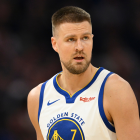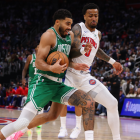


From practically the moment Jayson Tatum was drafted, Jaylen Brown was a fixture in the rumor mill. The question they were perpetually bombarded with was whether or not the Celtics could win a championship with the two of them as their best players. That question was theoretically answered in 2024, when the Celtics won their 18th title with Tatum as the team's best player and Brown as both the Eastern Conference Finals and NBA Finals MVP. It just turns out we were asking the wrong question.
But at his press conference Monday following his stunning decision to trade Brown to Philadelphia, Celtics president Brad Stevens raised an important difference between the 2024 Celtics and their 2027 counterparts. When the Celtics won the championship, Tatum and Brown combined to account for roughly 47% of the salary cap. In 2027 and beyond, they are set to account for roughly 70%, a figure that will likely tick slightly upward with cap growth lagging behind the 8% annual raises baked into their supermax contracts.
The question was never "can you win it all with Tatum and Brown as your two best players?" It was "how much can you afford to pay Tatum and Brown to be your two best players if you hope to win a championship? The Celtics have seemingly determined that the answer is somewhere between 47 and 70%, and recent league history supports the idea that paying them that much was ultimately untenable. Let's take a look at what percentage of the cap the last 15 NBA champions paid their two most expensive players:
| Year | Team | Two most expensive players | % of cap spent on top two players |
|---|---|---|---|
2025-26 | 59.95% | ||
2024-25 | 46.85% | ||
2023-24 | Boston Celtics | Jrue Holiday & Kristaps Porziņģis | 54.14% |
2022-23 | Nikola Jokić & Jamal Murray | 52.79% | |
2021-22 | 74.52% | ||
2020-21 | 55.50% | ||
2019-20 | 59.12% | ||
2018-19 | 55.78% | ||
2017-18 | Golden State Warriors | Stephen Curry & Kevin Durant | 60.23% |
2016-17 | Golden State Warriors | Kevin Durant & Klay Thompson | 45.89% |
2015-16 | LeBron James & Kevin Love | 60.95% | |
2014-15 | Golden State Warriors | David Lee & Andrew Bogut | 44.37% |
2013-14 | Tony Parker & Tim Duncan | 38.96% | |
2012-13 | LeBron James & Chris Bosh | 60.56% | |
2011-12 | Miami Heat | LeBron James & Chris Bosh | 55.2% |
Why are we using the last 15 years as our timestamp? Because the 2011 CBA was the beginning of the NBA's shift toward a harsher team-building climate with the revamped luxury tax formula. The aprons followed. In this window, only one team topped even 61% of the cap for their two most expensive players.
That would be the 2021-22 Warriors, who are perhaps the single team most responsible for the CBA changes that came in their wake. Remember when ESPN's Brian Windhorst called Game 5 of the 2022 NBA Finals a "checkbook win" for Golden State? Despite the backlash, he was absolutely right. Golden State paid its four most expensive players almost 124% of the salary cap. The sign-and-trade maneuver they pulled to turn Kevin Durant's outgoing money into eventual key championship cog Andrew Wiggins almost certainly would not have been possible in the second-apron era. Golden State's victory over Boston in 2022 is ironically part of what put the Celtics in this situation.
Outside of those Warriors, our 14 other champions averaged just under 53.6% paid to their two most expensive players. That's right around the 54.14% Boston paid its top two in 2024... neither of whom were Brown or Tatum. This is the other CBA-related championship cheat code we have to acknowledge. Not covered in the table above: 2026 Jalen Brunson, 2025 Chet Holmgren or Jalen Williams, 2024 Jayson Tatum or Jaylen Brown, 2019 Kawhi Leonard, or Stephen Curry in 2017 and 2015.
Underpaying a star-level player is the single easiest way field a championship-caliber roster. The Knicks could afford to allocate 60% of their cap to Towns and Anunoby because they weren't paying Brunson the max money he would have been eligible for had he not extended a year early. Conversely, the Celtics paying Tatum and Brown 35% or so each meant that they could no longer afford players like Holiday or Porziņģis to support them.
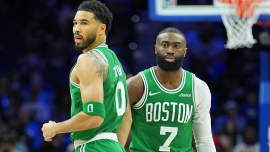
Could you win a championship in the modern NBA with two players making 70% of the cap? The Celtics were actually prepared to bet that yes, you can. Remember, they tried to trade Brown for Giannis Antetokounmpo before they sent him to Philadelphia. Antetokounmpo is arguably an even riskier bet for such a big contract because he's older and more injury-prone than Brown is. But he's a better player than Brown, and his specific style suits Boston's needs more than Brown did. The Celtics badly need rim pressure. Nobody in the NBA provides more of it than Giannis. Stevens was only willing to bet on two 35% max contracts long-term on a combo like Tatum and Giannis.
They were hardly the first team in this cap environment to wrestle with these sorts of dilemmas. The Timberwolves traded Karl-Anthony Towns after the best season in franchise history because he was set to make 35% of the cap while Julius Randle hovered around 20%. They determined to their ultimate detriment that the 15% difference between them would be necessary in preserving championship-caliber depth. Brown won't be the last CBA casualty either.
That's what we're going to try to figure out here. The basic idea of trading Brown made sense. The price the Celtics got for him -- just like the price the Timberwolves got for Towns -- was lower than anyone expected because teams were so afraid of their contracts. So who are the players, because of their contracts and the cap contexts their teams find themselves in, who look like future CBA casualties? We'll roll through a handful of candidates, and a few players and teams that don't quite make the cut.

De'Aaron Fox
Fox's four-year, $221.7 million deal will kick in starting next season. He'll make $61.3 million in 2029-30, his age-32 season.
Don't act surprised to see Fox on this list. You watched the NBA Finals. Fox remains an above-average starting point guard, but he's no longer the NBA's fastest player, and that was his calling card at his NBA peak. Without a reliable jumper, maintaining star status is going to be difficult, and Dylan Harper and Stephon Castle are already breathing down his neck. Fox is on a 30% max contract that frankly looks like negative value as is. San Antonio might have to attach an asset to move it. Eventually, a trade seems inevitable. We're really here to talk about two concepts that go hand in hand: timing and circumstance.
Right now, having Fox at 30% of the cap isn't a cap-killer for the Spurs. Harper, Castle and Victor Wembanyama will combine to make only around 24% of the cap next season, and there's a lesson in there for possible trading teams. Say some team like Boston has determined it can no longer pay max money to someone like Brown, and that has not only led to the availability of an All-NBA player, but the availability of such a player at a reduced asset cost. If you're a team like the Spurs with several artificially deflated contracts through the rookie scale in their case or perhaps shrewd negotiation in others, maybe trading for these cap casualty players could become a market inefficiency.
Think of the concept as a calculated overpay, and it such a decision can take many forms. Take the Mikal Bridges trade. Five first-round picks for a non-All-Star is ridiculous on its face. The Knicks paid that price because he checked a few boxes that no other player in the NBA checked. Wing is the NBA's scarcest position, and Bridges is a wing. Most 3-and-D wings don't offer any shot-creation, but Bridges does. Most 3-and-D wings that offer any shot-creation are making the max or close to it. Bridges was making far less than he was worth because of a below-market rookie extension he signed with the Suns, so he fit onto New York's books in ways few other players of his caliber could have. And of course, he went to Villanova.
The Knicks felt like they were close enough that a trade like that could win them a championship, and they were proven correct. This might be the future of these 35% max players. When their original teams need to move them, they might be calculated overpay candidates for teams in cap situations like San Antonio's. The Spurs are anomalous. Few teams ever have three stars on rookie deals at the same time. But there are teams out there -- Atlanta being the best current example -- who have managed their books diligently and have enough surplus value generated on their existing contracts to take such a swing.
Of course, the Spurs won't be in that boat forever. And that's where Fox comes in. The 2026-27 campaign will be Wembanyama's fourth season. If he plays 65 games, he is a Defensive Player of the Year lock, which means he'll almost certainly be making 30% of the cap for the 2027-28 season. Castle's rookie extension kicks in a year later, followed by Harper's after that. The 2029-30 season is the nightmare scenario in which all four players are making max money at the same time. The Spurs are going to have to be proactive in moving Fox sooner than that. The ideal would be winning the championship next season, and in doing so, raising Fox's value enough to trade him without attaching anything. If that doesn't happen, they still need to operate under a "the sooner, the better" mindset. The older he gets, the more it could cost to trade him.

Donovan Mitchell
The Cavs guard signed a four-year, $273 million deal on Tuesday that will take him through his age-34 season.
When Mitchell signed his first contract extension in Cleveland two years ago, it was met with celebration. The small-market team convinced the star to stay, a feel-good story. But the four-year, $273 million extension he agreed to on Tuesday? That one was met with skepticism. The current Spotrac estimate has Cleveland paying Mitchell 37.49% of the cap in his age-34 season, the 2030-31 campaign. Evan Mobley's current contract will be expired by then, but since he's still only 25, he's almost certainly getting extended. His current deal tops out at an estimated 32% or so of the 2029-30 cap.
Together, Mitchell and Mobley are going to cost Cleveland pretty close to that 70% figure the Celtics were afraid to pay Tatum and Brown, who were both the more accomplished duo and, frankly, the better one. Mobley and Mitchell haven't won a championship or even reached the NBA Finals, and unlike Boston, which is currently underpaying players like Neemias Queta, Payton Pritchard and its recent draft picks, the Cavaliers generate minimal surplus value because they've traded so many of their picks. Jarrett Allen is set to start a market-rate extension. Sam Merrill, Max Strus and Dennis Schröder have all been paid. James Harden will make a pretty penny to return. Basically, their only possible form of surplus value here would be getting LeBron James for the minimum or a mid-level exception. That is not a long-term strategy.
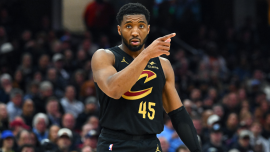
There's a version of this Cleveland run in which Mobley is traded in some sort of win-now gambit. That's why the Cavaliers were such a frequently-rumored Giannis Antetokounmpo destination. Cleveland doesn't have a traditional "best player on a championship team" level of player right now, and Mobley is their ticket to getting one and relegating Mitchell to sidekick status. This is, in essence, what Boston wanted to do with Antetokounmpo and Tatum. But if another year or two passes, this sort of move doesn't happen and Cleveland has made peace with falling out of contention, that's when the Mitchell rumors begin anew.
And if they happen, well, the Brown package would probably be a win for Cleveland. Teams rarely want to pay for small guards in their 30s. Mitchell is a tricky piece to build a roster around. He is point guard-sized, but can't defend top point guards or pass at the level of a point guard. That means, despite paying 35% of the cap to a guard, his team needs to allocate another starting slot to a passer, which usually weakens the defense enough that the other three slots have to be defense-oriented. If this sounds familiar, that's because this is the puzzle Cleveland has spent the past four years trying and failing to solve.
When Fox got traded in 2025, the Spurs ultimately sent out four first-round picks to get him (even if three of them, for one reason or another, were fairly weak assets). It's only been 18 months, and now the contract is viewed as a negative value. Guard values fall quickly. If there's even the slightest hint of decline here, especially for someone with a history of nagging lower-body injuries like Mitchell's, it's just hard to imagine him getting anywhere near what the Cavaliers paid for him in 2022.
Paolo Banchero or Franz Wagner
Orlando's star duo will combine to make roughly $83 million in the 2026-27 season.
The Magic don't have a "70% of the cap for two players" problem, they have a "70% of the cap for three players" problem. Well, not exactly, but Franz Wagner, Paolo Banchero, Desmond Bane and Jalen Suggs are projected at an estimated 93% or so of the 2027-28 cap. That's not an apocalyptic number in a vacuum. The Knicks won their championship with their top four just below 99% of the cap. The difference, to put it simply, is that the Knicks have better players than the Magic do. New York got more than it paid for, and Orlando is getting less.
That Magic foursome has one combined All-Star appearance, and none of them appear to be on a 2027 All-Star trajectory based on last year's performance. This was a Play-In Tournament team last season and is currently projected to be a Play-In Tournament team next season. Changing coaches is the classic last gasp before a team admits it needs major roster changes, but if Orlando repeats last year's disappointment, there will be no running away from this core's problems any longer. The Magic project to have around $40 million in second-apron room open in the 2027 offseason, but that's with only eight players under contract and basically no bench signed to speak of. An Anthony Black extension alone is going to eat into that space. This balance sheet is untenable.
Banchero isn't making as much as Brown, but a lot of the same concerns apply to him. He's known for poor shot selection. The all-in-one metrics, at least those that are publicly available, are lower on him than traditional stats. He's a tricky roster fit as a power forward who only makes 3s in the playoffs. Wagner is the more portable of the two players based on defense alone, but even he is an inconsistent shooter as well, and his injury concerns will complicate his trade value. Bane is the least acclaimed individual of the three, but they paid a fortune for him, and his shooting makes him a necessity for whoever remains.
This might be as simple as the Magic believing in their own players too much. The Bane trade represented an all-in push around a Wagner-Banchero core that may not make sense, and now they might be forced to trade one of them for less than they gave up for Bane simply to replicate the sort of depth they had when the two of them were more affordable on their rookie deals.
Why didn't ______ make the cut?
You might have questions about a few other teams. Let's run through them quickly:
- The Timberwolves have a bit of a financial cliff coming, but it's three years down the line. Anthony Edwards, LaMelo Ball and Jaden McDaniels are all currently set to expire after the 2028-29 season. Edwards will presumably re-up on the supermax when he becomes available. McDaniels is due a raise, and Ball is already on a 25% max contract. This is something to monitor, especially since Rudy Gobert's expected successor, Joan Beringer, will also be starting a rookie extension in the 2029-30 season. It's just so far away that it's not worth worrying about quite yet.
- The Jazz were facing 2027-28 financial problems when it looked like they would keep Walker Kessler. Lauri Markkanen and Jaren Jackson Jr. are both on 30% max contracts. Kessler's new deal with the Lakers will pay him over 18% of the cap, and Keyonte George will probably push for something in the neighborhood of a 25% max. But again, the Jazz traded Kessler for a haul of Laker picks, sidestepping these issues in the short term. They have three years now before Ace Bailey needs to make fair market value and four years before Darryn Peterson gets paid. Like Minnesota, Utah has time.
- The 76ers did an admirable job building depth this offseason despite having two 35% max contracts (Brown and Joel Embiid) and a 25% max contract (Tyrese Maxey) on their books. I could have given Embiid his own subhead, but that contract would be so hard to trade, I didn't bother. Embiid and Brown come off of the books right as VJ Edgecombe's rookie extension kicks in, so there's a natural pivot point built into Philadelphia's cap sheet if it needs it.
- The Suns shouldn't be paying Devin Booker 35% of the cap. There probably aren't many teams around the league eager to pay him 35% of the cap. He was a fringe All-Star last season, he's no longer making 3s at a strong clip, he's never really gotten to the rim much, and he's only a so-so defender. You need to be a consistent All-NBA player to justify that price tag in the modern NBA. Booker isn't one. But the Suns aren't realistically building with championship stakes in mind, and they have no one else good enough to justify a similar salary, so odds are, they just keep him around and try to be somewhat competitive. They have less of a cap problem than an asset and talent problem.
- You're probably wondering about the Thunder. Shai Gilgeous-Alexander jumps to 35% of the cap for the 2027-28 season, but he's arguably the best player in the NBA. He's worth it. The big question hovering around Oklahoma City's long-term outlook is "will they need to trade Chet Holmgren or Jalen Williams." The answer is no, they won't need to trade one of them. They're both starting 25% max contracts this season, and 85% of the cap to three players that good is manageable under Oklahoma City's circumstances. They've built a perpetual motion device of cheap depth. They draft good players, develop them into better players and then trade them for more picks to reset the cycle once they get expensive. They're as well-equipped to use a three-star model as any team in the modern NBA because of that pick surplus they operate with. They might choose to trade one of the stars, either because they believe there's a younger star in-house or because they'd prefer to maximize depth rather than just recycle enough of it, but that would be a decision they make, not a move that is forced on them.