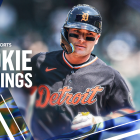


Will the 2026 Major League Baseball season provide us with one of the great rookie classes of all-time? We won't know the answer to that question for many years, but the name value of this year's rooks plus their early returns are highly encouraging and highly compelling. That's especially the case as we wrap up the first half of the season. How strong is this rookie class thus far? Four rookies were selected for the upcoming All-Star Game in Philly, and one of those didn't even crack our top 10 this time around.
Take a look at our list of the top 100 prospects for 2026, and you'll find that an impressive number of them have already made their way to the highest level this season. What's the cause of this blessed abundance? Thanks to advances in training and preparation at every level of baseball, premium talents are arriving in the pros more ready than ever, which means they tend not to need as much seasoning in the minors. As well, the last collective bargaining agreement brought us the Prospect Promotion Incentive (PPI) system. Designed to combat service time manipulation, in which teams would keep plainly ready top prospects in the minors for too long just to delay their arbitration and free agency horizons, PPI gives teams strong incentive to do the opposite.
In broad terms, rookie-eligible prospects who are called up within two weeks of Opening Day (and thus can accrue a full year of MLB service time during that season) can net their clubs a high draft pick if one of those prospects winds up winning Rookie of the Year honors in his respective league or finishing in the top three of the MVP or Cy Young vote. If that doesn't happen, there's still a chance in subsequent years for PPI-eligible players to fetch a pick. That can happen in year two or three of their careers if they finish in the top three for the MVP or Cy Young balloting. That's how the Royals got a PPI pick thanks to Bobby Witt Jr. in 2024. Hunter Brown did the same for the Astros in 2025. Clubs covet high draft picks because they're a very cheap way to add a high-ceiling young talent to the organization. The allure of getting a PPI selection is probably playing a secondary role in some of these promotion decisions.
Back to this general matter of the current class of rookies, we're here to rank them. First, some notes on the criteria:
- This is about which rookies have at the present juncture provided the most on-field value to their teams. Stated another way, the key consideration is which rookie performances have been the best so far in 2026. Given that overall is the driver, playing time matters.
- What kind of prospect status the rookie had coming into the season does not matter -- it's simply about results in 2026 without regard to what kind of future ceiling a given rookie may or may not have. Performance sustainability and long-term outlook will be, respectively, noted and occasionally mentioned, but those don't drive the rankings. In the event of a tie, yeah, we'll lean toward the rookie with the stronger long-term profile.
- First-year players who have made the leap from Japan to MLB are included even if they're not what we traditionally think of when we think of rookies. Along somewhat similar lines, rookies of any age are eligible for inclusion.
- This isn't some kind of Rookie of the Year award preview, as we're mixing leagues and so forth. There's certainly going to be a good bit of overlap and maybe some predictive value when it comes to the hardware of note, but how each player figures to fare in those votes doesn't matter for these purposes.
With all that laid out let's get to it and rank some rooks for the 2026 season thus far ...

1. Kevin McGonigle, Tigers
Age: 21
The youngest player in our rankings and our top overall prospect coming into this season is 116 games into his big-league career, and he boasts a slash line of .286/.391/.428 with 75 walks versus 71 strikeouts. Just 14 rookies in the Integration Era -- i.e., since 1947 -- have managed an OBP of .400 or higher across a qualifying number of plate appearances. The last two are Aaron Judge in 2017 and Albert Pujols in 2001. Will McGonigle join their exclusive ranks? He has a shot, but he'll need to up his pace down the stretch. Elsewhere, McGonigle is also 11 for 12 in steals, and he's taken the base an impressive 55% of the time. As well, McGonigle has spent the healthy majority of his defensive innings at the premium position of shortstop. That's a complete player, and he'll continue as such for the next decade or so. He leads the American League in WAR at this writing, and he's a deserving rookie All-Star. He's also an MVP candidate.
2. Parker Messick, Guardians
Age: 25
The lefty Messick was largely dominant in the minors coming out of Florida State, and he also impressed across seven starts last year. Still rookie-eligible in 2026, Messick has thrived over 23 starts in 2026 and emerged as the ace of a playoff contender. In 136 ⅔ innings, he has an ERA of 2.57, a 161 ERA+ and 136 strikeouts against 36 unintentional walks. Messick isn't a hard thrower, but he has a six-pitch repertoire with a changeup that has real out-pitch potential. He's right now third in the AL in pitcher WAR. Will he join Fernando Valenzuela of the Dodgers in 1981 as the lone rookies ever to win the Cy Young award? Right now, Cam Schlittler of the Yankees and Dylan Cease of the Blue Jays are probably the favorites, but Messick is in the discussion.
3. JJ Wetherholt, Cardinals
Age: 23
The former No. 7 pick out of West Virginia has been, according to Statcast's Outs Above Average, the second-most valuable defender at any position this season. And as for second basemen, well, it's a blowout:
Outs Above Average Leaders - Second Baseman pic.twitter.com/wScXtw2228
— Thomas Nestico (@TJStats) August 12, 2026
With the bat, he's no slouch, either. In 521 plate appearances this season, he has an OBP of .351 to go with 16 home runs and 12 stolen bases in 13 attempts. Wetherholt checks in just outside the overall top 10 in WAR in the NL, and not so long ago, our Matt Snyder highlighted him as an All-Star snub. Right now, Wetherholt seems like the favorite to take NL Rookie of the Year honors thanks to his broad base of overall value.

4. Sal Stewart, Reds
Age: 22
The former first-rounder has done nothing but hit as a pro, and that includes his brief stint in the majors last season. This year, with rookie eligibility still intact, Stewart has continued hitting. Stewart, at this writing, has a line of .256/.332/.472 with 25 home runs and 23 doubles. He's been the Reds' primary first baseman this season, but he's also seen time at second base and third -- flexibility that adds to his overall value.
5. Walbert Ureña, Angels
Age: 22
Ureña had a brief and largely unsuccessful stint as a reliever with the Angels earlier this season, and then he was optioned back to Salt Lake to get stretched out as a starter. Since he was recalled, he's thrived in the Halos' rotation. Over 101 ⅓ innings, he has a 2.83 ERA with 97 strikeouts. Ureña gets dinged for too many walks and too many unearned runs, but a fastball that averages 98, a changeup that's looking like a true out pitch, and elite ground-ball tendencies all suggest he's legit.
6. Payton Tolle, Red Sox
Age: 23
The former secound-rounder out of TCU was one of the top pitching prospects in the game coming into 2026. A shoulder injury suffered by Boston ace Garrett Crochet created an opportunity for Tolle in the big-league rotation, and he's seized it and then some. He boasts excellent fastball velocity -- especially by the standards of left-handed starters -- and the 6-foot-6 Tolle helps that fastball play up by getting elite extension off the mound. He complements the four-seamer with a new sinker and cutter, which allows him to confront (and overwhelm) hitters with three different fastball shapes. The results to date have been undeniable, opening with an 11-strikeout effort against the New York Yankees in his first start for Boston this season. Through 19 starts, he's got a 3.20 ERA, and he's struck out 124 batters against 28 unintentional walks. His last time out, Tolle showed what kind of dominance he's capable of:
Payton Tolle of the @RedSox is the only MLB pitcher to have 14+ strikeouts in a game where he threw fewer than 85 pitches (since pitches were first tracked in 1988). pic.twitter.com/DEVvzISEkQ
— OptaSTATS (@OptaSTATS) August 8, 2026
He's looking like a fixture in the Boston rotation for years to come.
7. Munetaka Murakami, White Sox
Age: 26
Murakami leads all rookies in home runs despite missing almost six weeks with a hamstring strain. In signing Murakami out of Japan this past winter, the Sox were betting big that his power potential would overcome his swing-and-miss issues -- issues that could very well be exploited by MLB hurlers. That's very much been the case so far. Presently, he's batting .240/.378/.560 with 20 homers in 57 games. He's elite at pulling the ball in the air and doing big damage on contact, which suggests he's likely to keep this up. If not for that lost time to injury, he might be No. 1 on this list.
8. Chase DeLauter, Guardians
Age: 24
The Guardians badly need an impact hitter alongside franchise legend José Ramírez, and DeLauter has been just that in his debut season. A No. 16 overall pick out of James Madison in 2022, DeLauter this season announced himself quite loudly by homering four times in his first three big-league games. While that of course wasn't going to continue, he has remained a productive batsman in his rookie campaign. Right now, he's slashing .283/.358/.445 with 36 extra-base hits. If you survey his Baseball Savant page, you'll find a lot of red -- meaning he's ranking near the top of the league in a number of key quality-of-contact metrics. That's a promising sign moving forward.
9. Foster Griffin, Nationals/Guardians
Age: 31
Here we have the rare case of a high-performing rookie who was traded leading up to the trade deadline, as the Nationals dealt the 31-year-old Griffin to the Guardians on Aug. 3. Griffin appeared in two prior MLB seasons, then spent three years pitching in Japan. The lefty, however, still had MLB rookie eligibility coming into this season, so here he is. On a performance level, he's more than worthy. Across 24 starts for the Nats and Guards, Griffin has ridden a balanced, seven-pitch repertoire -- a mix he greatly expanded while in Japan -- to an ERA of 3.31 with a K/BB ratio of 3.79. He also tops all rookies in innings pitched. He leads with the cutter against both sides, attacks lefties with a sweeper as his chief secondary, and confronts right-handers with a changeup. There's not much velocity to speak of, but there's also not much in the way of predictability.

10. TJ Rumfield, Rockies
Age: 26
Rumfield is on his third organization -- and he's twice been left exposed in the Rule 5 Draft -- but he's put it all together in 2026. Through the first 118 games of his career, Rumfield is slashing .294/.371/.453 with 39 extra-base hits and plus fielding at first base. Sure, playing home games at a mile above sea level helps the hitter's cause, but Rumfield thus far in 2026 has a quite respectable .801 OPS on the road. He's out-hitting his batted-ball metrics, which is a possible concern looking ahead, but this ranking is about his production already in the books.
Also considered: Sam Antonacci, White Sox; Samuel Basallo, Orioles; Travis Bazzana, Guardians; Carson Benge, Mets; Cole Carrigg, Rockies; Nathan Church, Cardinals; Chase DeLauter, Guardians; Connelly Early, Nationals; Bryce Eldridge, Giants; A.J. Ewing, Mets; Konnor Griffin, Pirates; Carter Jensen, Royals; Nolan McLean, Mets; Kazuma Okamoto, Blue Jays; Tristan Peters, White Sox; Bradgley Rodriguez, Padres; Esmerlyn Valdez, Pirates; Trey Yesavage, Blue Jays