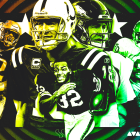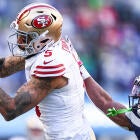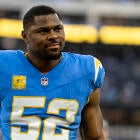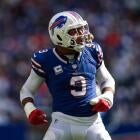


A new chapter has been added to one of the greatest individual rivalries in NFL history.
For nearly two full decades, Peyton Manning and Tom Brady competed for championships and their respective legacies as two of the greatest players in league history. Brady retired with five more championships, but Manning walked away with a record five league MVP awards to Brady's three. Manning was also 3-1 against Brady-led teams in AFC Championship games.
Manning now has another, albeit unofficial, distinction he can hold over his longtime rival: being named the greatest player for multiple franchises since the turn of the century. Manning and Brady are part of the following list, which includes every franchise's best player before and after 2000. Rest assured, this list is sure to generate some debate, as there were many tough calls.
It's important to note that the list was based solely on a player's career with that specific team. A player also had to have the majority of his success with that team during the selected time period. Randy Moss, for example, wasn't chosen as the greatest Vikings player since 2000, at least partly because his greatest season in Minnesota took place in 1998.

Pre-2000: Larry Wilson, S (1960-72)
The greatest defensive player in Cardinals history, Wilson filled the stat sheet with 52 career interceptions (including a league-high 10 picks in 1966), seven defensive touchdowns, 14 fumble recoveries and 21 sacks.
Nicknamed "Wildcat," Wilson is credited with popularizing the safety blitz. In 1966, he tied an NFL record by intercepting a pass in seven consecutive games.
Post-2000: Larry Fitzgerald, WR (2004-20)
A member of this year's Hall of Fame induction class, Fitzgerald is second only to Jerry Rice in career catches (1,432) and receiving yards (17,492). During the 2008 playoffs, Fitzgerald caught 30 passes for 546 yards and seven touchdowns while helping the Cardinals reach the franchise's first Super Bowl. He caught seven passes for 127 yards and two scores in Arizona's Super Bowl loss to Pittsburgh.
Pre-2000: Claude Humphrey, DE (1968-74; 1976-78)
A 2014 Hall of Fame inductee, Humphrey was one of the NFL's premier pass rushers for parts of three different decades. He had at least 10.0 sacks in seven seasons with the Falcons, including each of his first four campaigns. In all, Humphrey tallied 99.5 of his 130 sacks as a member of the Falcons.
Post-2000: Julio Jones, WR (2011-20)
It came down to either Jones or his quarterback, Matt Ryan. While Ryan's league MVP award in 2016 gives him a strong argument, Jones' prolific numbers and unofficial status as arguably the best receiver of the 2010s put him over the top. Jones led the NFL in receiving yards twice; his 1,871 yards in 2015 are the third-highest single-season total in league history.
Pre-2000: Ray Lewis, LB (1996-2012)
Lewis was the best player on the Ravens during the franchise's early years. From 1996-99, Lewis earned three consecutive Pro Bowl nods and led the NFL in tackles twice. His success in the '90s foreshadowed what turned out to be a Hall of Fame career.
Lewis edged out teammate and fellow 1996 first-round pick Jonathan Ogden, a Hall of Famer who was also named to three Pro Bowls during the '90s.
Post-2000: Ray Lewis, LB (1996-2012)
Lewis owns the distinction of being the only player to be named his franchise's best player in both eras. In addition to Ogden, Lewis edged out two-time league MVP Lamar Jackson and Hall of Famer and 2004 Defensive Player of the Year Ed Reed as the Ravens' best player since 2000.
Pre-2000: Bruce Smith, DE (1985-99)
Smith's longevity and status as the NFL's all-time career sack leader gave him the edge over O.J. Simpson, the first player to rush for more than 2,000 yards in a season.
Smith's case was also helped by the fact that he was the best player on Bills teams that advanced to four consecutive Super Bowls. His career also included a pair of Defensive Player of the Year awards.
Post-2000: Josh Allen, QB (2018-present)
While there was some debate between Smith and Simpson, there was none when it came to Buffalo's best player since 2000. The 2024 league MVP, Allen has been one of the league's best quarterbacks of the 2020s. Last year, he broke Cam Newton's record for the most career rushing touchdowns by a quarterback (79).
Pre-2000: Sam Mills, LB (1995-96)
A 2022 Hall of Fame inductee, Mills was 36 and had already enjoyed a productive career before joining the Panthers for their inaugural season.
Mills found the fountain of youth in Carolina; he finished third in Defensive Player of the Year voting in 1995 and was an All-Pro in 1996. That season, he helped the Panthers win their first playoff game en route to an NFC title game appearance.
Post-2000: Luke Kuechly, LB (2012-18)
At 35, Kuechly is the second-youngest person to earn Hall of Fame induction. The youngest was Gale Sayers, who was 34 when he was inducted in 1977.
Kuechly was one of the NFL's premier defensive players before injuries cut his career short after eight seasons. After winning Defensive Rookie of the Year, Kuechly won Defensive Player of the Year the following season and was named to seven straight Pro Bowls while earning five All-Pro selections. He helped spearhead a successful period in Panthers history that included three straight division titles and an NFC title in 2015.
Pre-2000: Walter Payton, RB (1975-87)
"Sweetness" was so good that there is an argument to be made about whether he is the greatest running back in NFL history. He's without question the greatest back since the 1970 merger.
Quite possibly the most fearless player of all time, Payton routinely took on eight-man fronts for mediocre Bears teams. When the Bears finally became competitive later in his career, Payton led them to a championship after gaining more than 2,000 all-purpose yards for the Super Bowl XX champions. Along with his running prowess, Payton was an exceptional blocker, receiver and overall football player.
Post-2000: Brian Urlacher, LB (2000-12)
Urlacher brought the Bears' rich tradition of productive and intimidating linebackers into the 21st century. The 2005 Defensive Player of the Year, Urlacher led the Bears to their second Super Bowl appearance at the end of the 2006 season. He was inducted into the Hall of Fame in 2018, his first year of eligibility.

Pre-2000: Anthony Muñoz, LT (1980-92)
Considered the greatest left tackle in NFL history, Muñoz earned 11 straight Pro Bowl nods and was an All-Pro in nine of his 13 seasons with the Cincinnati Bengals. A pillar on the Bengals' first two Super Bowl teams, Munoz's pass protection helped both Ken Anderson and Boomer Esiason win league MVPs.
Post-2000: Ja'Marr Chase, WR (2021-present)
Chase had some stiff competition that included current teammate Joe Burrow, fellow receiver Chad Johnson and former offensive tackle and perennial Hall of Fame finalist Willie Anderson. Chase got the nod by virtue of his five consecutive Pro Bowls to begin his career and his "triple crown" in 2024. Only Justin Jefferson has more receiving yards than Chase since his rookie season.
Pre-2000: Jim Brown, RB (1957-65)
Brown may be the most dominant player in NFL history. During his nine-year career, Brown led the NFL in rushing eight times and averaged an NFL-record 104.3 rushing yards per game. In 1964, Brown powered Cleveland to its fourth and most recent NFL title. He was the NFL's career rushing leader until 1984, when Walter Payton surpassed him.
Post-2000: Joe Thomas, OT (2007-17)
Thomas was a 10-time Pro Bowler and a six-time All-Pro over a seven-year span. His record of 10,363 consecutive offensive snaps may never be touched.
Pre-2000: Roger Staubach, QB (1969-79)
Bob Lilly and Emmitt Smith have extremely strong arguments, but Staubach is the pick because of his impact on making the Cowboys "America's Team."
Dallas wore the label of "next year's team" before Staubach won the starting job during the 1971 season. That year, Staubach won all 13 of his starts, including the Cowboys' first Super Bowl triumph. Staubach was named MVP following Dallas' 24-3 win over Miami in Super Bowl VI.
With Staubach as their quarterback, the Cowboys won two Super Bowls and played in two more during the 1970s while becoming the NFL's most popular team.
Post-2000: DeMarcus Ware, EDGE (2005-13)
Ware edged out Jason Witten and offensive linemen Zack Martin and Tyron Smith largely because his career has already been immortalized in Canton, Ohio. During his nine seasons with the Cowboys, Ware recorded a franchise-record 117 sacks and led the NFL in sacks twice. He earned seven Pro Bowl nods and four first-team All-Pro selections.
Pre-2000: John Elway, QB (1983-98)
This was a no-brainer. From 1986-89, Elway led the Broncos to three AFC titles and was named league MVP in 1987. He capped his career by helping the Broncos capture their first two Super Bowl titles. In his final game, Elway won MVP honors after throwing for 336 yards and scoring two touchdowns in Denver's Super Bowl win over Atlanta.
Post-2000: Peyton Manning, QB (2012-15)
Manning's historic four years in Denver were enough to put him ahead of Champ Bailey and Von Miller. Like Terrell Davis two decades earlier, Manning enjoyed a four-year run in Denver that culminated in a league MVP and Super Bowl hardware.
Manning's four seasons in Denver included one of the most dominant seasons in NFL history. In 2013, he won his fifth league MVP after setting NFL single-season records for passing yards (5,477) and touchdown passes (55). The Broncos lost that year's Super Bowl, but they reached the mountaintop two years later in Manning's final game.
Pre-2000: Barry Sanders, RB (1989-98)
The dynamic Sanders has a permanent spot on the Mount Rushmore of running backs. A truly unique player, Sanders parlayed his peerless running style into one of the greatest careers in NFL history. Sanders retired with the second-most rushing yards in NFL history and is currently fourth on the all-time list.
A Pro Bowler in each of his 10 seasons with the Lions, Sanders averaged a whopping 1,527 rushing yards per season during his career. He won four rushing titles and was the NFL's co-MVP in 1997 after becoming the third player to run for more than 2,000 yards in a season.
Post-2000: Calvin Johnson, WR (2007-15)
Like Sanders, "Megatron" had a relatively short but historic career that resulted in his induction into the Hall of Fame in his first year of eligibility. A Pro Bowler in each of his final six seasons, Johnson was also a three-time first-team All-Pro who won consecutive receiving titles in 2011-12. In 2012, his 1,964 receiving yards broke Jerry Rice's single-season record.
Pre-2000: Don Hutson, WR (1933-45)
It was an extremely close call between Hutson and Brett Favre, the only player in history to win three consecutive league MVP awards and whose record of 297 consecutive starts may never be broken. Hutson's pure dominance during his era and lasting impact on the receiver position ultimately put him over the top. It also helped that Hutson didn't end his career by playing for one of the Packers' rivals, which Favre ultimately did.
During his 11-year career, Hutson won three NFL titles while leading the NFL in touchdowns nine times, receptions eight times and receiving yards seven times. The first player to record a 1,000-yard receiving season, Hutson continues to hold NFL records for the most seasons leading the league in points scored (five) and touchdowns (eight). His 99 career touchdowns stood as the NFL record until 1989, when Steve Largent became the first player to catch 100 touchdown passes.
Post-2000: Aaron Rodgers, QB (2005-22)
Favre's successor in Green Bay, Rodgers led the Packers to the franchise's fourth Super Bowl title during his third season as the team's starting quarterback. He won MVP honors after throwing for 304 yards and three touchdowns in Green Bay's 31-25 win over Pittsburgh in Super Bowl XLV.
Rodgers, who has been called the "greatest passer of the football" by Tom Brady, won league MVP in 2011, 2014, 2020 and 2021. He enters his final season with the highest career passer rating and highest career touchdown-to-interception ratio in league history.

Pre-2000: N/A
The Texans were founded in 1999 and didn't begin play until 2002.
Post-2000: J.J. Watt, DE (2011-20)
Watt beat out former teammate Andre Johnson, who put together a Hall of Fame career during his 12 seasons in Houston.
Watt's career included becoming only the second player in NFL history (the first being Lawrence Taylor) to win NFL Defensive Player of the Year three times. An absolute nightmare to block, Watt was a five-time first-team All-Pro who tallied 101 of his 114.5 career sacks as a member of the Texans. He led the NFL in sacks twice.
Pre-2000: Johnny Unitas, QB (1956-72)
Often regarded as the greatest quarterback of the NFL's first half-century, Unitas led the Colts to back-to-back championships in 1958-59 as well as the franchise's first Super Bowl win following the 1970 season. He played brilliantly during the Colts' win over the Giants in the 1958 NFL title game, the first NFL game to go into overtime.
A three-time league MVP, Unitas led the NFL in passing yards and touchdown passes four times. His record of 47 consecutive games with a touchdown pass stood for 52 years until Drew Brees broke it in 2012.
Post-2000: Peyton Manning, QB (1998-2010)
During his 13 seasons in Indianapolis, Manning cemented his legacy as one of the greatest quarterbacks of all time. He made pre-snap audibles at the line of scrimmage commonplace and helped change the way offensive football is played, especially at the quarterback position.
Manning won four of his record five league MVP awards with the Colts. His best statistical season in Indianapolis came in 2004, when he threw a then-NFL single-season record 49 touchdown passes, breaking the mark previously held by his childhood idol, Dan Marino.
In 2006, Manning's passing led the Colts to their first title since moving from Baltimore to Indianapolis.
Pre-2000: Tony Boselli, LT (1995-2001)
The No. 2 overall pick in the 1995 NFL Draft, Boselli made 12 starts as a rookie before beginning a five-year run during which he earned five consecutive Pro Bowl selections and three straight first-team All-Pro nods. Boselli's success over that span helped the Jaguars earn five playoff berths, two division titles and two AFC Championship Game appearances.
Post-2000: Fred Taylor, RB (1998-2008)
One of the most criminally underrated players of all time, Taylor earned just one Pro Bowl selection despite being one of the NFL's best running backs for the majority of his time in Jacksonville. In 2003, Taylor was omitted from the Pro Bowl despite rushing for 1,572 yards and amassing 1,942 all-purpose yards. That was one of seven 1,000-yard rushing seasons Taylor compiled during his time with the Jaguars.
Pre-2000: Len Dawson, QB (1957-75)
Dawson was chosen over several Hall of Fame defensive players who starred for the Chiefs during the 20th century, a group that includes former defensive linemen Bobby Bell and Buck Buchanan, linebacker Willie Lanier, defensive back Emmitt Thomas and pass-rushing extraordinaire Derrick Thomas.
Dawson's impact on the Chiefs and the quarterback position are the two main things that put him over the top. He helped lead the Chiefs to three AFL titles as well as the franchise's first Super Bowl win. Dawson led his respective league in touchdown passes four times and completion percentage eight times.
Post-2000: Patrick Mahomes, QB (2017-present)
Aside from Travis Kelce, the only other player who threatened to take this spot was Tony Gonzalez, another prolific tight end who spent the majority of his Hall of Fame career in Kansas City.
Mahomes' individual greatness, coupled with his role in the Chiefs' dynasty, put him over the top. From 2018-24, Mahomes won two league MVP awards and three Super Bowl MVP awards while leading the Chiefs to three Super Bowl wins and five AFC titles. Still just 30 years old, Mahomes is still adding chapters to his Hall of Fame career.
Pre-2000: Jim Otto, C (1960-74)
Otto's unique number led to his nickname, "Double O." He was also pro football's ironman, never missing a game during his 15-year career despite playing one of football's most physically demanding positions during one of the league's most physical eras. He was a 10-time All-Pro and was named to 10 consecutive Pro Bowls.
Post-2000: Rich Gannon, QB (1999-04)
Maxx Crosby received consideration, but Gannon got the nod largely because of his memorable 2002 season, when he became the fourth Raiders player to win league MVP (the other three were Daryle Lamonica in 1967, Ken Stabler in 1974 and Marcus Allen in 1985). Gannon's play that season led the Raiders to their fourth (and most recent) AFC title.

Pre-2000: Lance Alworth, WR (1962-70)
While his nickname was as non-threatening as it gets, "Bambi" was a scary sight for defenders when he had the ball in his hands. One of the AFL's all-time great players, Alworth won three receiving titles over a four-year span and averaged 18.9 yards per catch for his career. He capped his career by helping the Cowboys win their first Super Bowl.
Alworth got the nod over Junior Seau, a tackling machine who was the best player on the Chargers' only Super Bowl team.
Post-2000: LaDainian Tomlinson, RB (2001-09)
One of the greatest fantasy football players ever, Tomlinson was also an elite player in real football. He was heralded for his versatility (he was the second running back to catch 100 passes in a season) and nose for the end zone. In 2006, he won league MVP after scoring 31 touchdowns, a single-season record.

Pre-2000: Deacon Jones, DE (1961-71)
It's fitting that Jones was the one who coined the term "sack," given his status as the preeminent pass rusher of the pre-Super Bowl era. He has been credited with 173.5 career sacks, including three seasons with at least 21.5 sacks. Jones was the leader of the Rams' "Fearsome Foursome" defensive line.
Jones nudged out former teammate Merlin Olsen, a 14-time Pro Bowler who was named a first-team All-Pro each year from 1966-70.
Post-2000: Aaron Donald, DT (2014-23)
If someone were to make a case for Donald as the greatest defensive player in league history, they wouldn't get an argument here. A three-time Defensive Player of the Year, Donald was an All-Pro eight times in a nine-year stretch from 2015-23 and was named to the Pro Bowl in each of his 10 seasons with the Los Angeles Rams before hanging up his cleats after the 2023 season. Donald's sheer will helped the Rams come back to defeat the Bengals in Super Bowl LVI.
Pre-2000: Dan Marino, QB (1983-99)
During his 17-year career (all with the Dolphins), Marino won five passing titles and led the NFL in touchdown passes three straight seasons from 1984-86. His 1984 season was one for the ages. That year, Marino set then-NFL records with 5,084 passing yards and 48 touchdowns while leading Miami to the Super Bowl.
Marino, whose career accolades also include winning Comeback Player of the Year in 1994, retired as the NFL's all-time leader in passing yards and touchdown passes.
Post-2000: Jason Taylor, DE (1997-2007; 2009; 2011)
Taylor terrorized opposing offenses throughout his time in Miami. He was especially dominant in 2006, when he won Defensive Player of the Year honors after leading the NFL with nine forced fumbles and returning two interceptions for scores. Taylor's 131 sacks as a Dolphin are 33 more than the franchise's next-closest player, Cameron Wake.
Pre-2000: Alan Page, DE (1967-78)
Along with anchoring the Vikings' legendary "Purple People Eaters" defense, Page owns the distinction of being the first defensive player to win NFL MVP. A Pro Bowler each year from 1968-76, Page amassed 148.5 career sacks, an unheard-of number for a defensive tackle.
Page's dominance helped the Vikings win three NFC titles and an NFL crown in 1969. He finished his career with three extremely solid seasons with the Bears, recording three sacks in his final game.
Post-2000: Adrian Peterson, RB (2007-16)
The explosive Peterson won three rushing titles, including in 2012, when he came within 8 yards of tying the single-season rushing record. In 2015, Peterson became the second player over the age of 30 to win a rushing title. Three years later, Peterson recorded his eighth and final 1,000-yard rushing season at age 33.
As great as Peterson was with the Vikings, Randy Moss is probably the best Vikings player since 2000. Moss wasn't picked, however, largely because his best season as a Viking took place before 2000 and his most memorable season during the 2000s was his record-setting 2007 campaign with the Patriots.

Pre-2000: John Hannah, G (1973-85)
The best player in Patriots history prior to Tom Brady, Hannah is also one of the best left guards in league history. He was the best player on the Patriots' first Super Bowl team. Hannah's last game was New England's 46-10 loss to the Bears in Super Bowl XX.
Post-2000: Tom Brady, QB (2000-19)
It goes without saying that this was a no-brainer. Brady, widely regarded as the greatest player in NFL history, was the driving force behind two Patriots dynasties. He won each of his three league MVP awards and six of his seven Super Bowl titles as a member of the Patriots. Of Brady's record five Super Bowl MVP awards, four came during his and the Patriots' unprecedented run of excellence.
Brady's legacy in New England also includes quarterbacking one of the greatest upsets in Super Bowl history (XXXVI), leading the greatest comeback in Super Bowl history, winning the first Super Bowl decided in overtime and throwing for the most yards in a Super Bowl game (505 in Super Bowl LII). Brady retired after the 2022 season as the NFL's all-time leader in passing yards and touchdown passes.
Pre-2000: Rickey Jackson, OLB (1981-93)
Jackson anchored New Orleans' vaunted "Dome Patrol" linebacker corps, which also included fellow Hall of Famer Sam Mills, four-time Pro Bowler Vaughn Johnson and 1991 NFL Defensive Player of the Year Pat Swilling.
A six-time Pro Bowler with the Saints, Jackson's 123 sacks with New Orleans stood as the franchise record until Cameron Jordan recently broke it. Jackson, who closed out his career by helping the 49ers win their most recent Super Bowl, had six seasons in New Orleans in which he posted at least 11 sacks.
Post-2000: Drew Brees, QB (2006-20)
Brees, who was inducted into the Pro Football Hall of Fame in August, became New Orleans royalty after leading the Saints to the franchise's first Super Bowl win at the end of the 2009 season. Three years earlier, Brees led the Saints' improbable run to an NFC Championship Game appearance just months after choosing to sign with the Saints over the Dolphins.
During his 15 seasons in New Orleans, Brees became one of the most prolific quarterbacks of all time. He led the NFL in passing yards seven times, completion percentage six times and touchdown passes four times. He retired as a Super Bowl MVP and the NFL's career passing leader.
Pre-2000: Lawrence Taylor, OLB (1981-93)
Taylor was so dominant as a rookie that he won both Defensive Rookie of the Year and NFL Defensive Player of the Year honors. Five years later, Taylor won league MVP while leading the Giants to their first Super Bowl title. Taylor's ferocious pass rush revolutionized the game while making left tackle one of the league's most important positions.
Post-2000: Eli Manning, QB (2004-19)
Until he gets his proper due in Canton, Ohio, Manning can take solace in knowing that he is the best player this century to don a Giants uniform. He is also the author of two of the most incredible (and unexpected) playoff runs in NFL history that culminated in upset Super Bowl wins over Tom Brady's Patriots.
Manning was unbelievably clutch at the end of both games. He threw two iconic passes that helped the Giants knock off the previously undefeated Patriots in Super Bowl XLII. Four years later, his 38-yard dime to Mario Manningham set up the game-winning touchdown. Fittingly, Manning was named MVP of both games.
Pre-2000: Joe Namath, QB (1965-76)
Namath beat out former teammates and fellow Hall of Famers Winston Hill and Don Maynard largely because of his role in the greatest upset in NFL history, which remains the greatest moment in Jets history.
After guaranteeing a win over the 18.5-point favorite Colts ahead of Super Bowl III, Namath backed it up by completing several key passes during the game's first three quarters. Namath didn't throw a single pass during the fourth quarter as the Jets held on for a 16-7 win.
Namath's career also included becoming the first player in either the AFL or NFL to throw for 4,000 yards in a season.
Post-2000: Darrelle Revis, CB (2007-12; 2015-16)
Revis was the preeminent cornerback for the majority of his time with the Jets. His dominance in coverage earned him the nickname "Revis Island," as quarterbacks often avoided throwing his way. Revis' success helped the Jets advance to within a game of the Super Bowl in 2009 and 2010.
Pre-2000: Reggie White, DE (1985-92)
White's incredible production as an Eagle put him over two other franchise icons: Chuck Bednarik and Steve Van Buren.
During his eight seasons in Philadelphia, White racked up 124 sacks and won his first of two Defensive Player of the Year awards. He led the NFL in sacks in consecutive seasons while anchoring a defense that helped the Eagles earn four playoff appearances over a five-year span.
Post-2000: Jason Kelce, C (2011-23)
Donovan McNabb received consideration given his role in the Eagles' run of four consecutive NFC title game appearances at the start of the century, which included the franchise's second Super Bowl appearance. Kelce's status as one of the best centers of his era, in addition to his role on the Eagles' first Super Bowl championship team, put him over the top. Kelce will undoubtedly garner considerable Hall of Fame consideration when he becomes eligible for enshrinement in 2029.

Pre-2000: Joe Greene, DT (1969-81)
Greene's sheer dominance during the first half of his career is reflected in his two Defensive Player of the Year awards over a three-year span. In 1974, he helped lead the Steelers to their first of four Super Bowl wins during the 1970s by recording an interception and a fumble recovery during Pittsburgh's 16-6 win over the Vikings in Super Bowl IX.
While a pinched nerve in 1975 took away some of his invincibility, Greene still churned out four more Pro Bowl seasons while remaining the leader of arguably the greatest team in league history.
Post-2000: Troy Polamalu, S (2003-14)
Appropriately nicknamed the "Tasmanian Devil," Polamalu's sixth sense allowed him to make breathtaking plays throughout his Hall of Fame career. Among his most memorable plays were his fingertip interception against Philip Rivers, his perfectly timed snap that resulted in a sack of Kerry Collins during his Defensive Player of the Year season and his game-clinching pick-six of Joe Flacco in the 2008 AFC title game.
Polamalu edged out Ben Roethlisberger, whose 18-year career in the black and gold included two Super Bowl wins, three AFC titles and the fifth-most wins in NFL history by a starting quarterback.
Pre-2000: Jerry Rice, WR (1985-00)
Joe Montana, the first three-time Super Bowl MVP, would get this spot on just about any other team. But for the 49ers, this spot belongs to Rice, whose list of NFL records spans longer than a football field.
A three-time Super Bowl champion with the 49ers, Rice caught his record eighth career Super Bowl touchdown with the Raiders at age 40. His career tally of 22,895 receiving yards is more than 5,000 yards ahead of the second-closest wideout, Larry Fitzgerald. In 1987, Rice caught 22 touchdowns -- a record that stood for 20 years -- despite playing in only 12 games.
Post-2000: Patrick Willis, LB (2007-14)
A 2024 Hall of Fame inductee, Willis beat out former teammate and future Hall of Famer Frank Gore, whose 16,000 career rushing yards (many of which came in San Francisco) are the third-most in NFL history.
During his eight-year career, Willis racked up seven Pro Bowl selections and five first-team All-Pro nods. His play helped the 49ers advance to one Super Bowl and three consecutive NFC Championship Games from 2011-13.

Pre-2000: Steve Largent, WR (1976-89)
The indomitable Largent overcame his small stature (5-foot-11 and 187 pounds) to become one of the all-time greats at his position. The first player to catch 100 touchdowns, Largent also retired as the league's career leader in receptions (819) and receiving yards (13,089). He also held the record for most consecutive games with a catch (177).
Post-2000: Bobby Wagner, LB (2012-21; 2023)
Wagner beat out several worthy candidates largely because of his impact on the Seahawks' first championship team, along with his overall body of work in Seattle that includes eight consecutive Pro Bowl selections. Wagner, who remains unsigned, is 60 tackles away from breaking Ray Lewis' all-time record of 2,059 tackles.
Pre-2000: Lee Roy Selmon, EDGE (1976-84)
Tampa Bay's first draft pick, Selmon spearheaded one of the quickest turnarounds in league history. After losing their first 26 games, the Buccaneers got to within a game of the Super Bowl in just their fourth season. Selmon became that year's Defensive Player of the Year and received his first of six consecutive Pro Bowl nominations.
Post-2000: Derrick Brooks, LB (1995-08)
Brooks was an 11-time Pro Bowler, a five-time All-Pro and arguably the best player on one of the best defenses of the 21st century. Including the playoffs, Brooks had seven interceptions and four pick-sixes during the 2002 season. Fittingly, his final interception, a pick-six, came in the final moments of the Buccaneers' Super Bowl win over the Raiders.
Pre-2000: Earl Campbell, RB (1978-84)
Arguably the best power back in league history, Campbell started his NFL career by winning three consecutive rushing titles. He had one of the best individual seasons ever in 1980, when he led the NFL in carries (373), rushing yards (1,934), touchdown runs (13) and yards per carry (5.2).
Post-2000: Derrick Henry, RB (2016-23)
In addition to Campbell, the Oilers/Titans boast two 2,000-yard rushers in Henry and Chris Johnson. In 2020, 11 years after Johnson's 2,000-yard season, Henry rumbled for 2,027 yards en route to winning his second straight rushing title. The previous season, Henry etched his name into Titans lore after carrying Tennessee to within a game of the Super Bowl.
In Baltimore, Henry has cemented his status as a future Hall of Famer.

Pre-2000: Sammy Baugh, QB (1936-52)
The NFL's first prolific quarterback, Baugh led the NFL in passing yards four times, touchdown passes twice and completion percentage eight times (including five straight years from 1945-49) while leading Washington to two championships. Baugh's 335 passing yards in the 1937 NFL title game stood as the league's championship-game record for 21 years. It was also the most passing yards by a rookie in a postseason game until 2012.
Post-2000: London Fletcher, LB (2007-13)
Fletcher had one of the most unique careers in NFL history. A former undrafted rookie out of Division III John Carroll, Fletcher won a Super Bowl with the Rams during his second season before spending five productive seasons in Buffalo. Fletcher didn't arrive in Washington until his age-32 season and was named to his first of four consecutive Pro Bowls at 34. In 2011, Fletcher, 36 at the time, racked up a league-high 166 tackles. A year later, he had 139 tackles and five sacks while helping lead Washington to a division title.