Agent's Take: Ultimate 2025 end-of-season, 53-man roster that's the best team money can buy
Here's our ultimate 53-man roster, with salary cap and draft restrictions taken into account

A 53-man roster under the salary cap using actual cap numbers with certain parameters, which are below, was assembled at the start of the season. Wholesale changes have been made to the roster since considerable weight has been given to 2025 performance.
Jayden Daniels is no longer the choice at quarterback after an injury-plagued 2025 season. Saquon Barkley and Justin Jefferson had disappointing seasons by their usual standards. Injuries derailed Sauce Gardner and Fred Warner's seasons.
Parameters
- The salary cap for the roster is $293.4 million although the actual NFL salary cap is $279.2 million for this league year. The number being used approximates the average adjusted salary cap according to NFLPA data. Each NFL team's working salary cap varies largely because unused cap room can be carried over from one year to the next. For example, the San Francisco 49ers have the NFL's highest adjusted salary cap at $341.46 million largely thanks to carrying over just under $50.1 million of cap room, which is the most in the league. The Buffalo Bills have the lowest at $278.17 million, which is $1.183 million below the league-wide number. Situations like this typically occur when incentives earned during the previous season that weren't counting on the cap get accounted for without sufficient cap room carrying over from the prior year to make up the difference.
- The NFL Draft is an essential element of roster building for NFL teams. It is here also. One player from each round of the 2025 draft must be on the roster. The number requirement drops by one player for each year of the preceding three drafts (2022-2024). The limit of one player per round remains. Thus, only four 2022 draft picks are required. There's one other draft pick constraint. Only one 2021 first-round pick whose fifth-year option was exercised is allowed. This means a choice must be made between Cincinnati Bengals wide receiver Ja'Marr Chase, Green Bay Packers edge rusher Micah Parsons, Detroit Lions right tackle Penei Sewell and Denver Broncos cornerback Patrick Surtain II. Selecting a 2021 first-round pick isn't a necessity.
- The backups at each position are limited to players who aren't clear-cut established starters. Positions where there's a "by committee approach," usually running back, qualify. A backfield containing Christian McCaffrey and Jonathan Taylor, 2025's leaders in rushing attempts, is prohibited since both are workhorse running backs. Those starting only because of an injury are also fair game as reserves. Starters in name only or starters with playtime for the season under 50% without missing significant time because of injury can also be backups. Young veterans, particularly second-year players solidifying a place in the lineup for the first time this season, are no longer allowed to be backups. Rookies can be either starters or backups regardless of actual playing time. Anyone who began the season on a practice squad or unsigned can also be a backup no matter how their season transpired.
- Choosing a player who was given a franchise or transition designation in 2025 is optional. However, only one player receiving a 2025 designation can be selected.
- There are three starting cornerbacks instead of a traditional base defense (either 3-4 or 4-3) since five or more defensive backs are now used over 60% of the time in the NFL.
- Starters must have appeared in at least 12 games. This requirement removes players like Philadelphia Eagles right tackle Lane Johnson from consideration.
Here's the revamped team I assembled with some of my thoughts behind the selections. The 2025 salary cap number for each player is in parentheses. The NFL collective bargaining agreement's $315 daily amount for participating in a team's voluntary offseason workout program is included in the cap numbers when applicable.
In cases where a player was elevated from the practice squad or signed off the street during the season, what would have been his full year cap number is being used. The full cap number is also used for players traded or claimed through waivers during the season and when there's a split (lower salary when a player isn't on the 53-man roster) in a contract.
Long-range planning wasn't taken into account so worrying about future salary cap obligations, the amount of cap room that could be carried over, expiring contracts and drafting players who might develop into starters down the road wasn't necessary. Different choices would have been made if these aspects had been considerations.
Offensive starters
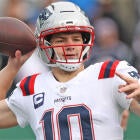
QB: Drake Maye, Patriots ($8,336,984) -- 2024 first round
The quarterback choice was between Maye and Matthew Stafford, the two leading candidates for NFL MVP. Stafford's $47,468,556 cap number being more than five and half times Maye's made the decision easy. Maye is a tremendous value among starting quarterbacks since he is in the second year of his rookie contract. It would have been foolish to pass up the roster flexibility Maye's cap number provides.
Maye taking a huge step forward was the catalyst for the Patriots winning the AFC East with this season's biggest turnaround going from 4-13 in 2024 to 14-3 in 2025. Maye led the NFL in completion percentage (72.0%) and passer rating (113.5). He threw for 4,394 yards (fourth in NFL) with 31 touchdowns (third) and eight interceptions. He added 450 yards on the ground as well.
RB: De'Von Achane, Dolphins ($1,490,813) -- 2023 third round
Achane's 1,350 rushing yards are fifth in the NFL. His 5.7 yards per carry led the league. Achane's 13 runs of 20 yards or more are the NFL's second most. He is also a receiving threat out of the backfield with 67 catches for 488 yards. Bijan Robinson or James Cook didn't get the running back nod because of stiff competition for the 2023 first-round pick and 2022 second-round pick spots.
WR: Jaxon Smith-Njigba, Seahawks ($3,939,238) -- 2023 first round
Smith-Njigba caught 119 passes for a league-leading 1,793 receiving yards with 10 touchdowns. He carried Seattle's passing attack. Smith-Njigba's 36.6% of the team's receptions and 44.1% of the team's receiving yards are the third and fourth marks all time in these respective categories, according to TruMedia.
WR: Puka Nacua, Rams ($1,100,695) -- 2023 fifth round
It's hard to find a better value in the NFL than Nacua, who is finishing the third year of a four-year, $4,084,980 rookie contract. He led the NFL with 129 receptions for 1,715 yards and 10 touchdowns. Nacua's 107.2 receiving yards per game topped the NFL. He also carried the ball 10 times for 105 yards with a touchdown.
WR: Amon-Ra St. Brown, Lions ($13.91 million)
St. Brown had 117 catches, 1,401 receiving yards and 11 touchdown receptions. He was only player to rank in the NFL's top five in each of these categories. St. Brown will spend considerable time operating out of the slot. According to Pro Football Focus, 55.7% of St. Brown's passing snaps were in the slot this season.
TE: Trey McBride, Cardinals ($9,574,393) -- 2022 second round
McBride set a single-season receptions record for tight ends. He had a career best with 126 receptions, 1,239 receiving yards and 11 touchdowns. McBride had 38 more receptions and 311 more receiving yards than the next best tight end.
LT: Garett Bolles, Broncos ($13,065,670)
Bolles is the only left tackle with 300 or more pass-blocking snaps who didn't surrender a sack this season, according to PFF. He also fared well in the NFL's Next Gen Stats. Bolles' 5.9% allowed pressure rate was the best among left tackles.
LG: Joe Thuney, Bears ($8 million)
Thuney continued to be a model of consistency at left guard after his offseason trade to the Bears. He had ESPN's best pass block win rate and third best run block win rate among offensive guards this season.
C: Creed Humphrey, Chiefs ($10.79 million)
The NFL best center discussion begins with Humphrey. He provides the NFL's best combination of run and pass blocking for a center. Humphrey only allowed eight quarterback pressures (combined sacks, quarterback hurries and quarterback hits), according to PFF.
RG: Quinn Meinerz, Broncos ($5,530,985)
Meinerz excels as a run blocker. Yet, his 4.4% pressure rate allowed was the second lowest for right guards who had at least 250 pass blocks.
RT: Penei Sewell, Lions ($9,545,505)
Lane Johnson missing seven games opened the door for a different right tackle selection. It also created a domino effect with selections at positions with Sewell taking the 2021 first-round pick slot. Sewell is a dominant run blocker who keeps improving as a pass protector.

Defensive starters
Edge: Myles Garrett, Browns ($22,920,120)
Garrett was going to be selected regardless of his cap number. He set an NFL single-season record with 23 sacks. Garrett will be named NFL Defensive Player of the Year next month for the second time in three years.
DT: Jeffery Simmons, Titans ($22,981,431)
Simmons led interior defensive linemen with 11 sacks. His eight tackles for loss against the run were also tops for interior defensive linemen.
DT: Quinnen Williams, Cowboys ($21,587,814)
Williams was a beast after the New York Jets dealt him for a 2027 first-round pick, a 2026 second-round pick and defensive tackle Mazi Smith at the Nov. 4 trade deadline. His 16.3% pressure rate led interior defensive lineman beginning with when he first took the field for the Cowboys in Week 11, according the NFL's Next Gen Stats. Per PFF, Williams had the second best run stop percentage for interior defensive linemen at 14%.
Edge: Brian Burns, Giants ($17.75 million)
Burns was one of the only bright spots for the 4-13 Giants. His 16.5 sacks were second in the NFL. The draft choice restrictions prevented the selection of 2021 first-round pick Micah Parsons, 2022 first-round pick Aidan Hutchinson or 2023 first-round pick Will Anderson Jr.
LB: Jordyn Brooks, Dolphins ($7,801,333)
Brooks is a tackling machine. He led the NFL with 183 tackles. Brooks was one of the NFL's surest tacklers. He had 2.9% missed tackle rate on run plays, according to PFF.
LB: Ernest Jones IV, Seahawks ($5,291,838)
Jones excels in coverage. He only allowed a 54.0 passer rating in coverage this season, according to Pro Football Reference. Jones' five interceptions were tied for the most among linebackers.
CB: Derek Stingley Jr., Texans (12,147,423) -- 2022 first round
The NFL's first $30 million-per-year cornerback more than lived up to his contract. Stingley's four interceptions were tied for third among cornerbacks despite being targeted on just 11.9% of his coverage snaps, according to the NFL's Next Gen Stats.
CB: Cooper DeJean, Eagles ($2,118,734) -- 2024 second round
DeJean has quickly established himself as arguably the best slot cornerback in the league. He had two interceptions and 16 passes defended this season.
CB: Joey Porter Jr., Steelers ($2,628,541) -- 2023 second round
There wasn't room for Quinyon Mitchell with Maye being the 2024 first-round pick on the team. Porter hasn't given up a touchdown in 1,467 snaps dating to Week 8 of the 2023 season, according to the NFL's Next Gen Stats. Opposing quarterbacks only completed 48.3% of passes (29 of 60 attempts) for a 56.2 passer rating when targeting Porter, per PFF.
FS: Kevin Byard, Bears ($8.5 million)
Byard was the league's preeminent ballhawk. He led the NFL with seven interceptions.
SS: Derwin James, Chargers ($23,865,314)
The Ravens' Kyle Hamilton, a 2022 first-round pick, can thank Stingley for being excluded. James has the largest cap number on the team. His inclusion wouldn't have been possible with Stafford at quarterback. This spot likely would have gone to Talanoa Hufanga (Broncos) given his $4,008,505 cap number. James is the Swiss Army knife because of his versatility. He can play in the box and the slot. James had three interceptions while his 16 quarterback pressures were the second most for a defensive back as tracked by the NFL's Next Gen Stats.
Specialists
- K: Cam Little, Jaguars ($1,004,677) -- 2024 sixth round
- P: Jordan Stout, Ravens ($1,284,223) -- 2022 fourth round
- LS: Ross Matiscik, Jaguars ($1,340,080)
- KR: Chimere Dike, Titans ($1,119,746) -- 2025 fourth round
- PR: Chimere Dike
Little is the owner of the two longest field goals in NFL history. He hit 67 and 68 yard field goals this season. Little connected on 88.2% of his field goal attempts (30 of 34) and only missed one of 51 extra point tries. Stout's 44.9 yard net punting average was the best in the NFL. Dike handles return duties. He led the NFL with 17.3 yards per punt return. Two punts were returned for touchdowns. He also averaged 25.6 yards per kickoff return. Matiscik earned Pro Bowl honors for the third straight season. His four special teams tackles were tied for third among long snappers.
Reserves
Quarterback
- Mac Jones, 49ers ($2.588 million)
Jones kept the 49ers afloat during the eight games Brock Purdy missed with a turf toe injury. He connected on 69.6% of his passes (201 of 289 attempts) for 2,151 yards with 13 touchdowns and six interceptions to post a 97.4 passer rating.
Running backs
- Rico Dowdle, Panthers ($2.75 million)
- Kenneth Gainwell, Steelers ($1,798,820)
- Kyle Monangai, Bears ($875,899) -- 2025 seventh round
- Reggie Gilliam, Bills ($1,346,005)
Dowdle took advantage of Chuba Hubbard's calf injury to rush for 206 and 183 yards in consecutive games on his way to a career-high 1,076 rushing yards. The impending unrestricted free agent expressed frustration that his workload decreased once Hubbard was completely healthy. Gainwell, who was voted Steelers team MVP, is a weapon in the passing game. His 73 receptions were fourth among running backs. Gainwell also had a career-high 537 rushing yards. Monangai emerged as the season progressed. He had 783 rushing yards including a career-best 176 in a Week 9 win over the Cincinnati Bengals. Gilliam is the lone fullback. He played a part in the Bills leading the league in rushing yards.
Wide receivers
- Tetairoa McMillan, Panthers ($5,081,795) -- 2025 first round
- Kendrick Bourne, 49ers ($1,669,375)
- Chimere Dike, Titans ($1,119,746) -- 2025 fourth round
McMillan was the only rookie to hit 1,000 receiving yard mark. He had 70 catches for 1,014 yards with seven touchdowns. Bourne made the most of San Francisco's injuries at wide receiver to have back-to-back games with 142 receiving yards in October. More than half of his 551 receiving yards (on 37 catches) this season came in those two games. Better known for his return abilities, Dike led Tennessee's wide receivers with 48 catches.
Tight ends
- Harold Fannin Jr., Browns ($1,230,004) -- 2025 third round
- Jackson Hawes, Bills ($923,978) -- 2025 fifth round
Fanning set a Browns rookie receptions record. He had 72 catches for 731 yards with six touchdowns. Blocking was Hawes' calling card in college. It has translated to the NFL.
Offensive line
- Cole Van Lanen, Jaguars ($4,616,080)
- Teven Jenkins, Browns ($2.29 million)
- Luke Fortner, Saints ($1.35 million) -- 2022 third round
- T.J. Bass, Cowboys ($1,043,413)
The offensive line depth has plenty of experience. Van Lanen is the swing tackle but has versatility. He started games at every line position except center before settling in at left tackle late in the season. Jenkins, who had started the last three seasons at guard with the Bears, began rotating with Browns right guard Wyatt Teller in Week 13 until a calf injury ended Teller's season the following week. Teller took every snap at right guard prior to Week 13. Fortner, who was Jacksonville's starting center in his first two NFL seasons, was supposed to add depth when the Saints acquired him in the preseason. He started 10 games because of Erik McCoy's season-ending biceps injury in October. Bass held his own when injuries necessitated the Cowboys moving Pro Bowl left guard Tyler Smith to left tackle.
Edge
- Nick Herbig, Steelers ($1,204,531) -- 2023 fourth round
- Al-Quadin Muhammad, Lions ($1,200,020)
Herbig had a career-high 7.5 sacks thanks to both Alex Highsmith and T.J. Watt missing time with injuries. Muhammad had 11 sacks mostly operating mostly as a situational pass rusher.
Defensive tackles
- Tommy Togiai, Texans ($1,689,996)
- Jowon Briggs, Jets ($960,000) -- 2024 seventh round
Togiai had the best run-stop percentage for interior defensive linemen at 14.1%. Briggs, who was acquired from the Browns during the preseason, was a pleasant surprise after Quinnen Williams was traded to the Cowboys.
Linebackers
- Carson Schwesinger, Browns ($1,153,165) -- 2025 second round
- Del'Shawn Phillips, Chargers ($1.7 million)
- D'Marco Jackson, Bears ($1.1 million)
- Jordan Magee, Commanders ($1,062,887) -- 2024 fifth round
Schwesinger is the overwhelming favorite to win the NFL Defensive Rookie of the Year award. He led all rookies with 156 tackles and 11 tackles for loss. Jackson was named NFC Defensive Player of the Week for Week 15 because of seven tackles, one sack and an interception in a 31-3 win over the Browns when Chicago's linebackers unit was depleted by injury. Magee showed enough to get consideration at middle linebacker next season if future first ballot Hall of Famer Bobby Wagner retires or isn't re-signed. Phillips is a special teams standout.
Cornerbacks
- Nahshon Wright, Bears ($1,109,765)
- Benjamin St-Juste, Chargers ($2,508,826)
- Jarrian Jones, Jaguars ($1,281,969) -- 2024 third round
Wright seized the opportunity created by multiple injuries at cornerback to have a breakout season. He was named NFC Defensive Player of the Month for November. Wright led the NFL with eight takeaways (five interceptions and three fumble recoveries). St-Juste was more impactful than anticipated in a smaller role with the Chargers after being a starter for the Commanders over the last three seasons. Opposing quarterbacks had a 65.7 passing rating when targeting St-Juste, according to PFF. It was 107.0 in 2024. Jones is cheap depth, who had mixed results after injuries to Travis Hunter and Jourdan Lewis led to more playing time.
Safeties
- Dadrion Taylor-Demerson, Cardinals ($1,180,531) -- 2024 fourth round
- Devon Key, Broncos ($968,505)
- R.J. Mickens, Chargers ($888,078) -- 2025 sixth round
Taylor-Demerson had the first two interceptions of his NFL career this season as Arizona's third safety behind Budda Baker and Jalen Thompson. Key's inclusion is because of his special teams prowess. Mickens has the best catch rate allowed over expected for safeties at -42.3% (minimum of 200 coverage snaps), according to the NFL's Next Gen Stats.
Final thoughts/Tale of the tape
- Total salary cap room used (53 players): $284,050,734
- Remaining salary cap room: $9,349,266
- Offense (25 players): $113,937,338
- Defense (25 players): $166,484,416
- Specialists (3 players): $3,628,980
Positional salary breakdown
(Salary cap percentage in parentheses)
- QB: $10,894,984 (3.71%)
- RB: $8,261,537 (2.82%)
- WR: $26,820,849 (9.14%)
- TE: $11,728,315 (4.0%)
- OL: $56,231,653 (19.17%)
- DE: $43,074,671 (14.68%)
- DT: $47,219,241 (16.09%)
- LB: $19,105,610 (6.51%)
- CB: $21,682,466 (7.39%)
- S: $35,402,428 (12.07%)
All of the cap room isn't being used. There's a little more than $4.6 million to spare after accounting for a full practice squad of 16 players (approximately $4.7 million).
Cap spending being heavily skewed to the defense because of Maye's low cap number for a quarterback isn't a surprise. It's 38.83% on offense to 56.74% on defense. Significant cap resources were devoted to the trenches. The defensive line took up nearly 31% of the cap.
The least amount of cap space is being used on running backs. A premium also wasn't placed on off-ball linebackers.
There are only six holdovers from the original 2025 team. Most of the continuity is on the offense line where three of the five starters are the same.
The Bears lead the way with five players. The Browns are surprisingly next with four players along with the Chargers. It's primarily because of Cleveland's strong 2025 draft class. The Green Bay Packers are the only playoff team that isn't represented. The Atlanta Falcons, Cincinnati Bengals, Indianapolis Colts, Las Vegas Raiders, Minnesota Vikings and Tampa Bay Buccaneers were also shut out.